
You could save up to 25% on transaction costs².
Speak with us now to see if you qualify.
Talk to sales 1-800-515-8366
Monday - Friday, 6 AM to 4 PM PT

Table of contents
Table of contents
Let’s say you run a small music lesson business, and you’re getting ready for the end-of-year recital. You’ve had your eye on a new piano that could really help you upgrade the student experience. Your accountant might ask whether you want to buy it before December 31 or wait until the beginning of next year.
That timing question is an important part of how you can benefit from the Section 179 deduction. This means either deducting the full cost of that equipment the same year you put it to work, instead of spreading the deduction out over the course of a few years.
The important part is having all of the necessary information ready, like the purchase date and the exact day the piano was set up and used for a lesson. Starting tax deduction tracking now saves you from scrambling in April. This guide explores what the Section 179 deduction is, its limits, what qualifies, and what you can do to claim it.
Section 179 lets businesses deduct the full price of things like equipment and vehicles in the year you start to use them. The alternative is spreading the deduction over a few years.
The words “placed in service” are important here because they’re saying that the deduction isn’t applied if you only *purchased* the asset that year. You have to actually start using it for business purposes in order to qualify.
Going back to our music lesson example, if your business purchased the new piano in December but didn’t use it until March the following year, you couldn’t claim it on this year’s taxes.
What’s great about Section 179 is that any business structure can use it. This includes sole proprietors, partnerships, LLCs, S-Corps, and C-Corps. You just have to meet the requirements and make sure you have enough taxable income to absorb the deduction.

Standard depreciation spreads the deduction across the useful life of an asset, which could be five to seven years. Section 179 lumps some or all of that same deduction into one year instead.
This is important because it impacts cash flow. If you take a bigger deduction now, you can get a smaller tax bill this year to free up cash and pay for the large equipment purchase or any other business need.

Section 179 works asset by asset. You can elect it for some purchases and depreciate others the standard way, whatever makes sense for your tax situation that year.
For tax year 2026, you can deduct up to $2,560,000 total in qualifying Section 179 purchases for that year. If your total qualifying purchases for the year go over $4,090,000, the deduction starts shrinking dollar-for-dollar past that point.
So if you buy $4.5M in equipment, you're $410,000 over the threshold, and your max deduction drops by that same $410,000 (from $2,560,000 down to $2,150,000).
These maximum deduction and phase-out thresholds have increased each year since 2024:
Most small businesses never come close to the phase-out threshold. If your equipment budget for the year is in the tens of thousands rather than the millions, this is one limit you probably don't need to lose sleep over.
The One Big Beautiful Bill Act (OBBBA) raised the cap to $2.5 million with a $4 million phase-out. The 2026 figures reflect the standard inflation adjustment on top of that.
One thing to note: Section 179 can shrink your tax bill, but it can't push you into the negative. So if your business made $50,000 in taxable income this year, you can only deduct up to $50,000 under Section 179. If you bought $80,000 worth of qualifying equipment, the deduction can zero out your income, but it can't turn a $50,000 profit into a $30,000 loss.
Tangible, depreciable business property that was put to use during the tax year generally qualifies. This could be machinery, equipment, computer software, office furniture, and vehicles. Things that improve your property can count too, like HVAC systems, roofing, security systems, and new windows.
Make sure to keep the invoice and the exact date you started using the item. This gives the IRS both the purchase date and the in-service date, information they need for the Section 179 deduction.
The item you purchase doesn’t have to be new to qualify for Section 179. Used equipment qualifies too, as long as it’s new to your business and meets all other requirements.
2026 Tax law changes explained: tax on tips, overtime, standard deduction caps

Let's walk through it with a fictional company as an example. Little Chords Academy, a music lesson business, buys $50,000 in qualifying items. They purchase new furniture, windows, gently used instruments, and a fresh HVAC system. The business has $120,000 in taxable income and elects the full section 179 deduction.
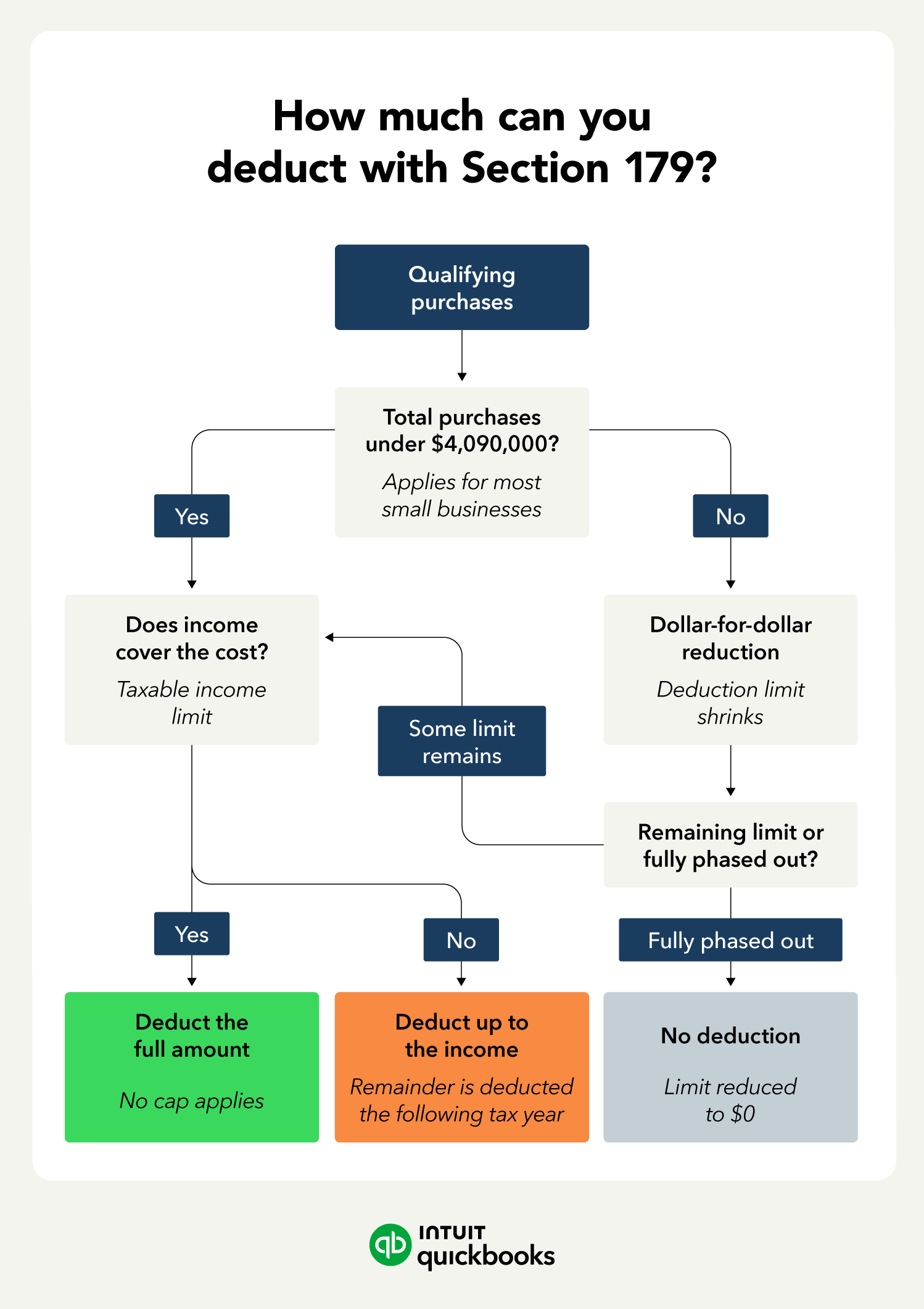
Here’s the math:
1. Confirm the purchase is under the phase-out threshold. $50,000 is nowhere near $4,090,000, so no reduction applies.
2. Confirm taxable income covers the deduction. $120,000 comfortably covers the $50,000 write-off.
3. Deduct the full $50,000 in year one, instead of spreading it across five years under standard depreciation.
Little Chords Academy’s accountant will ask for the invoices and a note of the exact day that everything was implemented and used for the first time.
Now let’s see the flip side. Let’s say Little Chords Academy’s taxable income for the year is only $40,000. This would mean that the deduction is capped at $40,000, even though the items cost $50,000. The remaining $10,000 will carry forward to the next year.
Section 179 is elected per asset, per year on Form 4562. You're not locked into an all-or-nothing choice across every purchase you make.
Section 179 applies first, subject to its own income and phase-out limits, and 100% bonus depreciation can then cover whatever's left, including amounts above the Section 179 cap.
The rule of thumb: Section 179 gives you more control, since you pick which assets to write off and to stay within your taxable income. Bonus depreciation has no income ceiling and can push you into a loss for the year, which matters if that's part of your tax strategy.
Passenger vehicles run into "luxury auto" limits that cap how much you can deduct. Vehicles with a gross vehicle weight rating (GVWR) over 6,000 pounds skip those limits, though heavy SUVs in that weight class still face their own Section 179 sub-cap of $32,000 for 2026. Trucks and vans with the right bed or cargo configuration can qualify for the full deduction.
The same 50%-plus business-use rule applies to vehicles as it does to any other property. Make sure to keep a mileage log; if the deduction ever gets a second look, that log is what backs up your business-use percentage.
To claim Section 179, all you need to do is complete Part I of IRS Form 4562, Depreciation and Amortization. You can file it with your business tax returns for the year the property was implemented and used.

Good records can make a difference, so be diligent now to save yourself from scrambling later. Also, remember that once you make this election for an asset, it’s generally irrevocable without special IRS permission.
Loop in a tax professional or CPA before electing Section 179 on a large purchase. Recapture rules and how your state conforms to federal tax law can get complicated, and it's worth having someone check the math before you file.
The Section 179 deduction can turn a big equipment purchase into real tax savings. A lot rides on what you kept track of during the year, like the invoice and the in-service date, along with the other documents your accountant needs.
QuickBooks keeps that record for you as purchases happen, so nothing gets pieced together from memory come filing season. Track your tax deductions year-round and hand your accountant a clean, complete picture when it's time to file.
This content is for information purposes only and the information provided should not be considered legal, accounting, or tax advice or a substitute for obtaining such advice specific to your business. Additional information and exceptions may apply. Applicable laws may vary by state or locality. No assurance is given that the information is comprehensive in its coverage or that it is suitable for dealing with a customer’s particular situation. Intuit Inc. does it have any responsibility for updating or revising any information presented herein. Accordingly, the information provided should not be relied upon as a substitute for independent research. Intuit Inc. cannot warrant that the material contained herein will continue to be accurate, nor that it is completely free of errors when published. Readers should verify statements before relying on them.

Call Sales: 1-800-285-4854