QuickBooks Blog
A small business owner reviewing how to file W-2 and 1099 together.
Self-employed

How to file a W-2 and 1099 together: Tax guide for freelancers and small businesses


Quick guide to filing W-2 and 1099 together:

  • W-2s report employee income, while 1099s cover contractor pay.
  • You can file both forms in one return—just track each income source.
  • Employers may issue both if a worker changes roles or duties.
  • Tax software or pros can help you avoid mistakes and stay compliant.


More people are mixing traditional jobs with freelance gigs, earning both W-2 and 1099 income in the same year. But come tax time, that flexibility can lead to confusion.

If you’ve ever wondered how to handle both forms at once, you’re not alone. This guide breaks down what each form means, how to report them accurately, and what to expect when filing your taxes with both types of income.

1099 vs. W-2 forms: What’s the difference?

Independent contractors vs. employees 

Employers issuing both Forms 1099 and W-2 in the same year

Employees or contractors receiving a 1099 and W-2 form

Filing taxes when you have both a W-2 and 1099

6 Common pitfalls and mistakes when filing W-2 and 1099 together

What you need to know before filing W-2 and 1099 together

Find peace of mind come tax time

1099 vs. W-2 forms: What’s the difference?

Both a 1099 and W-2 form report income, but they serve different purposes and have different tax consequences. Businesses typically employ two types of workers—employees and independent contractors. 

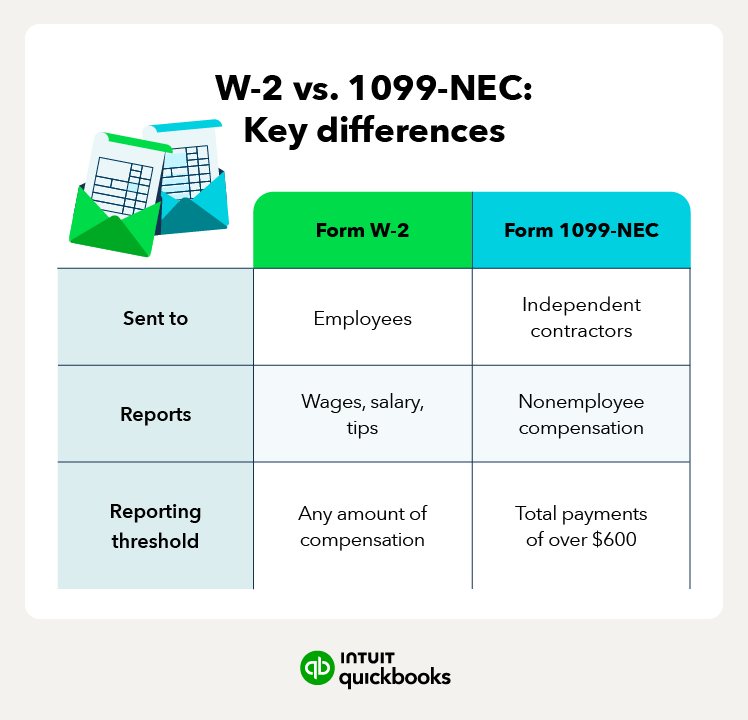
Form W-2 reports wages for employees, while Form 1099-NEC reports nonemployee compensation. If you pay an independent contractor over $600 during the year, you must send them a 1099-NEC form. You’ll send employees a W-2 form regardless of the amount of wages, salary, or tips.

W-2 vs. 1099-NEC: key differences.

Companies don’t withhold payroll taxes for independent contractors. The payments are treated as self-employment income for the contractor. As a result, the contractor is responsible for paying Federal Insurance Contributions Act (FICA) taxes as a self-employed person. 

Note there are other 1099 forms, such as the 1099-MISC, which report different forms of income. The 1099-NEC reports payments of over $600 to contractors, freelancers, and self-employed individuals.  

Form W-2 is for salaried employees or regular workers. It outlines the employee's income, taxes withheld, and other deductions.

Stay on top of 1099s with Bill Pay

See your vendors and everyone who needs a 1099 all in one place. Plus, get unlimited 1099 e-filing, with printing and email, for no additional fee.

Independent contractors vs. employees

Employers handle taxes differently for 1099 and W-2 income. For W-2 employees, payroll taxes are withheld automatically, while independent contractors (the 1099 workers) are responsible for paying their own taxes.

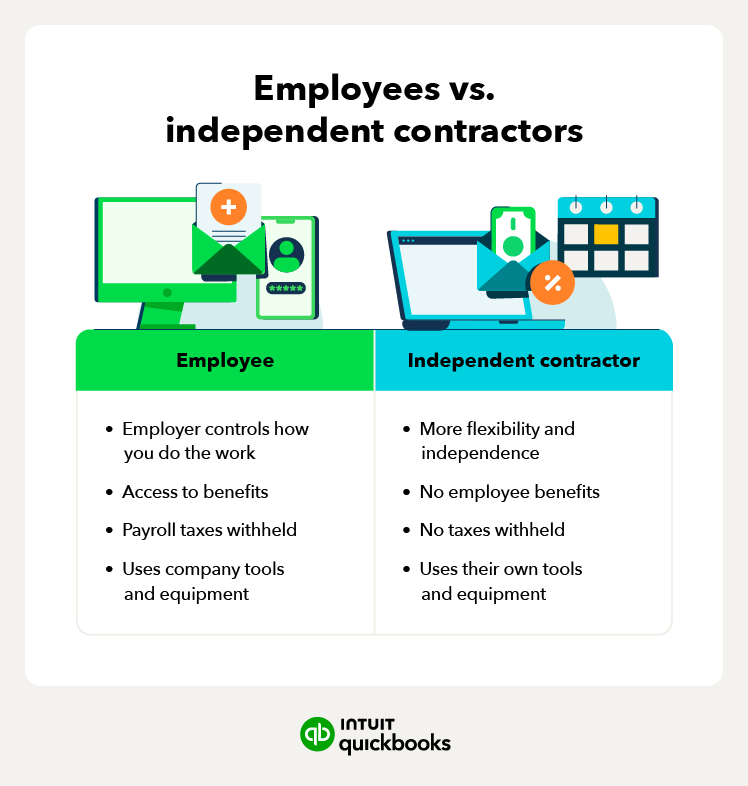
Employees vs. independent contractors.

You’re typically an employee if any of these are true:  

  • Behavior: The company can control how, when, or where you work. 
  • Financial: The company provides tools and equipment. 
  • Training: The company provides training and development, such as on-the-job training or workshops. 
  • Taxes: The company withholds payroll tax
  • Benefits: The company provides various benefits and perks like insurance, paid time off, or retirement.

Employers issuing both Forms 1099 and W-2 in the same year

Small businesses often need to issue both Forms 1099 and W-2 in the same year because they hire independent contractors and employees. So, if you pay employees and contractors in the same year, you’ll likely need to issue both. 

Most individuals receive a W-2 and 1099 form from different employers. Businesses typically do not issue both a Form 1099 and W-2 to the same person. However, there are a few situations where you might need to issue both forms to the same worker. 

Here are some situations when you might need to issue a 1099 and W-2 to the same person: 

  • When the worker becomes an employee (or vice versa): For example, you may have an independent contractor who works for part of the year and later becomes an employee. If you paid them over $600 for their independent contractor work, you’ll send them a 1099 plus a W-2 for the wages earned as an employee. Similarly, if a worker changes from employee to independent contractor during the year, you'll need to issue both forms. 
  • When an employee does side projects: An employee may take on additional freelance projects outside their normal role. In that case, the pay for those side projects should be reported on a 1099 form rather than a W-2.

In both scenarios, employers should accurately report both the W-2 income and the 1099 income. This will help avoid any discrepancies or potential audits.

If you find yourself in this situation, a bookkeeping professional may be able to provide guidance on properly reporting both the W-2 and 1099 income.


note icon When issuing both 1099 and W-2 forms to the same individual, consider using tax software to streamline the process and reduce errors.


Employees or contractors receiving a 1099 and W-2 form

On the flip side, some employees or contractors will receive both a Form 1099 and a Form W-2. This happens if you have a job where you are a paid employee but also freelance or do contractor work for another company. 

When receiving both a 1099 and a W-2, it's important to consider the different tax implications. For W-2 income, the employer typically withholds taxes. With 1099 income, individuals are responsible for paying their own taxes. There are ways to help make tax time easier if you know you’ll be getting both forms this year: 

Using 1099 income to lower your tax bill

A 1099 for self-employed individuals does offer advantages when it comes to lowering your tax bill. One advantage of being self-employed is having access to additional tax deductions that can help reduce your taxable income.

Self-employed individuals, including those who also have a W-2 job, can claim tax deductions for 1099 contractors. You can deduct business expenses, such as:

  • Home office expenses
  • Phone and internet bills
  • Health insurance premiums
  • Business travel
  • Business meals

These deductions can lower your taxable income and ultimately decrease the amount of taxes you owe. 

Using your W-2 job to lower your quarterly taxes

If you have a mix of income sources, including a W-2 job and freelance work, you can use your W-2 job to help lower your quarterly taxes. You can do this by increasing your tax withholdings from your W-2 income using Form W-4.

By increasing your tax withholdings from your W-2 job, you can have additional tax withheld from your wages, which can help cover the tax liability generated from your freelance income. Understanding the distinction between the W-4 and the W-2 is essential for anyone dealing with payroll taxes.

However, note that using your W-2 job to lower quarterly taxes through increased withholdings may be inaccurate. You could accidentally over-withhold or under-withhold, which may create tax complications. Consider consulting with a tax advisor to ensure you make the best decision for your individual circumstances.

Tools plus experts, together

Confidently manage your finances with QuickBooks experts by your side.*

Filing taxes when you have both a W-2 and 1099

Filing taxes when you have both W-2 and 1099 income can seem daunting, but with a step-by-step approach, you can do it accurately and efficiently:

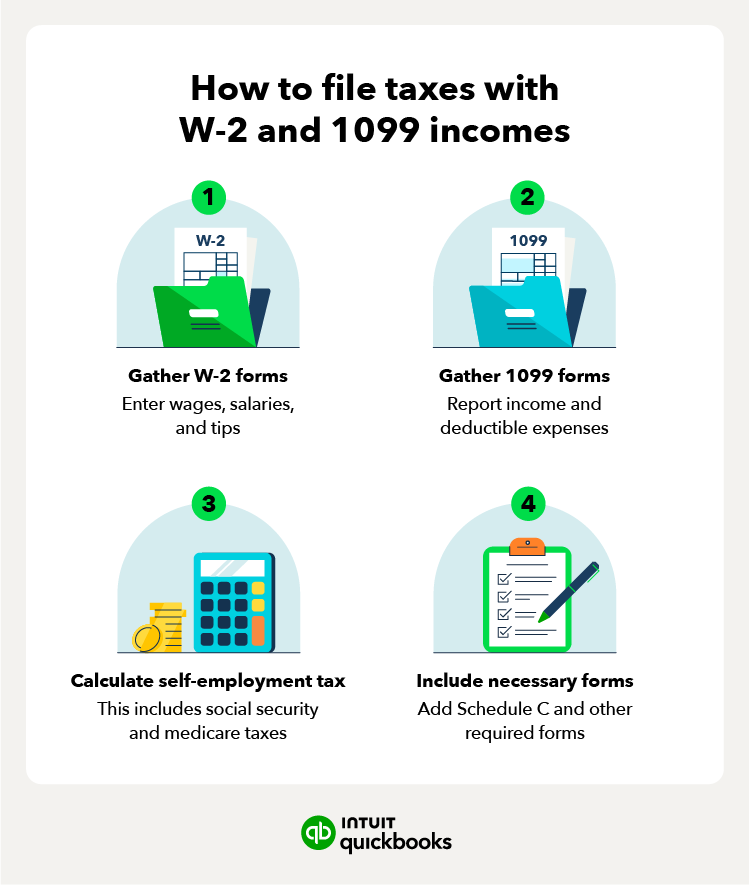
How to file taxes with W-2 and 1099 incomes.
  1. Report your W-2 income: Gather all W-2 forms from your employers and enter the information in wages, salaries, and tips section of your tax return. Make sure everything matches to avoid discrepancies.
  2. Report your 1099 income and deductions: Collect your 1099 forms independent contractor or freelance income, and enter each amount into the correct section of your tax return. Include any business-related deductible expenses to reduce your tax liability.
  3. Calculate self-employment tax: If you're self-employed, you’ll need to pay self-employment tax, which covers both the employer and employee portions of Social Security and Medicare taxes. Use a self-employment tax calculator or tax software to simplify the math. 
  4. Include all necessary forms and schedules: In addition to the standard tax forms, you may need to include additional forms and schedules specific to your self-employment income. The most common is Schedule C, which reports business income and expenses. Submitting complete forms ensures accurate reporting of your income and helps you claim eligible deductions.

note icon FYI: Employees must receive W-2 forms by Jan 31, and independent contractors must receive 1099-NEC forms by Jan 31.


6 Common pitfalls and mistakes when filing W-2 and 1099 together

Filing both W-2 and 1099 forms can be confusing, especially if it’s your first time. Avoiding these common mistakes can save you from IRS notices, penalties, or missed deductions.

1. Misclassifying workers

One of the biggest risks for small businesses is labeling an employee as a contractor, or vice versa. Misclassifying workers can lead to payroll penalties and back taxes. Review IRS guidelines carefully or consult a payroll professional before classifying workers.

2. Missing forms or income

Some businesses or freelancers forget to include all W-2 or 1099 forms on their tax return. Check your records carefully before filing, and make a list of all income sources to ensure no form is overlooked.

3. Mixing personal and business expenses

If you’re filing a 1099 as a self-employed individual, keep business expenses separate from personal spending. Mixing expenses can trigger audits and reduce deduction accuracy.

4. Incorrectly calculating self-employment tax

1099 income is subject to self-employment tax, which covers both Social Security and Medicare. Underestimating these taxes can lead to penalties. Use tax software or a tax professional to calculate them accurately.

5. Overlooking quarterly payments

Contractors often forget to pay estimated quarterly taxes, assuming W-2 withholding will cover all tax liability. This can result in a large tax bill in April. Plan ahead and set aside funds for quarterly payments to stay current.

6. Failing to adjust withholdings 

If you have both W-2 and 1099 income, not adjusting your W-2 withholdings can result in underpayment or a surprise tax bill. Review your W-4 and adjust withholdings to account for additional freelance or contractor income.

What you need to know before filing W-2 and 1099 together

Tax season can raise a lot of questions, especially if you’re managing both W-2 and 1099 income for the first time. Whether you’re a small business owner issuing forms or an individual earning mixed income, here’s what you should know before you file.

Choosing between 1099 and W-2 depends on your business needs

Small businesses must weigh flexibility against responsibility when deciding how to classify workers. W-2 employees require employers to manage payroll taxes, benefits, and insurance—but they often bring more stability and long-term control. 

1099 contractors, on the other hand, give you flexibility for short-term or project-based work but require accurate 1099 filings and clear contracts to avoid misclassification penalties.

If you’re unsure which classification is right, review the IRS’s guidelines on worker classification or consult a payroll expert before hiring.

Self-employed workers can still receive W-2s

Even if you run your own business or freelance, you might still get a W-2 from a part-time or seasonal job. For example, a freelance designer could take a short-term in-house contract for a few months and receive a W-2 for that role.

When filing taxes, treat each income source separately: report the W-2 income under wages and the 1099 income on Schedule C. This helps you claim the correct deductions and keep business and personal finances separate.

You can file both forms together without issue

It’s perfectly normal to have both W-2 and 1099 income. When filing, include both forms on your Form 1040. Report W-2 income as employee wages, and1099 income under self-employment income on Schedule C.

Tax software like QuickBooks or TurboTax can handle both forms in the same return, automatically calculating total taxable income and self-employment taxes.

Adjusting your withholdings can balance your tax bill

If you’re earning both types of income, taxes can get tricky. One smart option is to increase your withholdings from your W-2 job using Form W-4. This helps cover the taxes you’ll owe on 1099 income, which typically has no automatic tax withholding.

If you’re self-employed full time, make quarterly estimated tax payments to spread your tax burden and avoid a large bill—or penalties—at year's end.

Both income types must be reported together

No matter how many income streams you have, all earnings must be reported on the same return. Omitting even one 1099 form, even accidentally, can trigger an IRS notice.

Create a checklist of expected forms—W-2s from employers, 1099s from clients, and other income statements—to ensure nothing slips through the cracks. Keeping organized records throughout the year makes this process much easier.

You can receive both a W-2 and 1099 from the same company

It’s rare, but it happens. For instance, if a marketing agency employs you part-time (W-2) and also pays you separately for freelance design work (1099), you’ll receive both forms.

Just make sure each income type reflects the type of work performed. The W-2 should show your employee wages and benefits, while the 1099 should report freelance or project-based payments.

Taxes may be higher for 1099 income

1099 income typically results in higher taxes because you’re responsible for both the employer and employee portions of Social Security and Medicare—called self-employment tax.

However, 1099 contractors claim business deductions to offset those taxes. Track expenses like software, supplies, mileage, or your home office to lower taxable income.

Independent contractor deductions still apply if you earn both

If you earn both W-2 and 1099 income, you can still deduct eligible business expenses for your freelance or contractor work. The key is to keep your business and employment records separate.

For example, you can’t deduct travel or equipment costs from your W-2 job, but you can for your 1099 work. Good recordkeeping, such as saving digital receipts or using accounting software, makes filing smoother and helps support deductions if you’re ever audited.

Form 1040 is your main filing form

Report both W-2 and 1099 income on Form 1040, the standard individual tax return. Use Schedule C to report business income and expenses, and Schedule SE to calculate self-employment taxes.

Keep all supporting documents—1099-NEC, 1099-MISC, and W-2s, and receipts for deductible expenses. Staying organized through the year helps you save time and reduce errors at tax time.


Find peace of mind come tax time

Balancing multiple income streams can be rewarding—but it also adds complexity when filing your taxes. Accounting software that integrates payroll and contractor payments can simplify filing and improve accuracy.

Whether you’re an employer managing both W-2s and 1099s or an individual with multiple income sources, organization is key. Track your income throughout the year, set aside money for taxes, and consult a tax professional when needed to stay compliant and stress-free.


Recommended for you

Mail icon
Get the latest to your inbox
No Thanks

Get the latest to your inbox

Relevant resources to help start, run, and grow your business.

By clicking “Submit,” you agree to permit Intuit to contact you regarding QuickBooks and have read and acknowledge our Privacy Statement.

Thanks for subscribing.

Fresh business resources are headed your way!

Looking for something else?

QuickBooks

From big jobs to small tasks, we've got your business covered.

Firm of the Future

Topical articles and news from top pros and Intuit product experts.

QuickBooks Support

Get help with QuickBooks. Find articles, video tutorials, and more.