QuickBooks Blog
A businesswoman calculating capital for her company
accounting

What is capital in business? Types, sources, and how it works

Capital is the cash and resources that help you cover today’s needs, stay flexible when surprises happen, and invest in the kind of growth you’re working toward.

And that growth is top of mind for most small business owners. In fact, a QuickBooks Small Business Insights report states that 81% of U.S. small businesses say growth (not stability) is their goal. Whether you’re hiring, expanding your services, stocking up on inventory, or upgrading equipment, capital plays a role in what’s possible and when.

Below, we’ll break down business capital, the main types of capital, where it comes from, and how to manage it confidently.

Jump to:

Understanding business capital

The main types of business capital

Fixed capital vs. working capital

Sources of business capital

How businesses use capital

Measuring capital efficiency

Common capital challenges

Strategies for building capital

Protecting your capital

Capital and business growth stages

Your next step with business capital

Understanding business capital

In the business world, capital is the money and resources your business uses to do the work, today and over the long term. That includes cash in the bank, as well as the tools, equipment, and other assets that help you deliver your product or service.

For example, a landscaping company needs cash (working capital) to cover payroll and supplies, but it also needs trucks and lawnmowers (fixed capital) to get the job done. Both types matter, and both should be part of your financial plan.

Capital also helps you stay flexible. When you know what resources you have (and how quickly you can access them), you can make decisions with more confidence, buying inventory ahead of a busy season or handling an unexpected expense without derailing your cash flow.

The main types of business capital

Business capital comes in several distinct forms, each serving different purposes within an organization.

Working capital

Working capital is the money your business has available to handle the everyday expenses, like payroll, bills, inventory, and other short-term needs. It’s calculated by subtracting what you owe soon (current liabilities) from what you have on hand or expect to collect soon (current assets). It’s the breathing room that helps your business stay on track between paydays and payments.

Key characteristics:

  • Covers day-to-day operational expenses
  • Helps pay for inventory, payroll, and utilities
  • Offers a quick snapshot of short-term financial health
  • Calculated as: current assets - current liabilities

Positive working capital means you can comfortably cover upcoming expenses. Negative working capital can signal that cash is tight, so you may need to review cash flow, payment timing, or short-term financing options.

Equity capital

Equity capital is funding that business owners and investors contribute in exchange for ownership stakes. This type of capital doesn't require repayment like loans do.

Sources of equity capital include:

  • Personal savings from founders
  • Angel investors and venture capitalists
  • Public stock offerings
  • Retained earnings reinvested in the business

The advantage of equity capital is that it doesn't create debt obligations. However, owners must share control and profits with investors.

Debt capital

Debt capital is money you borrow for your business and pay back over time, usually with interest. It can be a practical way to fund growth, cover big purchases, or build a little financial flexibility without giving up ownership.

Common forms include:

The upside of debt capital is that you keep full control of your business. The tradeoff is that repayment is required on a set schedule, even if sales dip or cash flow gets tight, so it’s important to borrow with a clear plan and a realistic view of your monthly budget.

Trading capital

Trading capital refers to the money you set aside specifically for buying and selling financial instruments or inventory. Retailers and trading firms rely heavily on this type of capital. It’s the funds you have specifically earmarked to make money through transactions.

This capital allows businesses to:

  • Purchase inventory at optimal times
  • Take advantage of bulk discounts
  • Respond quickly to market opportunities
  • Maintain adequate stock levels

Fixed capital vs. working capital

Understanding the difference between fixed capital and working capital helps you allocate resources with more clarity and avoid cash flow surprises.

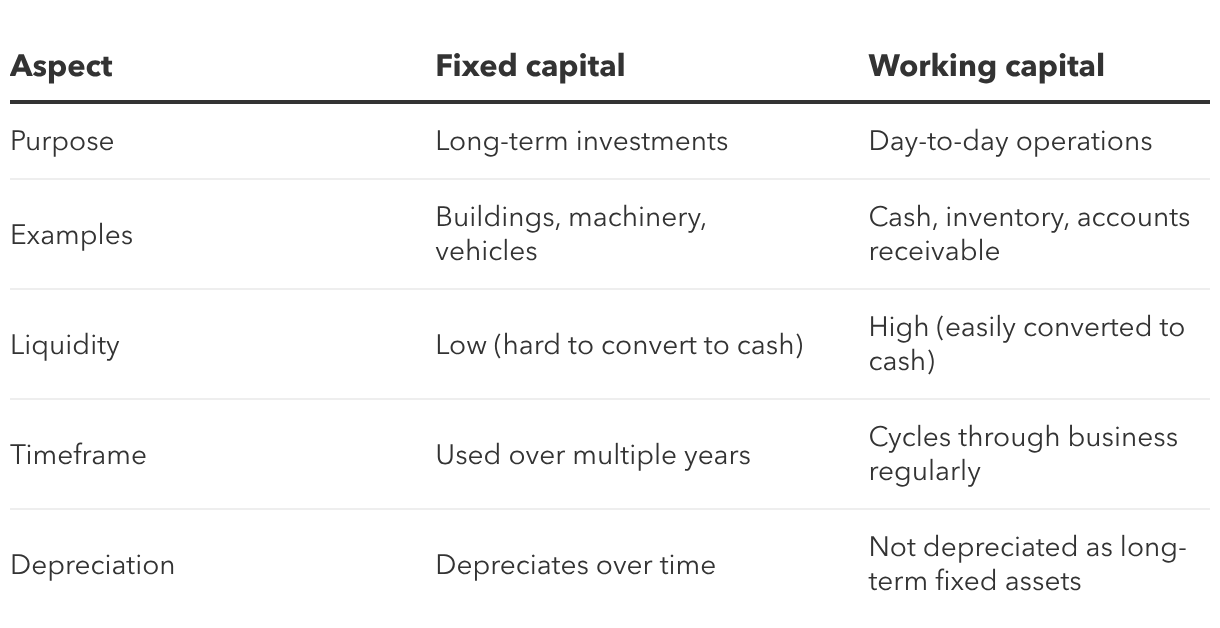
Fixed capital represents the long-term investments that support your operations over time. These are assets that aren’t easy to turn into cash quickly, but they’re essential for doing the work, like buildings, machinery, vehicles, and major equipment. Because fixed capital is meant to last, you’re usually thinking in years, not weeks.

As mentioned earlier, working capital is what helps you cover short-term needs and keep the business moving day to day. It’s the cash and near-cash resources you rely on for things like payroll, supplies, and paying vendors while you wait for customer payments to come in.

A simple way to remember it:

  • Fixed capital helps you do the work.
  • Working capital helps you fund the work.

Here’s a quick side-by-side look:

Sources of business capital

Businesses can get capital through numerous channels, each with distinct advantages and requirements.

Traditional financing

Traditional financing usually comes from established lenders. These options can offer strong rates and longer terms, but they typically require solid credit, clear financials, and sometimes collateral.

Common types include:

  • Bank loans: A lump sum you repay over time, often with a fixed interest rate and set repayment schedule.
  • SBA loans: Loans backed by the Small Business Administration through approved lenders. They’re designed to help small businesses qualify for funding with competitive terms.
  • Business lines of credit: A pre-approved credit limit you can draw from as needed. You typically pay interest only on what you use.
  • Business credit cards: Useful for short-term expenses and everyday purchases, but rates can be high if you carry a balance.
  • Equipment financing: Funding specifically used to purchase equipment or vehicles, with the equipment often serving as collateral.

Alternative financing

Alternative financing has grown quickly in recent years, especially through online platforms. These options can be faster and more flexible than traditional small business loans, but they may come with higher costs or shorter repayment timelines.

Some alternative financing options include:

  • Crowdfunding: Raising money from many people, usually in exchange for early access to a product or other perks.
  • Invoice factoring: Selling unpaid invoices to a third party for immediate cash. It’s helpful if you have long payment cycles.
  • Merchant cash advances: Receiving upfront funds based on expected future sales (typically repaid through a percentage of daily card sales).
  • Peer-to-peer lending: Online platforms that connect borrowers with individual lenders, often with faster approval than banks.

Equity investment

Equity investment means raising capital by giving someone an ownership stake in your business. This can be a strong option for high-growth companies, since you’re not taking on monthly loan payments, but it does mean sharing future upside (and sometimes decision-making).

Some common equity sources include:

  • Angel investors: Individuals who invest in early-stage businesses, often with guidance and mentorship along with funding.
  • Venture capital: Firms that invest larger amounts in businesses with high-growth potential (more common in tech or scalable startups).
  • Private equity: Investors who typically back more established companies and focus on improving performance over time.

Initial public offering (IPO): Selling shares to the public market, usually a step for mature, high-scale companies.

How businesses use capital

Capital can do a lot of good, but how you use it matters just as much as how much you have. When you put capital toward the right priorities, it can help you run more consistently today and build real momentum for the future. Here’s how businesses generally use capital.

Operational uses

Businesses use capital every day to keep operations moving. That includes paying employees, stocking inventory or materials, covering rent and utilities, and staying protected with business insurance. It also shows up in the less flashy but just as important work, like maintaining equipment, fixing what breaks, and investing in marketing and sales so new customers keep finding you. 

When operational capital is healthy, your business can deliver consistently without constantly feeling like you’re one expense away from a scramble.

Growth investments

Capital also gives you room to grow when the timing is right. You might use it to open a new location, expand into a new market, develop a new product or service, or upgrade technology so your team can work faster and more efficiently. In some cases, growth capital can support a strategic acquisition or help you hire the right people to reduce bottlenecks and take on more work. 

The best growth investments are the ones that increase your capacity or revenue in a way that’s sustainable, not just exciting in the moment.

Financial management

Some of the smartest ways to use capital are the ones that make your business more resilient. Many businesses use capital to create an emergency reserve, pay down high-interest debt, or strengthen cash flow so bills are easier to manage month to month. If you have extra cash, you might also choose to put some of it to work in a low-risk way, as long as you’re not sacrificing liquidity you’ll need soon. 

The goal is simple: protect your financial flexibility so you can make good decisions from a position of strength, not pressure.

Measuring capital efficiency

Successful businesses monitor how effectively they use capital through key performance indicators (KPIs). Here’s what they generally utilize.

Return on capital employed (ROCE)

This metric shows how much profit a company generates from its capital. It tells you if your investments are actually paying off.

Formula:

ROCE = Earnings before interest and tax (EBIT) / capital employed

In general, a higher ROCE suggests you’re using capital efficiently because you’re earning more profit for every dollar tied up in the business. It’s most meaningful when you compare your ROCE over time or against similar businesses in your industry.

Capital turnover ratio

Capital turnover looks at how effectively your business uses capital to generate revenue. Unlike ROCE, which focuses on profit, this metric focuses on sales, which is helpful if you want a clear sense of how hard your capital is working to drive top-line growth.

Formula:

Capital turnover = Net sales / total capital

A higher capital turnover ratio usually means you’re generating more sales per dollar of capital invested. It can point to strong demand, efficient operations, or both, especially when you track it consistently.

Working capital ratio

The working capital ratio is a quick way to understand short-term financial health. It tells you whether you have enough current assets (e.g., cash, accounts receivable, and inventory) to cover current liabilities due soon.

Formula:

Working capital ratio = Current assets / current liabilities

A ratio above 1.0 generally means you can cover your short-term obligations. A ratio below 1.0 can be a sign that things are tight, since it means you have more due soon than you can cover with near-term resources. That doesn’t always mean something is wrong, but it’s a helpful signal to take a closer look at cash flow and timing.

Common capital challenges

Most businesses run into capital challenges at some point, especially while you’re growing, navigating seasonal swings, or adjusting to changing costs. Here are some common pitfalls and how to avoid them.

Undercapitalization

Undercapitalization means you don’t have enough capital to comfortably support day-to-day operations. When capital is too tight, it can be hard to cover payroll or pay vendors on time, and you may have to pass on growth opportunities simply because the cash isn’t there. It also makes slow months or unexpected business expenses feel much heavier.

The solution: Plan ahead whenever you can. Forecast your cash needs, build a reserve over time, and explore funding options before the situation feels urgent. The goal is to secure support while you still have choices, not when you’re already under pressure.

Overcapitalization

Overcapitalization happens when you have more capital than you’re putting to productive use. Excess cash sitting idle can drag down returns and lead to inefficient decisions, like spending money just because it’s available or letting opportunities slip because there’s no clear plan for that capital.

The solution: Give extra capital a job. You might invest in high-impact growth initiatives, pay down expensive debt, upgrade equipment, or make strategic purchases that improve efficiency. In some cases, returning capital to owners can also make sense, especially if there isn’t a clear business use for it.

Poor capital structure

An unbalanced mix of debt and equity can destabilize a business. Too much debt may lead to excessive interest payments and increased risk during downturns. Too much equity dilutes your ownership and control.

The solution: Review your debt-to-equity mix regularly and adjust as your business evolves. A healthy structure balances the stability of equity with the leverage of debt—so you can grow without putting too much pressure on your cash flow.

Strategies for building capital

Building capital takes time, and that’s okay. Most businesses grow their capital the same way they grow everything else: through consistent decisions, solid financial habits, and a clear plan. Here are some strategies to consider.

Increase profitability

The most reliable way to build capital is to generate it from within your business. That usually comes down to improving how you operate and making sure your pricing and spending support your goals. 

Look for ways to tighten efficiency, reduce costs that don’t add real value, and invest in the parts of your product or service that keep customers coming back. Even small improvements in margin can add up quickly over time.

Retain earnings

Keeping more money in the business can be one of the fastest ways to strengthen your financial position. That might mean limiting owner draws for a period, reinvesting profits into the next stage of growth, or simply building a cash reserve before you expand. 

The key is balance: you want growth that’s exciting, but you also want growth your cash flow can comfortably support.

Attract investment

Outside capital can make sense when you have a clear use for the funds and a strong plan for how they’ll help you grow. If you’re pursuing investment, focus on telling a simple, credible story: what you do, what’s working, what you need, and how the money drives results. 

Clean, accurate bookkeeping matters here, too. Investors want proof, and your financials are a big part of that.

Protecting your capital

Once you have capital, you must safeguard it. Let’s look at some ways you can do that.

Implement strong financial controls

Strong financial controls help you stay on top of your numbers and catch small issues before they become costly ones. That can be as simple as reviewing your financial statements on a regular schedule, keeping a close eye on your budget, and looking at any meaningful differences between what you expected and what actually happened. 

It also means putting basic safeguards in place, like fraud prevention steps and separating key financial responsibilities, so no single person has total control over payments, approvals, and reconciliations.

Manage risk effectively

Risk management is really about planning for what could happen, not assuming the worst. Here are a few ways to manage risk:

  • Get insurance coverage can protect you from major losses, while 
  • Diversify your revenue streams to help reduce your reliance on any single client, product, or season. 
  • Build an emergency cash reserve to give you added stability when something unexpected hits, and 
  • Pay attention to market or industry trends to help you adjust early instead of reacting late.

Optimize cash flow

Cash flow is one of the most practical ways to protect your capital, because it affects what you can handle month to month. Simple improvements (e.g., collecting receivables faster, setting clear payment terms, and following up consistently) can make a noticeable difference. 

It also helps to negotiate vendor terms that fit your cash cycle, keep inventory lean (without running short), and cut expenses that aren’t truly supporting your goals. When cash moves through your business efficiently, you’re far less likely to dip into reserves just to cover everyday needs.

Capital and business growth stages

Capital needs evolve as businesses progress through different lifecycle stages. What you need today might be very different from what you need in five years. 

Startup stage

In the startup stage, you’re focused on proving your concept and getting your first real momentum. Capital typically goes toward building or refining your product or service, covering early operating costs, and funding marketing so you can reach your first customers. 

Many owners start with personal savings, help from friends and family, or early-stage support like crowdfunding or angel investors. It’s also common to lean on credit cards at this stage. Just be mindful of the long-term cost if balances stick around.

Growth stage

Once you’ve found demand, the challenge becomes scaling without stretching your cash flow too thin. Growth-stage capital often supports hiring, increasing inventory or capacity, expanding into new markets, and upgrading systems to handle higher volume. 

At this point, funding might come from retained earnings, bank loans or lines of credit, strategic partners, or venture capital for businesses with high-growth potential. This is also when many businesses start using more formal financing, because growth usually requires investments before the revenue fully catches up.

Maturity stage

In the maturity stage, your business is established, and capital decisions tend to focus on staying competitive and building long-term strength. That can mean investing in innovation, upgrading technology, expanding thoughtfully, or pursuing strategic acquisitions. 

Many mature businesses fund these moves through operating cash flow, since the business is generating its own capital. Larger companies may also use options like bonds, institutional investment, or public markets, depending on their size and goals. At this stage, capital is less about survival and more about smart, sustainable leadership.


Your next step with business capital

Capital is one of those business concepts that can sound complicated at first, but in practice, it’s very grounded. It’s the money and resources you use to keep your business running, stay flexible when surprises pop up, and invest in the kind of growth you actually want. When you understand the different types of capital, where it comes from, and how to measure it, you can make decisions with more clarity and a lot less guesswork.

And if you ever need an extra boost to help manage cash flow or take the next step with confidence, QuickBooks Capital can help. With a QuickBooks term loan, you can apply and manage everything right in QuickBooks, with clear terms upfront and a streamlined experience built around your business data.

Explore your options and see if you’re eligible so you can keep moving forward without losing momentum.

QuickBooks Term Loan ("Term Loan") and QuickBooks Line of Credit ("Line of Credit") loans are issued by WebBank.

Small business loans — big opportunities for growth

Get the funding you need fast with QuickBooks Term Loans or Lines of Credit.


Recommended for you

Mail icon
Get the latest to your inbox
No Thanks

Looking for something else?

QuickBooks

From big jobs to small tasks, we've got your business covered.

Firm of the Future

Topical articles and news from top pros and Intuit product experts.

QuickBooks Support

Get help with QuickBooks. Find articles, video tutorials, and more.