BLACK FRIDAY SALE  
70% OFF 
QuickBooks
for 3 months  Ends 11/30
QuickBooks Blog
Two women with laptops work in an office
bookkeeping

CPA vs. Accountant: Understanding Key Differences

Do you need help with your finances but don't know if you should go to a CPA or an accountant? The two are easy to confuse for people outside the accounting field, so you’re not alone if you’re wondering what the difference between a CPA and an accountant actually means.

The short version is that all CPAs are accountants, but not all accountants are CPAs. Certified public accountant (CPA) is a professional certification that some accountants pursue to qualify for higher-level roles and serve more complex clients. Businesses and individuals don’t always need a CPA as their accountant. Still, a CPA’s expertise and privileges can be critical assets for businesses with complex accounting needs.

Let's take an in-depth look at the key differences between accountants and CPAs so you can make well-informed decisions about when to hire each type of professional.

Jump to:

What is an accountant?

An accountant helps manage the financial health of businesses and individuals. Their responsibilities include preparing financial statements, maintaining accurate financial records, and ensuring compliance with relevant laws and regulations. They also handle tasks such as budgeting, tax preparation, and financial analysis. While the qualifications for becoming an accountant can vary, most have a degree in accounting or a related field and may pursue additional certifications to boost their expertise.

What is a CPA?

A Certified Public Accountant (CPA) is a highly trained professional with expertise in accounting, auditing, and tax services. CPAs have met rigorous education and experience requirements, including passing the CPA exam. Their responsibilities usually include conducting audits, preparing tax returns, and providing strategic financial advice.

CPAs also adhere to strict ethical guidelines. For example, they shouldn’t offer services where they both audit and consult for the same business. This is so they maintain an unbiased, trustworthy approach.

Key differences between a CPA and an accountant

CPAs are a specialized subset of accountants with advanced skills and rigorous professional standards. Here are some of the main differences between CPAs and accountants.

Tasks and responsibilities

The day-to-day tasks and responsibilities of accountants and CPAs overlap in many ways, as shown in the chart above. Both accountants and CPAs can provide essential financial services like creating financial reports, reconciling bank statements, and preparing tax returns. Accountants may also specialize in services such as tax preparation or ecommerce accounting. 

However, certain tasks require the advanced training and strict ethical guidelines that only a CPA can guarantee. These can include accounting for public companies, external audits, complex transactions such as mergers, and advanced tax planning optimization. CPAs can even represent taxpayers before the IRS.

Education

Most accountants have a degree in accounting or a related field, which gives them a solid foundation in financial principles and practices. A bachelor’s degree in accounting is a common credential for entry-level accountants, while other accountants may have a graduate degree, such as a master’s in accounting or an MBA. These advanced degrees help accountants acquire the expertise required for higher-level accounting roles.

On the other hand, CPAs must meet higher educational standards to qualify for the advanced roles and responsibilities that many CPAs take on. At minimum, CPAs are required to have a bachelor’s degree with a certain number of credit hours in accounting courses. Most states also require CPAs to complete a certain number of continuing education hours per year to ensure that they stay current with subjects like accounting ethics, as well as acquiring work experience working under the supervision of another CPA. 

Certification and licensing

Accountants can practice without a degree or certification, but many businesses require candidates for accounting positions to have at least a bachelor's degree. Accountants who want to enter specialized fields such as business analysis or tax preparation can take certification courses to build their skill and get certified in these areas.

CPAs must pass the demanding four-part CPA exam, with all four parts being completed within a certain time period determined by state authorities. A CPA must also meet state-specific licensing requirements in experience and continuing education, as well as working for a period of time after passing their exam. This extra knowledge and official recognition is what distinguishes CPAs from standard accountants in the field. 

Ultimately, this also means that training time is one of the biggest differences between accountants and CPAs. An accountant can start working in the field with just the time it takes to get a degree, or even less if they’re self-trained. CPAs, on the other hand, require formal education and must pass the exam and acquire work experience, a process that often adds multiple years onto the time required to enter the field. For this reason, many accountants get their accounting degree, then study for their CPA while working in an entry-level accounting position.

Scope of services

Accountants can offer a wide range of services, including bookkeeping, tax preparation, and financial planning. There are, however, some restrictions on which services non-CPA accountants can offer. For example, an accountant without a CPA cannot audit a public company or represent a taxpayer before the IRS. 

A CPA can provide any services that an accountant can, but their credentials also allow them to take on additional types of work. CPAs are qualified to conduct in-depth audits and prepare audited financial statements for the SEC, and they’re often employed in consulting fields where they offer strategic business advice and perform financial analysis on sensitive company data. A CPA certification is also required for jobs in many specialized fields such as forensic accounting. 

Legal authority 

Without a CPA license, an accountant generally does not have any special legal authority. They’re still required to follow the legal and ethical principles of accounting, but they have no specific authority in any legal process.

CPAs, meanwhile, have unique legal responsibilities and authorities that general accountants don’t have. For instance, as previously mentioned, only CPAs can perform audits of publicly traded companies and represent clients in IRS proceedings. That’s why CPAs are often in high demand among businesses that work extensively with regulatory agencies and have high compliance needs. 

Code of ethics

All accountants should follow ethical standards including avoiding conflicts of interest and maintaining strict confidentiality for their clients. The vast majority of accountants uphold these standards every day, but there’s no single universal code of ethics that all general accountants must follow. 

CPAs, on the other hand, must follow a specific and strictly enforced code of ethics, the AICPA Code of Professional Conduct. A CPA who violates these rules can have their license revoked by their State Board of Accountancy, providing an additional accountability mechanism to ensure CPAs uphold the highest standards of objectivity and due care in their work. 

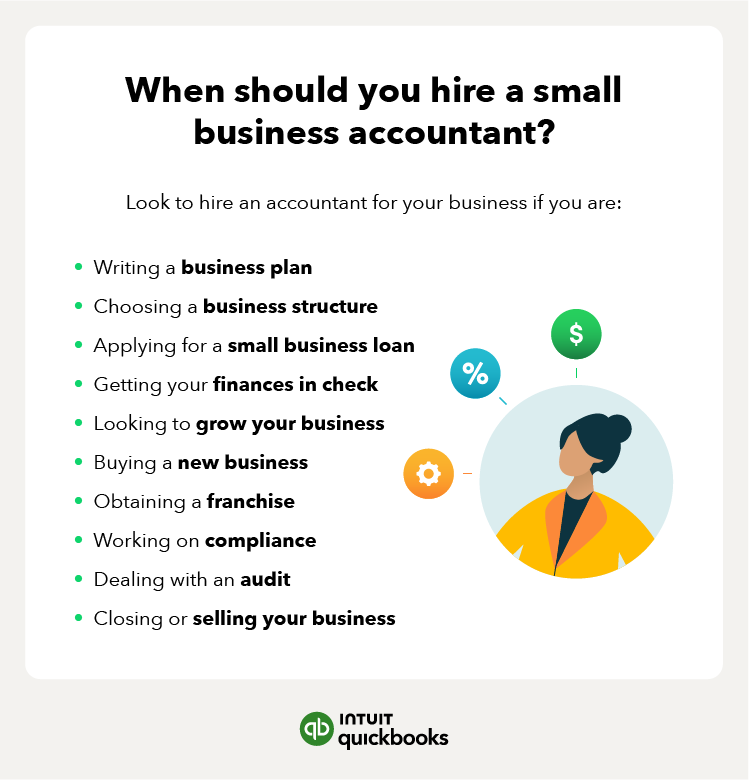
A list showing different times when a small business accountant is helpful to business owners: When you write a business plan, choose a business structure, apply for a small business loan, get your finances in check, grow your business, buy a new business, obtain a franchise, work on your tax compliance, deal with an audit, or choose to close or sell your business.

When to hire an accountant vs. CPA

Many business owners and managers wonder if they should hire an accountant or a CPA. These are some of the key considerations to keep in mind:

When to hire an accountant

Hiring an accountant instead of a CPA can be a smart choice for small business owners who need more basic accounting and bookkeeping services. General accountants often charge less for their services than CPAs, making it a potentially appealing deal. You’ll often see accountants hired for tasks such as:

  • Everyday bookkeeping: Any qualified accountant can handle most of the day-to-day bookkeeping tasks of a small business. These might include meeting payroll, reconciling transactions, and handling payables and receivables. Accountants can also prepare standard financial statements like cash flow statements, profit-loss statements, and balance sheets.
  • Organizational tasks: Accountants can also help small business owners perform critical tasks like organizing invoices and keeping receipts for expense deductions. This ensures your records are ready to go for tax time and makes them easier to find in case you need to consult old invoices or other documents.
  • Preparing and filing taxes: Tax preparers don’t have to be CPAs in most cases. Any qualified tax preparer can handle typical small business tax operations like maximizing deductions and credits, making estimated tax payments, and preparing W-2s for employees and 1099 forms for contractors. Remember that an IRS enrolled agent can provide many of the same tax preparation services as a CPA, sometimes at a lower cost.
  • Personal finances: Working with an accountant can also be helpful for small business owners in managing their personal finances, especially if they operate their business as a sole proprietor or single-member LLC who reports business income on their personal tax return via Schedule C

When to hire a CPA

Sometimes, a small business owner needs the authority, expertise, and in-depth knowledge that only a CPA can provide. For services like these, it’s often worth hiring a CPA:

  • Audits and back taxes: Working with a CPA is invaluable if your business owes back taxes, is undergoing an audit, or otherwise tangling with the IRS. A CPA’s training includes extensive testing on compliance and regulations, and they’ll be able to help you work with the IRS to satisfy the agency’s requirements. They can also act as your legal representative in dealing with the IRS.
  • Complex tax returns: Some small businesses have more complex tax needs. Common examples include businesses that work in highly regulated industries, ecommerce businesses that deal with interstate sales tax, construction or real estate firms with complex depreciations, corporations with shareholder changes, companies involved in mergers, and businesses that operate internationally. Because these businesses file more complex returns, it’s often crucial for them to work with a CPA.
  • In-depth financial analysis: CPAs also know how to go beyond the basics when it comes to financial reporting and analysis. If you’re looking for an accounting partner who can provide insights and advice on subjects like cost-cutting, expansion, or debt management, a CPA’s more thorough training will be a major asset. 
  • Tax planning: Another key service that many CPAs offer is tax efficiency planning. CPAs can help you decide on the most tax-efficient structure for your business, as well as using advanced techniques like tax-loss harvesting and timing asset sales to reduce your business’s overall tax liability. Finally, they can also help business owners harmonize their tax planning with long-term financial goals like retirement through accounts like 401(k)s and IRAs.

For many individuals and small businesses, working with a CPA may not always be the best fit if a qualified accountant can provide the services you need at a better price. However, some business owners find that they need the more advanced menu of services that a CPA can offer, and/or that a CPA’s more rigorous training provides valuable peace of mind.

Should I work with a CPA or an accountant for taxes?

Not everyone needs to have a CPA prepare their tax return. Many experienced and credible professional tax preparers are not CPAs, and these preparers often provide their services at a lower cost than a CPA’s services. Thus, for small business owners and individual taxpayers, it can be financially advantageous to look beyond CPAs for tax preparation.

Who should use a CPA to do their taxes? Generally, taxpayers who have more complex tax returns benefit from working with a CPA. Some circumstances in which you might want to work with a CPA include:

  • You have a large business with diverse revenue streams
  • You have a lot of investment income from different sources
  • Your business operates internationally
  • You sell products in many different markets via ecommerce
  • You’re dealing with audits, back taxes, or other IRS issues
  • Your business involves complex transactions like mergers and acquisitions
  • You’re interested in using advanced methods to optimize your tax liability

CPA vs. accountant: Differences in salary

It’s also important to recognize the differences in salary and pay scale between CPAs and accountants. While they often work in similar entry-level roles, CPAs frequently end up pursuing a higher-paying career path. Let’s look at why that is.

Do CPAs make more than accountants?

Getting a CPA license is one of the most widely-recognized ways for accountants to boost their earning potential. According to data from Indeed, a CPA’s average base salary is $92,879 per year, while an accountant’s is $65,806.

A CPA license is often a prerequisite for higher-earning roles in the accounting field, such as accounting manager, financial controller, or CFO. Many jobs specifically recruit candidates with their CPA license for accounting roles, since these workers may have higher potential to get promoted and take on more demanding responsibilities.

CPAs can also charge more for their services than accountants without a CPA license. Businesses are often willing to pay a premium for a CPA’s services due to the expanded responsibilities that CPAs can take on and their more rigorous training. Certain high-paying accounting fields, such as public auditing, also require CPA credentials. 

How many CPAs are there?

As reported by the National Association of State Boards of Accountancy (NASBA), there are approximately 672,000 currently licensed CPAs in the US as of 2024. Because becoming a CPA requires demanding training, CPAs have always been in much more limited supply than general accountants.

What about accountants in general? According to the Bureau of Labor Statistics, there are approximately 1.4 million accountants and auditors employed in the United States. Crunch those numbers, and you’ll find that roughly 48% of accountants in the US are certified CPAs.

That might sound like a lot, but according to The CPA Journal, the accounting industry is actually in the midst of an ongoing labor shortage that’s left the profession short by many thousands of roles, including CPAs. That potentially makes it even more important for businesses looking for accounting help to expand the scope of their search beyond CPAs if they don’t require CPA-specific qualifications.

Other accounting credentials

In addition to CPAs, you might see the following credentials and/or titles listed for accountants:

  • Accounting Associate: An accounting associate typically holds an associate degree in accounting or a related field and performs various accounting tasks under the supervision of senior accountants or CPAs. They typically handle more routine, clerical, and support-based tasks within the accounting department.
  • Enrolled Agent: This credential, offered directly by the IRS, focuses on tax preparation and requires an accountant to pass a three-part IRS test. Like CPAs, enrolled agents can represent taxpayers in disputes with the IRS.
  • Certified Management Accountant (CMA): An accounting certification that focuses on management and financial planning and also requires passing a rigorous test. Many CMAs work in corporate accounting positions.
  • Registered Professional Accountant and Chartered Accountant: These are two international credentials that have similar requirements to the CPA license. Registered Professional Accountant is specific to Canada.

Benefits of hiring a CPA

Hiring a CPA can come with some substantial advantages, including:

#1: Accountability and trustworthiness

For many clients, the CPA designation is a badge of accountability and integrity that justifies the price premium for a CPA’s tax preparation services. Becoming a CPA requires extensive training and passing difficult tests that measure the accountant’s in-depth knowledge of accounting standards, and prospective clients can verify a CPA’s credentials in a national database to ensure that they’re legitimate.

#2: Knowledge and expertise

The rigorous process to become a CPA also ensures that those who pass their exams have expert-level knowledge of a variety of accounting subjects. If your tax return is complex and/or includes unusual elements like foreign bank accounts or large real estate transactions, a CPA’s specialized expertise is often a must-have.

#3: Strict ethical standards

When you hire a CPA, you can be confident that they’ll manage sensitive financial matters with the utmost professionalism. A CPA’s training includes extensive instruction on maintaining strict ethical standards, including client confidentiality and objectivity, as set out in the American Institute of Certified Public Accountants’ Code of Professional Ethics.

#4: Professional privileges

CPAs also have certain legal and professional privileges, including preparing audited financial statements for public companies and representing taxpayers in IRS disputes. If you need these services, you’ll need to work with a CPA.

#5 Advanced insights

CPAs can work with data at a high level to extract big-picture financial insights that make them invaluable for projects such as budgeting, financial forecasting, and tax optimization. If you want to work with an accountant who can go beyond the basics to help your business thrive, consider working with a CPA.

Find the right accounting professional for your business

Working with the right finance professional is a crucial step toward financial stability for small business owners. If you’re currently in the process of looking for an accounting professional to help you with taxes, payroll, cost-cutting, or any other key financial operation, these considerations can help you make the right choice.

CPA vs. accountant: Important questions to ask

When it comes to choosing between a CPA and an accountant, which option is more effective? That’s something of a trick question, because there’s no one-size-fits-all answer. It’s all about deciding which option works better for your business, and asking these questions can help.

What are my specific financial needs? Consider which parts of accounting create the biggest pain points for your business. Do you need someone to help keep your tax documents organized and get everything filed on time, or do you need in-depth financial reports and someone to go over them with you?

Am I looking for someone to file my taxes or provide strategic financial advice? If you’re more concerned about day-to-day operations and normal tax filing, an accountant can often provide what you’re looking for. If you need strategic advice about topics like tax efficiency or cost cutting, a CPA may be more appropriate.

  • Do I need someone with formal certification and/or regulatory credentials? Working with a CPA is often the go-to option for business owners looking for credentialed financial help. However, remember that accountants with other credentials, like Certified Management Accountants (CMAs) or IRS Enrolled Agents, can also provide excellent services depending on your needs.
  • What is my budget for financial services? CPAs typically charge more for their services, so business owners should expect to pay more when they work with a CPA than with other accountants. Working with a non-CPA accountant can save you money if your accounting needs are less complex and you don’t need any of the specific capacities that a CPA offers, such as IRS representation.
  • Do I need industry-specific financial expertise? Working with a CPA is especially common in financially complex industries like construction and banking. However, if you need industry-specific expertise, it’s important to look beyond the CPA designation and find a professional with experience in your industry. In some cases, an accountant may not have their CPA, but may have other industry-specific certifications that make them a great fit for your business.
  • Am I looking for long-term guidance or one-time assistance? Some accountants thrive on single-project contract work, while others prefer to establish relationships with returning clients or even take on full-time work. This has less to do with an accountant’s qualifications and more to do with the specific tasks you need help with, so be sure to ask about an accountant’s preferred working style. 

Whether you choose to work with a CPA or an accountant, accounting professionals can help support your business with bookkeeping, taxes, payroll, and more. Search our database to find a qualified accountant near you


Recommended for you

Mail icon
Get the latest to your inbox
No Thanks

Get the latest to your inbox

Relevant resources to help start, run, and grow your business.

By clicking “Submit,” you agree to permit Intuit to contact you regarding QuickBooks and have read and acknowledge our Privacy Statement.

Thanks for subscribing.

Fresh business resources are headed your way!

Looking for something else?

QuickBooks

From big jobs to small tasks, we've got your business covered.

Firm of the Future

Topical articles and news from top pros and Intuit product experts.

QuickBooks Support

Get help with QuickBooks. Find articles, video tutorials, and more.