







QuickBooks Blog
A business owner reading about hiring laws in California
California

Understanding hiring laws in California in 2025

California, the most populous state in the U.S., is known for its robust economy and diverse workforce. As of 2024, the state's labor force consists of over 19 million people, with employment spanning various sectors from technology and entertainment to agriculture and manufacturing. California is also recognized for its progressive employment laws, often setting nationwide trends.

Understanding and complying with California's hiring laws is not just a legal requirement—it's a strategic necessity for business owners. The state's Department of Industrial Relations and the California Labor Commissioner's Office oversee the enforcement of labor laws, including those related to hiring practices and employment contracts. Without a sufficient understanding of how employment contracts and hiring differ in California, employers can experience regulatory trouble and damaged employee relationships.

California’s laws can be challenging to grasp, but starting with an understanding of the basics will help ensure you’re prepared. Let’s look at some of the major features of California’s hiring laws, including how they differ from many other states.

Jump to:

Understanding California hiring laws

California's employment laws are among the most comprehensive in the nation. They aim to protect workers' rights while promoting fair business practices. Key aspects of these laws include:

Broader protections

One of the most important aspects of California’s hiring and employment law is the ways in which it extends protections beyond federal requirements. Key aspects of these laws include:

  • Ban-the-box law: California’s Fair Chance Act restricts employers from asking about a candidate’s criminal record until they’ve made a conditional offer and requires them to conduct an individualized assessment of the candidate’s record.
  • Pay transparency: California also requires most employers to list the pay scale in job postings or provide it when candidates ask. Employers must also provide a pay scale for an employee’s own position upon request.
  • Salary history ban: Employers may not ask for a candidate’s salary history as part of an interview process in California.
  • Driver’s license requirements: Employers in California cannot require employees to have a driver’s license unless driving is a core part of the job or their lack of a license would prevent them from getting to work.
  • Anti-discrimination protections: California hiring law contains anti-discrimination rules that go beyond federal law. Protected characteristics in California include sexual orientation, gender expression, marital status, medical conditions, and any combination of protected categories.

Employers should note that many of these laws only apply to organizations above a certain number of employees. Ban-the-box, for example, only applies to employers with five employees or more, and pay transparency laws only apply to employers with 15 employees or more. 

Non-discrimination hiring in California

California's commitment to workplace equality is reflected in its extensive non-discrimination laws. These regulations aim to ensure fair treatment for all job applicants and employees, regardless of their personal characteristics or background. 

Civil Rights Act

The Civil Rights Act is a federal law prohibiting discrimination based on race, color, religion, sex, or national origin. While this act sets a baseline for fair employment practices nationwide, California has expanded on these protections with its own human rights laws, such as the California Fair Employment and Housing Act (FEHA). 

Fair Employment and Housing Act (FEHA)

California’s FEHA builds on the Civil Rights Act by offering broader protections.

  • It applies to employers with five or more employees, so even small businesses must understand and comply with these regulations.
  • It also prohibits discrimination based on race, color, religion, sex, gender, gender identity, gender expression, sexual orientation, marital status, national origin, ancestry, mental and physical disability, medical condition, age, pregnancy, denial of medical and family care leave, or military and veteran status.
  • Lastly, employers must take reasonable steps to prevent discrimination and harassment.

Americans with Disabilities Act (ADA)

The Americans with Disabilities Act is a civil rights law that safeguards individuals with disabilities from discrimination in the workplace and other areas of public life. In terms of employment, it mandates that employers with 15 or more employees refrain from discriminatory practices in all aspects of employment and provide reasonable accommodations to qualified individuals with disabilities, ensuring a level playing field for all.

California’s Fair Chance Hiring Law

The Fair Chance Act, also known as "Ban the Box," aims to reduce barriers to employment for individuals with criminal records. The following are key provisions of the Fair Chance Act:

  • Prohibits employers from asking about conviction history before making a conditional job offer.
  • Requires an individualized assessment of an applicant's conviction history.
  • Provides applicants an opportunity to respond before a final decision is made.

Complying with the Fair Chance Act requires:

  • Removing questions about conviction history from job applications.
  • Conducting background checks only after making a conditional offer.
  • Assessing the nature and gravity of the offense in relation to the job duties.
  • Providing written notice and opportunity to respond if considering adverse action.

California Freelance Protection Act

The California Freelance Protection Act, which went into effect in January 2025, requires written contracts between employers and freelancers. It also stipulates that employers must pay freelancers for their services on the due date specified in their contracts or no later than 30 days after the freelancer’s work is completed. The law also includes various other protections for freelancers, including legal protections against retaliation by employers.

Immigration Verification

California also restricts under which circumstances employers can use the E-Verify system to confirm a person’s legal authorization to work in the US. Employers cannot pre-emptively use E-Verify before offering employment, nor can they use it to verify the authorization status of existing employees. 

However, an employer can use E-Verify to confirm legal authorization after making a conditional offer of employment. Employers who receive a non-confirmation or tentative non-confirmation from the federal government are required to notify the job candidate of the results of their E-Verify check.

Jury Duty Leave

So long as an employee gives “reasonable notice” that they’re required to serve on a jury, California law says that employers cannot fire or otherwise discriminate against an employee for taking time off for jury duty. Employees may also use vacation or personal leave time to serve on a jury, but employers are not required to pay them any kind of jury duty stipend during their absence.

Voting Leave

If employees don’t have sufficient time outside of work hours to vote, an employer in California is required to give them time off to vote, a maximum of two hours of which has to be paid. However, employees must provide their employer with at least two days’ notice if they think they’ll need time off for voting. 

Alcohol and Drug Rehabilitation Leave

So long as it doesn’t impose “undue hardship” on the employer, any organization with 25 members or more must give its employees accommodations to voluntarily participate in a drug and alcohol rehabilitation program.

Drug Testing

California allows employers to require drug testing as a condition of employment, as well as to drug test employees suspected of being intoxicated on the job. However, it allows randomized, systematic drug testing only under limited circumstances, including jobs where drug use would create safety hazards. 

With marijuana legal for both recreational and medical purposes in California, laws have been amended to protect employees’ right to use cannabis in their free time. Employers may not discriminate against employees due to current or past cannabis use so long as it doesn’t happen on the job. However, employers can still terminate employees who use cannabis at work or come to work under the influence. 

Wage and Salary Regulations

California law also includes several regulations pertaining to employees’ pay rates. These are a few of the most important ones that every employer should keep in mind:

  • Minimum Wage: Minimum wage in California is $16.50 per hour as of 2025, including for tipped employees. Employers in certain industries, including fast food and some types of healthcare, may be required to pay a higher minimum wage.
  • Equal Pay: California requires employers to pay equal wages to employees who are performing "substantially similar” work and responsibilities, regardless of their sex, race, or ethnicity. Pay differentials may still be legal if the employer can demonstrate that they’re part of a system based on factors like seniority, merit, or experience rather than protected classes.
  • Overtime: California requires that workers be paid 1.5x their normal pay for work over 8 hours a day or 40 hours a week and double the normal pay for work over 12 hours a day or over 8 hours for seven or more consecutive days. Keep this in mind if you’re planning to hire for a position that will include substantial overtime work.

Non-Compete Agreements

Most non-compete agreements are illegal under California law. This prohibition also extends to no-poach agreements, in which companies agree not to hire each other’s employees, and provisions that require employees to pay back their training costs if they quit within a certain time frame. 

Employers should make sure their employment contracts are free of these types of clauses. Not only will they likely be unenforceable, but they can expose employers to legal penalties and lawsuits. 

Fair hiring practices in California

California employers must adhere to stringent fair hiring practices to ensure equal opportunities for all job applicants. These practices encompass various stages of the hiring process, from writing job advertisements to conducting interviews and performing background checks. Compliance with these practices not only helps avoid legal issues but also fosters a diverse and inclusive workforce.

Job advertisements

Job advertisements must not express any preference, limitation, or discrimination based on protected characteristics.

  • Avoid language that might discourage certain groups from applying. For example, phrases like "young and energetic" or "recent graduate" could be seen as age discrimination.
  • Be cautious with gender-specific terms; use neutral job titles (e.g., "firefighter" instead of "fireman").
  • Clearly state the necessary skills, experience, and education for the position.
  • Use inclusive language to attract a diverse pool of candidates.
  • Consider including an equal-opportunity employer statement.

Under recent California legislation, all employers with 15 or more employees are also required to include a salary or wage range in their job postings. This applies to all companies, regardless of location, as long as they have employees based in California.

Background checks

Background checks must comply with the Fair Credit Reporting Act (FCRA) and Fair Chance Act policies:

Fair Credit Reporting Act

In California, the Fair Credit Reporting Act ensures that hiring practices adhere to strict guidelines, protecting applicants' rights and promoting fair assessment of their credit history. Employers must:

  • Provide written notice and obtain authorization before conducting a credit check.
  • Follow specific procedures if taking adverse action based on credit information.
  • Ensure credit checks are directly related to the job responsibilities.

Fair Chance Act

The Fair Chance Act for criminal background checks requires that businesses: 

  • Delay inquiries about criminal history until after a conditional job offer is made.
  • Conduct an individualized assessment if considering adverse action.
  • Consider the nature of the offense, time passed, and its relevance to the job.
  • Clearly explain the nature and scope of the background check. 

Hiring laws during the interview process 

To maintain compliance with California's hiring laws during the interview process, employers should:

Avoid questions about protected characteristics

  • Do not ask about age, marital status, plans for children, or other personal details.
  • Refrain from inquiries about religious beliefs or practices.
  • Avoid questions about an applicant's native language or country of origin.

Focus on job-related inquiries and qualifications

  • Ask about relevant work experience, skills, and education.
  • Use behavioral questions to assess how candidates handle job-related situations.
  • Inquire about the ability to perform essential job functions.

Ensure consistent treatment of all candidates

  • Ask all applicants for a given position the same core questions.
  • Provide equal opportunities for candidates to showcase their qualifications
  • Use a diverse interview panel when possible to minimize bias

ADA compliance in hiring

To stay ADA-compliant, all businesses are required to make reasonable accommodations for job applicants with disabilities. Reasonable accommodations can vary based on the nature of the job, but some of the most common ones include:

  • Ensure interview locations are accessible.
  • Provide application materials in alternative formats if requested.
  • Allow for accommodations during skills tests or assessments.
  • Focus on the applicant's ability to perform essential job functions.
  • Clearly define essential job functions in job descriptions.
  • Ask all candidates if they can perform essential functions with or without reasonable accommodation.
  • Avoid medical inquiries before a job offer
  • Do not ask about the nature or severity of a disability
  • After a conditional job offer, medical examinations must be required of all employees in the same job category

Eligibility to work in California

Verifying an employee's eligibility to work is a critical step in the hiring process for California employers. This procedure ensures compliance with both federal and state laws while maintaining a legal workforce. 

A graphic showing the purpose of an I-9 form

Complete Form I-9

Form I-9 is the Employment Eligibility Verification form used by all U.S. employers to verify the identity and employment authorization of individuals hired for employment in the United States. It's required by federal law. Below is an overview of how to complete Form I-9

Section 1: The employee must complete this section no later than the first day of employment. In this section, they attest to their eligibility to work in the U.S. and provide identifying information.

Section 2: Must be completed by the employer within three business days of hire. The employer examines original documents presented by the employee to verify both their identity and employment authorization. Acceptable documents include:

  • Documents that establish both identity and employment authorization (e.g., U.S. passport, permanent resident card)
  • Documents that establish identity (e.g., driver's license, state ID card)
  • Documents that establish employment authorization (e.g., Social Security card, birth certificate)

It’s important to note that employers cannot discriminate based on citizenship status or national origin during hiring or verification.

Some California employers choose to use E-Verify, a voluntary, web-based system to electronically confirm the employment eligibility of newly hired employees. It's optional for most businesses in the state, except for specific cases like public employers and certain government contractors. 

After completing the required Form I-9, employers can enter information from the form into E-Verify, which compares it to federal databases to verify the employee's work authorization. 

If an employer chooses not to use E-Verify, the completed I-9 form itself serves as proof of verification, and it must be retained according to federal regulations, which is three years after the date of hire or one year after the date employment ends, whichever is later.

Offer letters in California

In California, an offer letter or employment contract outlines the terms and conditions of employment. While not legally required, they serve as a vital communication tool and a reference point for both the employer and the employee.

A comprehensive offer letter should include:

  • Title and duties: The specific position the employee is being hired for and the basic responsibilities required for the position.
  • Start Date: The date on which the employment officially begins.
  • Compensation: Details of the compensation rate, including whether the position is salaried or hourly and the annual or hourly pay rate itself. Make sure to also note the position’s exempt or non-exempt status from overtime laws, bonus structure (if any), and pay frequency. 
  • Benefits: Overview of health insurance, retirement plans, paid time off, and other benefits offered.
  • Work schedule: Specify whether the position is full-time, part-time, or temporary and the expected work hours, as well as whether the position offers remote or hybrid work as an option. If the job requires on-call shifts or working evenings and weekends, include these facts, too.
  • Contingencies: List any conditions that must be met before employment begins, such as background checks, drug tests, or possession of certain credentials, such as a valid driver’s license.
  • Arbitration agreement: If your business handles employee disputes via arbitration, you’ll need to include a legally binding arbitration agreement, usually presented alongside the offer letter in a separate statement for the employee to sign.
  • At-will employment statement: California is an "at-will" employment state. This means that the employment relationship can be terminated by either the employer or employee at any time, with or without cause (unless there is a contract specifying otherwise). It's crucial to include a clear at-will employment statement in the offer letter to avoid misunderstandings, such as employees claiming contractual obligations that you didn’t specify in the offer letter. 

Commission agreements

If you’re hiring for a position that pays commissions, such as a sales job, California requires you to create and issue a commission agreement to the hired employee. A commission agreement explicitly states the formula you’ll use for calculating employee commission payments and other important facts like the schedule for paying out commissions. Unlike an offer letter, a commission agreement is mandatory under California law. 

Onboarding and training

After the employee accepts the offer, the onboarding process begins. This generally involves the following:

New hire paperwork

Completing necessary payroll, tax, and benefits forms. For most employers, this will include:

  • Form I-9: The previously mentioned federal form required to document each employee’s legal authorization to work in the US.
  • Form W-4: Another federal form that employees fill out to establish how much tax they want withheld from each paycheck.
  • Form DE-4: The California version of the federal W-4 which determines tax withholding for California state taxes.
  • LC 2810.5 Notice: Also called a “Wage Theft Prevention Act notice” or a “DLSE-NTE,” this form specifies the employee’s pay rate and conditions. Required only for hourly non-exempt employees.

In addition, you’ll need to provide forms for employees to enroll in direct deposit for their paychecks and in benefits such as health insurance and retirement accounts if offered. Contact your benefits providers for these forms. Finally, if you’re hiring employees who are less than 18 years old, remember that you’ll need to fill out and file a Work Permit for Minors (CDE B1-4).

Mandatory information pamphlets and forms

California law also requires that most employers distribute the following literature that keeps employees informed of their rights and responsibilities under state law:

Introduction to the company

Providing an overview of the company's mission, culture, and policies. Most employers handle this by providing a comprehensive employee handbook that outlines standard policies on day-to-day company operations, as well as key employment topics such as procedures for requesting time off and reporting harassment. 

Mandatory training programs

In addition to onboarding and job-specific training, California law mandates specific training programs to ensure a safe and inclusive workplace:

Sexual harassment prevention

Employers must provide sexual harassment prevention training if they have five or more employees, even if not all of those employees work at the same location, or some work outside the state of California. Supervisors must complete a two-hour training, and non-supervisor employees must complete a one-hour training. 

You can learn more about the training requirements here. When you’re ready to provide the training to your employees, the training materials are available here

Safety training

Depending on the industry, various safety training programs may be required. Title 8 of the California Code of Regulations specifies which training programs are mandatory for your industry, so check the Title 8 database on the Cal/OSHA website to find out which training you might be required to provide.

Reporting new hires

Employers in California are required to report new hires to the Employment Development Department (EDD) within 20 days of the employee's start date. The reporting requirement helps enforce child support orders and prevent fraud.

Staying compliant with California hiring laws

Maintaining meticulous records is essential for complying with California's stringent employment laws. These records serve as proof of compliance during audits or legal disputes.

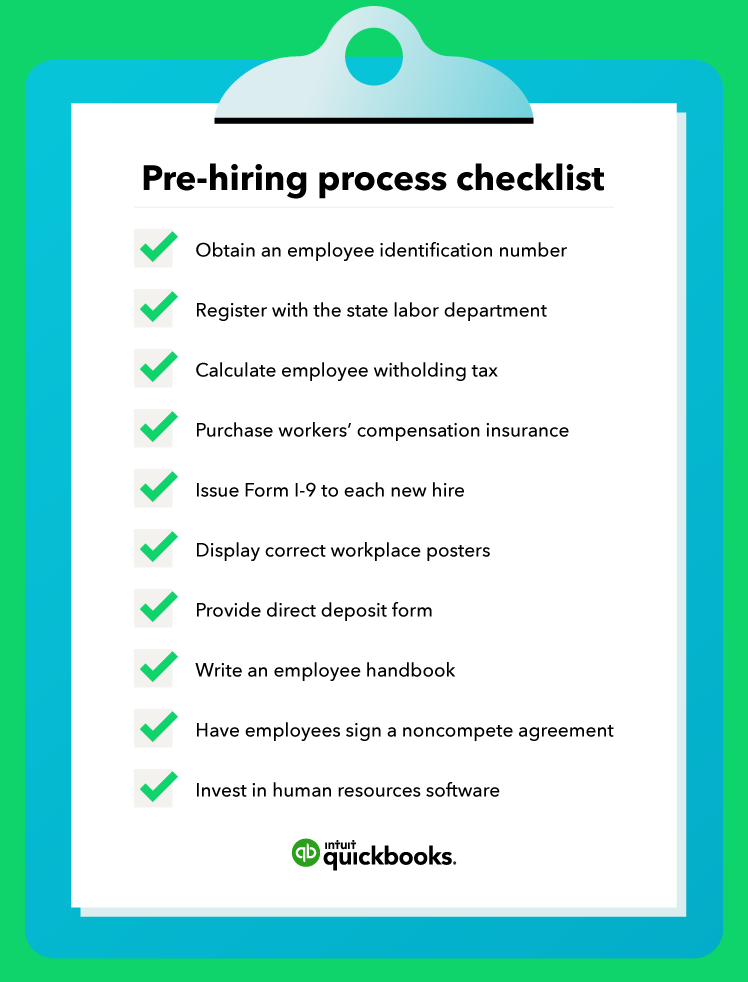
Pre-hiring process checklist

Required records

California employers must keep various records related to their employees, including:

  • Payroll records: Wage rates, hours worked, overtime, deductions, and payment dates.
  • Personnel files: Applications, resumes, performance reviews, disciplinary actions, and termination documents.
  • Form I-9
  • Itemized wage statements
  • Employee benefits data
  • Performance reviews and appraisals
  • Fair Labor Standards Act records
  • Workers compensation or injury records
  • Training records: Proof of completion of mandatory training programs, such as sexual harassment prevention and safety training.

Record retention periods

Different records have varying retention periods under California law, such as the following:

  • Personnel files: Personnel records must be retained for at least four years from the date of the latest applicable event, whether it be the date of creation, termination of employment, or non-hire of an applicant.
  • Payroll records: Payroll records must be kept for at least three years.
  • I-9 Form: Three years after the date of hire or one year after the date employment ends, whichever is later.

It's important to note that this is not an exhaustive list of recordkeeping requirements, and retention periods may vary depending on the specific document or situation. To ensure compliance, consult with an employment law attorney for guidance on specific record retention requirements.

Conduct periodic reviews and audits

Regularly reviewing and auditing your recordkeeping practices is crucial to ensure compliance and identify any areas for improvement. This can include internal audits, in which you conduct in-house reviews of your records to verify accuracy and completeness, or external audits, in which you hire a third-party auditor to assess your compliance with employment laws.

Create compliance checklists

Utilize compliance checklists to ensure you're meeting all legal requirements. These checklists can be tailored to your specific industry and company size and can include the following:

  • Appropriate job posting language
  • Legal interview questions and what questions to avoid
  • Background check procedures
  • Salary transparency requirements
  • Onboarding and training protocols

Support your business with QuickBooks
Ready to streamline your business processes from managing payroll to recordkeeping and beyond? QuickBooks offers support and solutions tailored to the needs of small businesses. Whether you're a single-member limited liability company or an established corporation, leverage our tools and resources to empower yourself with the knowledge you need to grow your business.

Disclaimer:

This content is for information purposes only and information provided should not be considered legal, accounting or tax advice or a substitute for obtaining such advice specific to your business. Additional information and exceptions may apply. Applicable laws may vary by state or locality. No assurance is given that the information is comprehensive in its coverage or that it is suitable in dealing with a customer’s particular situation. Intuit Inc. does not have any responsibility for updating or revising any information presented herein. Accordingly, the information provided should not be relied upon as a substitute for independent research. Intuit Inc. cannot warrant that the material contained herein will continue to be accurate, nor that it is completely free of errors when published. Readers should verify statements before relying on them.


Recommended for you

Mail icon
Get the latest to your inbox
No Thanks

Get the latest to your inbox

Relevant resources to help start, run, and grow your business.

By clicking “Submit,” you agree to permit Intuit to contact you regarding QuickBooks and have read and acknowledge our Privacy Statement.

Thanks for subscribing.

Fresh business resources are headed your way!

Looking for something else?

QuickBooks

From big jobs to small tasks, we've got your business covered.

Firm of the Future

Topical articles and news from top pros and Intuit product experts.

QuickBooks Support

Get help with QuickBooks. Find articles, video tutorials, and more.


