QuickBooks Blog
A woman trying out small business advertising ideas
Growing a business

27 highly effective small business advertising ideas to skyrocket your brand


Key takeaways from this article:

  • Learn about emerging advertising trends for small businesses in 2026
  • Discover free advertising strategies you can implement now
  • Find 27 specific small business advertising ideas
  • Get tips for saving money on ads when you're on a tight budget


It can be overwhelming to decide where to put your time—and possibly your money—for advertising your small business. Knowing your options is a strong place to start.

The 27 ideas in this article represent some of the most popular longstanding and trending advertising options—including many that are free or low-cost. And they come at a pivotal time for business owners.

The 2025 holiday season is proving critical to small businesses, with a massive 93% saying holiday sales are vital to their success, the 2025 Holiday Shopping Report from Intuit QuickBooks found. One way that 40% of small businesses are trying to entice shoppers is through heavier advertising or social media outreach, the report found. Three in four small business owners verified that social media is effective for marketing—the most effective advertising channel across those surveyed in the 2025 Small Business Advertising Trends Report by Intuit SMB MediaLabs.

The good news is that there are many free and low-cost advertising strategies to spread the word about your offerings. Whether you’re a well-established small business with a solid budget or a solopreneur looking for budget-friendly ways to market your brand, these 27 small business advertising ideas can help increase your revenue.


What is small business advertising?

Small business advertising is creating and delivering messages to promote your products or services. Essentially, it’s how you create awareness and encourage sales.


What are emerging advertising trends for small businesses in 2026?

Technological advances for 2026 are driving best practices for small business advertising. Try integrating these emerging trends to stay on the cutting edge.

Artificial intelligence

Artificial intelligence (AI) continues to be a significant game-changer across industries, and it's no different for small business advertising. Many online advertising platforms offer AI-based audience targeting that can help you use your marketing dollars more efficiently. Generative AI (GenAI) can help you create copy and designs for ads. (Try leveraging these three GenAI prompts for small business owners this holiday season.) A full 92% of small businesses plan to maintain or increase their ad budgets in 2025—largely backed by growing confidence in their ability to target the right audiences and measure the return on investment (ROI), according to Intuit's 2025 Small Business Advertising Trends Report.

Short-form video

Short-form video is becoming a go-to format for ad creation across platforms. Younger and newer small businesses especially value video advertising; those founded in the last five years with revenues over $2.5 million are seven times more likely to use video ads than older, smaller businesses, Intuit's advertising trends report found. But bite-sized, mobile-first videos (like reels, TikToks, and YouTube Shorts) give even small brands a way to build brand personality and engage users with lower production costs.

Social commerce

Within the realm of social media advertising, social commerce continues to emerge as a powerful channel for sales. Integrated shopping features on platforms like Instagram and TikTok let small businesses transform social ads directly into sales without asking customers to leave their social media apps.

What are free advertising ideas for small businesses?

The 27 advertising ideas covered in this article are low-cost and even free, though they require that you invest time in creating assets or setting up the marketing strategy. Use the jump links to navigate directly to the options that don't require direct costs:

  • Tap into the power of email lists
  • Create content for:
  • YouTube
  • Facebook
  • Instagram
  • LinkedIn
  • TikTok
  • Share user-generated content
  • Set up Google My Business
  • Harness online review platforms
  • Connect with your local chamber of commerce and visitors bureau

What are online and social media advertising ideas for small businesses?

1. Set up pay-per-click (PPC) campaigns in Google Ads

Pay-per-click (PPC) advertising is a digital advertising approach where you pay a fee when a customer clicks on your ad. Google Ads is by far one of the most popular PPC advertising platforms. Some social media platforms also provide popular PPC advertising options.

In a pay-per-click ad campaign, you can select keywords and create ads that are relevant to your target customers. The cost per click is determined by the keywords or audience categories you bid on, and you only pay when someone clicks on your ad. Many small business owners like that PPC ads are easy to measure and a relatively affordable way to stretch their budget further.


Money-saving solopreneur tip

When you’re getting started, it’s best to select ad keywords that are a little less popular; the price will be higher the more popular a keyword or audience is. Identify targeted keywords that are highly relevant to your niche and still target the right audience without breaking the bank.


2. Increase brand visibility with banner and display ads

Banner and display ads are some of the most common forms of online advertising. They're static or animated visuals promoting a product or service, and they're meant to drive immediate sales. Banner and display ads run at the top and sides of most media and publication websites as well as many blogs. You generally pay based on the number of impressions or clicks your ad has gotten.

For effective small business advertising, identify websites that are highly targeted to your customers, such as local news media websites to capture local customers. Alternatively, you can buy display ads on an ad network, like the Google Display Network, which spreads your message across a collection of websites. An ad network saves the effort of contracting with individual websites for placements.


3. Tap into the power of email lists

Creating an email list to send newsletters, updates like product or service launches, and promotions lets you connect with existing and potential customers on your own terms. Email marketing creates brand awareness, connection points, and opportunities for repeat sales. Because email subscribers have opted in to communications, they tend to provide a high return on the invested time. Services like Mailchimp make it easy to maintain email lists, build and design emails with AI, and increase engagement through personalization.

Small businesses can also grow through sponsoring other people’s newsletters, which allows you to reach highly targeted audiences. Independent newsletters, podcast hosts, and community email lists often offer affordable sponsorship slots that put your brand in front of engaged readers.


4. Create content for YouTube

With 6 billion visits in September 2025, YouTube is the second-most visited website in the world, according to Semrush. As a Google-owned company, YouTube's search function is powerful, and its videos are increasingly showing up in Google search results—creating an even larger opportunity for visibility. (Google is the top-most visited website in the U.S., with nearly 24 billion visits in September 2025.)

You can promote your business on YouTube by creating organic video content. Your videos should include keywords in the audio, captioning, and description that speak to your audience, location, and business type. You can also pay for ads that play during others' videos or that appear elsewhere on the site. Target customers via keywords or specific demographics, interests, and topics.


5. Find your customers with Facebook content

With billions of daily users, Meta’s Facebook is a great platform if you’re looking to reach a large audience, particularly of millennials and older generations. By creating a Facebook business page, you can create native posts or start running advertising campaigns across the platform.

Facebook ads can be tailored to your specific campaign goals and budget. Start an ad campaign by selecting your objective, such as getting more messages, promoting your business page, or attracting more website visitors. You can also set a daily budget starting at $1 and determine how long you want your ad to run. Your budget determines how many people the ad can reach. 


6. Post photos, graphics, and videos on Instagram

Instagram is a social media platform that leverages photos, graphics, and videos. Its users are largely millennials and Gen Z, so it's a good place to advertise to younger generations. Post organically for free, or set up a business page to use Meta's platform to boost posts or buy ads.

Running ad campaigns on Instagram can help you reach your target audience by setting up ads based on location, interests, and behaviors. The setup process is nearly identical to Facebook; both platforms use Ads Manager via Meta for Business. Instagram Shop offers a route to direct social commerce sales for app users.


Money-saving solopreneur tip

Turn already-published posts into Instagram ads with the boost feature. This is an easy and cost-effective way to get your content in front of more people without making separate ad content.


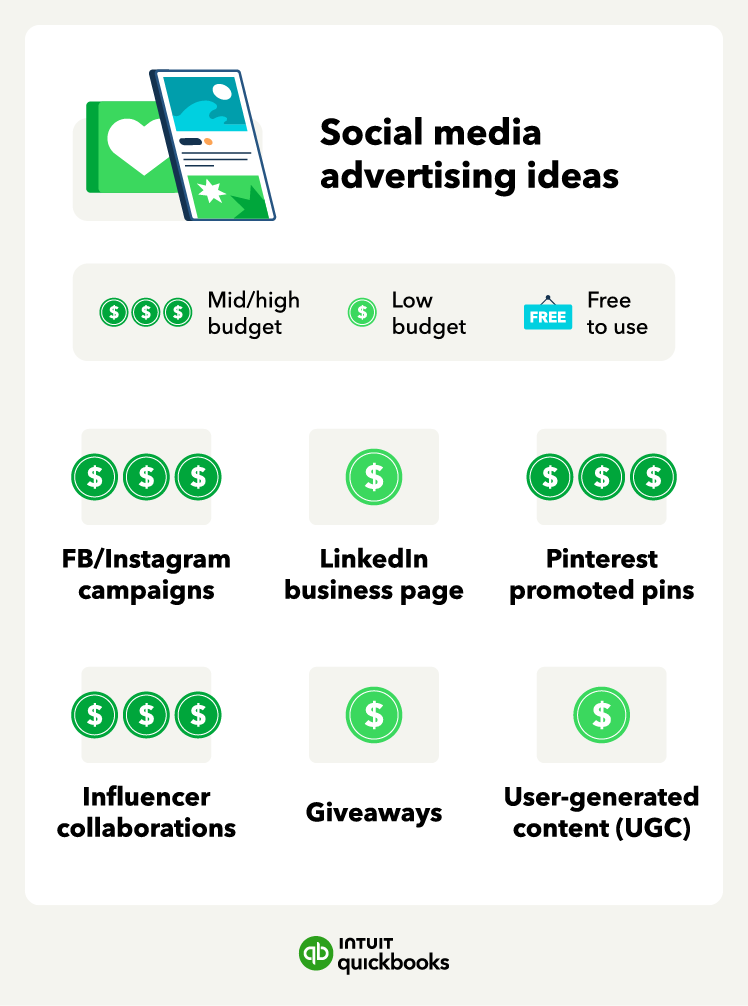
List of pricing for small business advertising on social media

7. Target businesses and business professionals on LinkedIn

If your target customers include other businesses or business professionals, create a free business page and post content on LinkedIn. According to LinkedIn, the platform has over 1 billion users worldwide, giving you broad reach.

Once you have a business page, you can advertise through sponsored content posts, direct messaging, and lead generation forms. You can also promote content posts you’ve already created and tailor them to target specific industries or users—enticing the right audience to return to your page.

Simplify workflows with everything in one place

Essential business tools work seamlessly together on one platform, saving you time across your most critical jobs.

8. Publish bite-sized videos on TikTok

Advertising on TikTok gives small businesses access to a massive, highly engaged audience—especially younger consumers who prefer short, entertaining content. The platform’s algorithm makes it possible for even small accounts to reach large numbers of people if the content is relevant and compelling. The financial investment in ads is flexible: You can run campaigns for just a few dollars per day.

TikTok also rewards creativity over production value, meaning you don’t need expensive equipment or a big budget to create effective videos and ads. TikTok offers several ad formats depending on your goals as well as direct sales through in-app shopping tools.


9. Share user-generated content (UGC) 

What better way to advertise your brand than with the help of your existing customers? When customers put up posts, photos, or videos that include your products or business, they're creating user-generated content. This organically created content can be incredibly persuasive for other potential customers because users weren't incentivized to leave a positive review. When you come across great UGC, you can ask permission from the creator to share it on your platforms.

You can also ask customers to create social media content that reviews your products in exchange for free items. This can help build up your social media presence without significant content creation costs.


10. Collaborate with influencers 

Influencer marketing continues to be a powerful advertising strategy for small businesses looking to increase brand awareness and expand their reach. Collaborating with influencers—content creators with a platform, a niche, and a dedicated audience—can be a route to bringing in new customers. 

Influencers are known for creating relatable content, which makes your ad more appealing to potential customers. Because they’ve built trust with their audience, influencers’ followers are more likely to buy products they recommend. Partner with influencers who are relevant to your industry and whose values align with your brand.

How much you pay an influencer can vary widely; some are happy with free products while others can charge hundreds or thousands of dollars to collaborate.


11. Set up Google My Business 

It’s important to have a local presence on Google, even if you don’t plan to buy paid search ads. You can create a free profile on Google My Business, which lets your business show up in Google search results and Google Maps. For example, let’s say you own an auto repair shop. If a local were to search "auto repair shop near me" on Google, your business would pop up because you have a Google My Business profile.  

Your profile can include essential business information like your hours of operation, website, phone number, and address. You can also customize your profile by adding photos of your space, products, and logo. 

Customers can also post reviews, book appointments, make reservations, or request a quote through your profile. This free business advertising option is an easy way to boost your business and build your reputation.

AI and Experts: Working for You.

AI agents automate bookkeeping, payroll, bill pay, and sales tax—working with your experts or accountant saving hours each week.

12. Harness online review platforms

Platforms like Yelp, OpenTable, Tripadvisor, Google, Facebook, and LinkedIn are useful for generating online reviews from customers. Setting up a business profile with complete information and photos on review sites relevant to your niche lets you promote your business to potential customers. Asking customers to leave you reviews of their experience builds trust among potential customers considering coming to your business.

If your budget allows, paid advertising on review platforms can get your business profile in front of new customers by moving your profile to the top of search results. Test out boosting your profile with a small budget first before investing more dollars.


Money-saving solopreneur tip

Yelp and other review platforms often encourage small businesses to sign up by awarding ad credits, so it’s worth checking for any incentives before running your first campaign.


13. Host giveaways 

Online contests or giveaways can connect your business with its online community and get people talking about your products. After all, who doesn’t love free stuff?

Giveaways attract the attention of potential customers and encourage them to engage with your brand. Your brand gains increased visibility and exposure as each person enters the giveaway and tags friends to enter as well. Online giveaways can be a cost-effective way to generate buzz around new products while reaching a wider audience. Be sure to check local laws regulating contests before you launch your first giveaway.


14. Create a referral program

A referral program is a low-cost way for a small business to turn happy customers into an active advertising channel through word of mouth. The basics are straightforward: Offer an incentive—such as a discount or free product—when a customer refers someone to your business. Keep the rules simple, and make it easy to refer and collect rewards.

Creating a referral program leverages the power of personal recommendations. When current customers bring in new ones, your business gains warm leads who are more likely to buy and stay loyal.


15. Build an affiliate network 

In affiliate advertising, other individuals, businesses, or websites choose to promote your product on their platforms. Affiliates are essentially a bridge between you and your product or service. When an affiliate makes a sale through their personalized link, you pay them a percentage of those sales.

Similar to ad networks, you can explore affiliate networks to help spread your message. Bloggers and content creators are often members of affiliate networks because they can make passive income by including a link to your product on sharing platforms. This is a pretty cost-effective way to expand your reach and drive additional sales to your business..


16. Boost sponsored products on e-commerce marketplaces 

If you’re selling products on e-commerce platforms, like Etsy or Amazon, creating sponsored ads can help your products stand out in the search results. Since these platforms have so many sellers, the native search results are highly competitive; boosting your product can get it visibility it wouldn't have otherwise. 

With sponsored ads, you can promote your product listings to a larger audience. Typically, these ads run on a cost-per-click (CPC) model, meaning you don’t pay unless someone clicks on your ad.

What are print and out-of-home advertising ideas for small businesses?


What is out-of-home advertising?

Out-of-home (OOH) advertising refers to any ads posted outdoors or in public spaces. It's advertising in the wild!


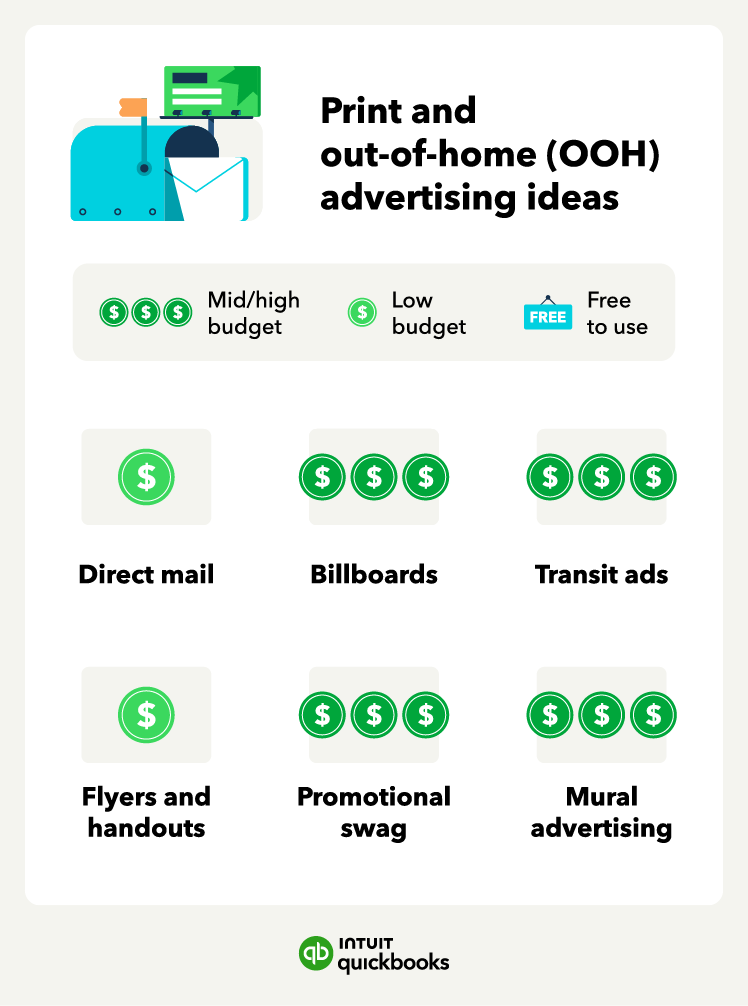
Image listing small business advertising pricing for print and OOH

17. Create promotional products 

Who doesn’t love swag? Creating promotional products like stickers, pens, reusable cups, hats, T-shirts, sweatshirts, and bags can be a form of advertising. If a person wins a T-shirt with your logo at a local event, they become a walking billboard for your business every time they wear it.

Distributing products with your business logo increases your brand’s visibility. You can create promotional products to hand out at community events, offer them as a freebie when a customer makes a purchase, or sell higher-value items at an affordable price in your store. 


18. Send direct mail

Direct mail campaigns let you send specific, targeted messages within a specific location. With this type of small business advertising campaign, you need to plan for copywriting, designing, printing, mailing list development, and postage.

The cost of sending mailers can vary depending on your distribution goals. You can save on costs by creating the message and design yourself and using your own mailing list or targeting a ZIP code through USPS. Printing and mailing averages $320 for 500 postcards in 2025, per USPS.


19. Print flyers and handouts 

Distributing flyers and handouts is a tried-and-true advertising strategy to spread awareness about your product or service. It can be a cost-effective way to reach a wide range of people and break away from the deluge of online advertisements. 

You can save on costs by designing flyers yourself, making sure to focus on a simple, legible design that clearly conveys your message. You can create flyers to promote a store opening, a new product or service, or discounts for potential customers. Try distributing flyers at local events, local markets, school campuses, shopping centers, and sporting events.


Money-saving solopreneur tip

Flyers are typically cheaper when printing in bulk, so consider printing a large quantity to save on costs.


20. Invest in billboards 

Billboards are a form of out-of-home (OOH) advertising that are effective because they can be targeted to specific geographic regions where your customers are most likely to see them. They’re designed to capture the attention of those passing by and are useful for local businesses. Because of their size, billboards can get pricey.

Another option is to buy an electronic billboard ad placement, which can rotate or scroll your message. These can be indoors as well, like at airports, in sports facilities, or in malls.


21. Run transit ads 

Transit advertising can be a more affordable alternative to billboard advertising while helping to raise brand awareness in targeted areas. You can choose between different ad sizes and locations based on your budget and campaign objectives. 

Some common types of transit ads include exterior and interior bus ads, top-of-car taxi ads, and interior subway ads. Transit ads are versatile and allow you to reach a diverse audience.


22. Get creative with mural advertising 

Mural advertising is an artistic, creative approach to create brand awareness. Murals leverage your public spaces: They're usually painted on the sides of buildings or other outdoor areas. Mural advertisements include vibrant colors, images, and designs that capture the attention of those passing by. They might explicitly convey your message, or they might simply create an attraction that's connected to your business. 

Because these ads are so visually captivating, they increase the likelihood of people sharing on social media. This shareability can broaden your target reach and increase brand awareness.

What are local advertising ideas for small businesses?

23. Publish newspaper or classified ads

Although print circulation numbers have generally dwindled, newspaper and classified ads offer a hyper-targeted route to customers who might not be as engaged with online platforms. If you’re targeting a specific demographic, like baby boomers with an active interest in the community, newspapers might make strategic sense. 

Depending on your budget, you can buy local newspaper print ads, smaller classified ads, or online ads. Classified ads are a form of text-based advertisement that are organized into categories or classifieds, like "for sale," "jobs," and "businesses and services." Local newspapers often price ads by the space they take up and the complexity of the design.


Money-saving solopreneur tip

Many local newspapers offer free or low-cost classified ads on their websites, so do your research to find these options. You can also use free online classified sites, like Craigslist.


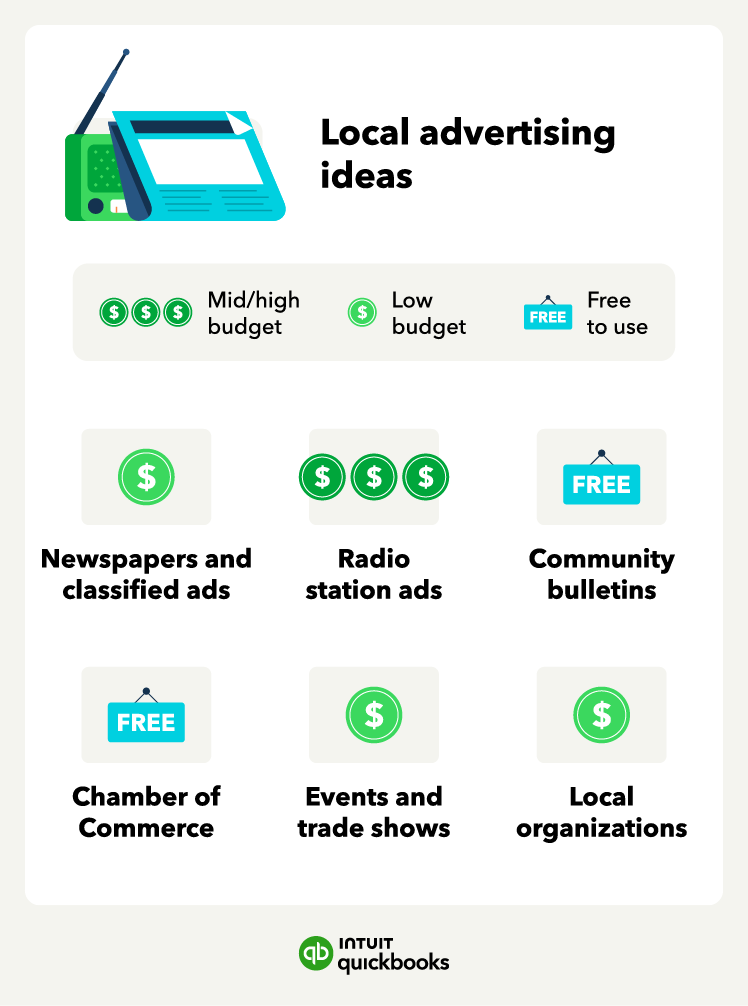
image listing local pricing for small business advertising ideas

24. Partner with local radio stations or podcasts

Radio and podcast advertisements are auditory gateways to your target customers. Your goal with both radio and podcasts is to write a catchy ad to get maximum impact from listening ears. These types of ads excel at creating brand awareness and engagement.

Ads are often 15, 30, or 60 seconds long; the length is one factor that determines how much you pay. The radio station or podcast's popularity, audience size, and ad timing also determine pricing. You might pay a premium to have the radio or podcast host specifically recognize your business. Consider running local radio ads for a short time as a way to raise awareness, like ahead of a store opening or when offering holiday discounts.


25. Collaborate with local events and businesses

Local events like trade shows, farmers’ markets, parades, concerts, fundraisers, street fairs, and business expos offer a great opportunity to connect with your community and promote your business. For example, you can sponsor a float at a local holiday parade, pay for an ad spot in a fundraising flyer, or sell your products directly to consumers at your local farmers market.

Engaging in local events can help you strengthen your connections within your community. You might meet business owners with complementary businesses, offering an opportunity to collaborate, snag sponsor spots in their email newsletters, or advertise in printed newsletters or at events they host. Find an organization with a very targeted membership, event attendance, or email subscriber base. 


26. Post on community bulletin boards

If you’re a solopreneur looking for a free and easy way to advertise your small business, start by posting flyers or business cards on community bulletin boards. You can find these boards at local libraries, churches, community centers, restaurants, gyms, yoga studios, grocery stores, coffee shops, coworking spaces, and shopping centers. Be strategic about where you post; it might not be worth your time to advertise your cupcake shop on gym bulletin boards, for example.

Local bulletin boards are most beneficial for those looking to advertise specific products, services, or in-person events that could benefit the community. Consider offering some sort of incentive like a discount or freebie to entice potential customers to engage with your business.


27. Connect with your local chamber of commerce and visitors bureau

Local chambers of commerce and visitors bureaus offer strong opportunities for small businesses to promote their products or services within a specific area. They often maintain online business directories and have newsletters or other publications with advertising space.

Every chamber of commerce is different, but you can usually advertise for free or for a small fee as a member. Many chambers of commerce also host networking events and participate in community gatherings, which can help you gain local exposure. Visitors bureaus may offer advertising space in publications, directories of businesses, and event calendars for tourists seeking local experiences.

You're never too small to feel more stable

With market-leading APY, no monthly fees, and seamless payments—QuickBooks Money works harder for those who work for themselves.**

What's the difference between advertising and marketing?

The terms advertising and marketing can often be mistaken for one another, but advertising falls within marketing. In short, advertising is a part of an overall marketing strategy.

Small business marketing encompasses the strategy of promoting a product or service, including product development, branding, content marketing, and advertising. It involves understanding your target audience’s needs, creating a product that’s tailored to them, and promoting it effectively.

Marketing consists of the four P's:

  • Product: The products or services your business offers to meet the needs of your target customers.
  • Price: The amount of money you are charging for the products or services you offer.
  • Promotion: The ways you plan to communicate and promote your products to your target customers—like advertising.
  • Place: The location where your target customers go to purchase your product and the different distribution channels you can utilize to reach them.

Grow your business with confidence 

Whether you want to attract new customers or encourage repeat sales, developing a few intentional advertising strategies is essential. With so many small business advertising ideas to choose from, you can create effective ads that attract the right customers at the right time. 

When running a business as a solopreneur, you can start with low-budget advertising strategies. As your business grows, you can adjust your advertising spend to work for your business. 

Ready to invest in your advertising strategy? Small business accounting software like QuickBooks can help you track and manage your advertising spending and small business expenses all in one place.

Move, manage, and grow your money

No matter what stage your business is in, QuickBooks can help you manage your business finances.

Intuit is a technology company, not a bank. Banking services provided by our partner, Green Dot Bank, Member FDIC.

**Product Information:

QuickBooks Money: QuickBooks Money is a standalone Intuit offering that includes QuickBooks Payments and QuickBooks Checking. Intuit accounts are subject to eligibility criteria, credit, and application approval. Banking services provided by and the QuickBooks Visa® Debit Card is issued by Green Dot Bank, Member FDIC, pursuant to license from Visa U.S.A., Inc. Visa is a registered trademark of Visa International Service Association. QuickBooks Checking Deposit Account Agreement applies. Banking services and debit card opening are subject to identity verification and approval by Green Dot Bank. Money movement services are provided by Intuit Payments Inc., licensed as a Money Transmitter by the New York State Department of Financial Services. For more information about Intuit Payments' money transmission licenses, please visit https://www.intuit.com/legal/licenses/payment-licenses/. No subscription cost or monthly fees. Other fees and limits, including transaction-based fees, apply.

Industry-leading Annual Percentage Yield (APY): Competitive rate information based on publicly available data for small business checking accounts provided by the largest national and online banks as of September 18, 2023. APYs are subject to change at any time.


Recommended for you

Mail icon
Get the latest to your inbox
No Thanks

Get the latest to your inbox

Relevant resources to help start, run, and grow your business.

By clicking “Submit,” you agree to permit Intuit to contact you regarding QuickBooks and have read and acknowledge our Privacy Statement.

Thanks for subscribing.

Fresh business resources are headed your way!

Looking for something else?

QuickBooks

From big jobs to small tasks, we've got your business covered.

Firm of the Future

Topical articles and news from top pros and Intuit product experts.

QuickBooks Support

Get help with QuickBooks. Find articles, video tutorials, and more.