BLACK FRIDAY SALE  
70% OFF 
QuickBooks
for 3 months  Ends 11/30
QuickBooks Blog
A person sitting at a desk with a laptop computer.
Minnesota

Minnesota small business taxes: Types, rates, deadlines, and how to file in 2025

Minnesota offers a wealth of advantages for businesses, even if it may not have the lowest corporate tax rates. The Tax Foundation's 2024 State Business Tax Climate Index shows that Minnesota's corporate tax rate is currently 9.8%. However, the state's thriving economy, supportive business environment, and access to a skilled workforce can more than offset this cost. You'll find dozens of competitive entrepreneurial activities throughout Minnesota that can help your business flourish.

Whether you’re starting your first business or are a seasoned entrepreneur, understanding Minnesota business taxes is essential for success. Our guide simplifies the process, breaking down key tax types, including franchise, sales, and payroll taxes. We’ll also cover exemptions, credits, and incentives to help you optimize your tax strategy and keep more money in your business's pocket.

Refer to the table of contents below to quickly find the information that matters most to you:

Taxes in Minnesota overview

  • The state sales tax rate in Minnesota is 6.875%.
  • The corporate tax rate is a flat rate 9.8%.
  • Other business taxes may include unemployment taxes, excise taxes, and property taxes.

Key Minnesota business tax adjustments for 2024

Staying informed about the latest tax changes is essential for businesses to maintain compliance, optimize their tax strategies, and plan ahead. Here are some important adjustments and updates for 2024 that could impact your business:

Corporate Franchise Tax – Net Operating Loss Limit

Effective April 8, 2024, the 70% Net Operating Loss (NOL) deduction limitation applies retroactively. Businesses that filed 2023 returns before this change may need to amend their returns to claim additional NOL deductions.

Moist Snuff Tobacco tax update

Starting July 1, 2024, the definition of "moist snuff" has expanded to include nicotine-containing, tobacco-free products. These products will be taxed under Minnesota’s Tobacco Tax, just like traditional moist snuff.

Minnesota state income taxes

Minnesota income taxes are a key part of the financial responsibilities for individuals and businesses. With a progressive personal income tax system and specific business tax requirements, understanding the details is essential for staying compliant and maximizing potential savings.

Does Minnesota have a state income tax?

Yes, Minnesota currently has a state income tax with rates ranging between 5.35% and 9.85%, depending on your taxable income bracket. In addition to traditional state income tax, the state also imposes various property, sales, and payroll taxes on business owners, depending on your business model and tax structure.

Image Alt Text

Types of business taxes in Minnesota

As a Minnesota employer, you may be responsible for reporting and paying other business taxes in addition to withholding payroll taxes from your employees' paychecks. From federal to state and local levels, understanding the different tax programs and their impact on your business’s finances is important.

Federal taxes

You'll be responsible for federal taxes in whatever state you open a business in. Unfortunately, there are dozens of federal tax forms with unique due dates and requirements. Using an accountant or small business accounting software can be helpful in avoiding mistakes that can lead to overpayment or penalties. 

As a business owner, you have both personal and business tax filing obligations. Here’s what you need to know:

Personal tax filing

Federal income tax returns:

Every individual is required to file and pay federal personal income tax. This forms the foundation of your overall tax responsibility.

Business tax filing

Business owners have additional filing requirements, depending on the business structure:

  • Sole proprietorship: Income and expenses are reported on your personal tax return using Schedule C (Form 1040).
  • Partnership: A partnership must file an information return (Form 1065) to report income, deductions, and other relevant details, while each partner reports their share of income on their personal return.
  • Corporation: A corporation files a corporate tax return (Form 1120), paying taxes on its profits.
  • S Corporation: An S corporation files an informational return (Form 1120S). Its income, losses, and deductions pass through to shareholders, who report them on their personal returns.
  • Limited Liability Companies (LLCs): LLCs are not classified separately for federal tax purposes and are taxed based on their ownership structure. Single-member LLCs default to sole proprietorship taxation or may elect corporate taxation, while multi-member LLCs default to partnership taxation or may elect corporate taxation.

Self-employment tax

If you work for yourself and earn more than $400 a year, you pay toward Social Security and Medicare programs through a self-employment tax. The Social Security system provides retirement benefits, disability benefits, survivor benefits, and hospital insurance (Medicare) benefits.

Employment taxes

As an employer, you are responsible for withholding and depositing federal income tax and the employee contribution to Social Security and Medicare taxes. You must also pay the employer portion of Medicare and Social Security and pay federal unemployment tax (FUTA). 

State taxes

As a business owner, understanding your state tax obligations is an integral part of running your organization.

Minnesota corporate franchise tax

In Minnesota, corporations pay a franchise tax based on their net income. 

What is the franchise tax rate?

The tax rate for 2024 is a flat 9.8%, regardless of the corporation's income level. This applies to both domestic corporations (incorporated in Minnesota) and foreign corporations (incorporated elsewhere but doing business in Minnesota). Corporations must file an annual franchise tax return, even if they have no tax liability.

It's important to note that the term "franchise tax" can sometimes be used generally to refer to taxes levied on businesses for the privilege of operating within a state. However, in Minnesota, corporate franchise tax and corporate income tax are often used interchangeably and essentially refer to the same tax. For more detailed information and filing instructions, refer to the Minnesota Department of Revenue website.

How is the corporate franchise tax calculated?

Minnesota calculates the portion of a corporation's income that is subject to the state's franchise tax by using a single-sales factor apportionment formula. This considers only the percentage of the business’s total sales made to customers located in Minnesota. Using this method ensures that the tax reflects the corporation's economic activity within the state, without considering property or payroll factors that some states include in their formulas.

For example:

  • If a corporation has total sales of $10 million, with $2 million in sales to Minnesota customers, 20% of the corporation's net income would be apportioned to Minnesota and taxed at the 9.8% rate. This ensures the tax reflects only the corporation’s economic activity within Minnesota.

Who may be liable for the franchise tax in Minnesota?

In Minnesota, a company is subject to franchise tax if it has "nexus" with the state, which includes:

  • Domestic corporations: Corporations incorporated in Minnesota.
  • Foreign corporations: Corporations doing business, employing capital, owning or leasing property, maintaining an office, or deriving receipts from activity in Minnesota.
  • Economic nexus: For tax years beginning on or after January 1, 2024, corporations with $1 million or more in receipts from Minnesota sources.
  • Unitary businesses: Corporations that are part of a unitary business with Minnesota nexus, even if they don't have nexus individually. This applies to corporations with at least $10,000 in Minnesota receipts if they are part of a unitary group that, in aggregate, derives receipts of $1 million or more from Minnesota sources.
  • Partnerships: Foreign corporations that are general partners in partnerships doing business in Minnesota.

Certain entities, such as insurance companies, S corporations, and some types of partnerships, are generally not subject to the corporate franchise tax but may have other tax obligations in Minnesota.

For detailed information, refer to the Minnesota Department of Revenue's Corporation Franchise Tax page.

Minimum fee

While pass-through entities like "S" corporations, partnerships, and LLCs are exempt from the corporate franchise tax, they—and "C" corporations—are subject to a minimum fee if their Minnesota property, payroll, and sales exceed $1,220,000. This fee ranges from $250 to $12,200, depending on the total, and applies even if the entity has no taxable income or corporate franchise tax liability.

Excise taxes

Excise taxes are special taxes imposed on specific goods or services. In Minnesota, these taxes apply to a wide range of products and activities, including:

  • Alcoholic beverages: Different types of alcoholic beverages are taxed at varying rates. For instance, distilled spirits are subject to an excise tax of $5.03 per gallon.
  • Tobacco products: Cigarettes, cigars, and other tobacco products incur excise taxes based on quantity or weight. As of 2024, the tax rate for a pack of 20 cigarettes is $3.04. The rate for premium cigars is 95% of the wholesale sales price or $0.50 per cigar, whichever is less.
  • Motor fuel: Minnesota imposes a motor fuels excise tax on gasoline and diesel fuels. The tax rate is $0.318 per gallon, which includes a $0.02 per gallon cleanup fee and a $0.001 per gallon inspection fee.
  • Vehicles: A $20 excise tax is applied to motor vehicle sales in certain cities or counties. Retailers selling new or used vehicles are required to collect and remit this tax. It must be reported on the retailer's Sales and Use Tax return.

Unemployment tax

Minnesota employers are required to pay state unemployment (UI) taxes, which are used to provide temporary benefits to eligible unemployed workers. For 2024, the taxable wage base is $42,000, meaning employers pay UI taxes on each employee's wages up to this amount. The tax rate comprises a base rate of 0.1% and an experience rating that can be as high as 8.9%, depending on the employer's history with unemployment claims. New employers are assigned rates based on their industry classification.

Local taxes

Minnesota business owners should remain aware of how local tax rates can impact their operations. These special local taxes often focused on specific sectors like lodging and large-scale public projects, impacting both residents and businesses.

For example, effective April 1, 2024, Plymouth implemented a 3% lodging tax, while Ortonville introduced the same rate starting October 1, 2023. These taxes apply to hotel rentals and other short-term lodging accommodations within these cities. Metro Area Sales and Use Taxes include a 0.25% rate dedicated to funding housing projects and statewide rent assistance along with a separate 0.75% rate for supporting transportation initiatives.

Sales and use taxes 

The state imposes a sales tax rate of 6.875% on most taxable goods and services. In addition to this state rate, local taxing jurisdictions—including cities, counties, special purpose districts, and transit authorities—may levy an additional sales and use taxes. The City of St. Paul, for instance, implemented a 1.5% sales tax rate as of April 1, 2024. Many smaller towns across Minnesota impose a general sales tax of 0.5%.

Remote seller tax considerations

In Minnesota, remote sellers—businesses without a physical presence in the state—are required to collect and remit Minnesota sales tax if they have an economic nexus in the state. Specifically, a business must register for a Minnesota Tax ID Number and begin collecting sales tax if, over a 12-month period, a remote seller either:

  • Makes 200 or more retail sales shipped to Minnesota
  • Or has more than $100,000 in retail sales shipped to Minnesota

Remote sellers meeting these thresholds should register and start collecting Minnesota sales tax by the first day of a calendar month no later than 60 days after exceeding the threshold. For detailed information, refer to the Minnesota Department of Revenue's Sales Tax FAQs for Remote Sellers.

Property taxes

Minnesota property taxes attach to real estate and are set by the state's local governments. These taxes fund services like education, public safety, and infrastructure. Taxation rates vary by county and city, and they're determined by the area's budgetary needs. Property valuations conducted annually establish tax amounts payable.


Minnesota business tax deductions, credits, and exemptions

Minnesota offers a range of business tax deductions, credits, and exemptions aimed at reducing taxable income and incentivizing specific economic activities. These state-level incentives can significantly lower a business's overall tax burden.

  • The Minnesota Film Production Tax Credit. Minnesota offers a 25% transferable tax credit for film productions spending $1 million or more on eligible costs within 12 months. Credits are awarded first-come, first-served until funding is depleted.
  • SEED Capital Investment Credit Program. The SEED Capital Investment Program offers a 45% tax credit (up to $112,500 annually) to investors supporting innovative businesses in Minnesota's border cities: Breckenridge, Dilworth, East Grand Forks, Moorhead, and Ortonville. This non-refundable credit can be carried forward for up to four years.
  • Greater MN Job Expansion Program. Qualified Greater Minnesota businesses may receive seven years of sales tax refunds by meeting job growth targets through the Job Expansion Program.
  • Beginning Farmer Tax Credit. This program provides state tax credits to landlords and sellers who rent or sell farmland, equipment, livestock, and other agricultural assets to beginning farmers.

Credit and exemptions for Minnesota sales tax

In Minnesota, certain businesses and activities qualify for sales tax exemptions or credits, offering significant savings on purchases directly tied to their operations.

Nonprofit organizations

Certain nonprofit organizations may qualify for sales tax exemptions on purchases used in their exempt functions. Eligibility and application procedures are detailed in the Minnesota Department of Revenue's Sales Tax Fact Sheets and Industry Guides.

Capital equipment exemption

Minnesota provides a sales tax exemption on capital equipment used to produce goods for retail sale, transmit data electronically to retail customers, or generate electricity or steam for retail sale.

Types of Minnesota taxes for different business entity types

It’s important to understand the implications of your business structure on your tax liability. Different types of business entities in Minnesota may be subject to different taxes. If you haven’t set up your business yet and are considering options for structuring it, knowing the tax rules can help you make a decision. 

Of course, all types of businesses will need to pay federal personal or corporate income tax, depending on their structure, plus unemployment insurance and any sales and use, property, or excise taxes that apply to their specific business.

Minnesota sales taxes

In Minnesota, a 6.875% state sales and use tax applies to most retail sales of goods and certain services. Keep in mind that many cities and counties impose local sales taxes, which vary by jurisdiction.

The types of services that are generally taxable are:

  • Telecommunications and pay television services
  • Laundry and dry-cleaning services
  • Building cleaning and maintenance services
  • Lodging and associated services
  • Pet grooming, boarding, and care services
  • Admission to amusement venues, recreational areas, and sports events
  • Security, detective, fire alarm, and armored transport services
  • Nonresidential parking services
  • Rental or use of amusement equipment (e.g., bowling lanes, arcade games, pool tables)
  • Carpet, drapery, and upholstery cleaning
  • Lawn care, gardening, and tree or shrub maintenance services
  • Motor vehicle services, including towing, washing, waxing, rustproofing, and cleaning

Visit the Minnesota Department of Revenue website for more information on taxable services in the state. 

Do you need a sales tax permit?

Yes, you need a sales tax permit in Minnesota. Before making any taxable sales, you must register for a Minnesota Tax ID Number and a Sales and Use Tax account. Apply for a Minnesota Tax ID Number online or call 651-282-5225 or 1-800-657-3605 (toll-free). 

You'll need details such as your expected filing schedule, accounting method, and applicable local taxes. Once registered, you are responsible for collecting and remitting sales tax to the state, with penalties and interest for noncompliance.

How to file business taxes in Minnesota

A note is placed on a paper on top of a table.

To file business taxes in Minnesota, first determine your business structure and complete the appropriate federal tax forms. At the state level, register for a Minnesota Tax ID Number and the necessary tax accounts, such as Sales and Use Tax and Withholding Tax, through the Minnesota Department of Revenue.

When are business taxes due in Minnesota?

Deadlines often align with federal tax dates, and both federal and state taxes can be filed electronically for convenience. Maintain detailed financial records to ensure compliance. For specific forms and guidance, visit the IRS and Minnesota Department of Revenue websites.

Corporate income tax

Annual returns: Due on or before the 15th day of the fourth month following the close of the taxable year. For calendar-year taxpayers, this means a due date of April 15, 2025.

Other business structures

Tax returns for S corporations and partnerships are due on March 15, 2025.

Estimated taxes

In Minnesota, business owners must make quarterly estimated state tax payments if they anticipate owing $500 or more in state income tax after accounting for withholding and refundable credits. To avoid penalties, your combined estimated payments, withholding, and refundable credits must meet one of the following criteria:

  • 90% of your current year's tax liability
  • 100% of your prior year's tax liability

Federal estimated tax payments

Business owners may also need to pay estimated federal taxes if they expect to owe at least $1,000 in federal taxes for the year after subtracting withholding and refundable credits. Corporations typically have to make estimated tax payments if they expect to owe tax of $500 or more when their return is filed.

This typically applies to self-employed individuals, sole proprietors, partners, and S corporation shareholders who receive income that is not subject to withholding.

Due dates for estimated taxes for businesses

For 2025, the due dates for both federal and Minnesota estimated tax payments are:

  1. 1st Quarter Payment: Due on April 15 (for income earned January 1 - March 31).
  2. 2nd Quarter Payment: Due on June 16 (for income earned April 1 - May 31).
  3. 3rd Quarter Payment: Due on September 15 (for income earned June 1 - August 31).
  4. 4th Quarter Payment: Due on January 15 of the following year (for income earned September 1 - December 31).

If any due date falls on a weekend or holiday, the payment is due the next business day.

These payments can be made electronically through the IRS website for federal taxes and e-Services for state taxes.

It's essential for businesses to stay informed about these deadlines to ensure compliance and avoid potential penalties.

Year-end business tax checklist

Stress less during tax season. Use this small business tax checklist to ensure you have everything you need to stay organized throughout the year and file your taxes accurately and on time:

Year-round business tax preparation

  • Maintain accurate records: Keep detailed records of all income and expenses throughout the year.
  • Categorize expenses: Organize your expenses into relevant categories for easier tax preparation.
  • Reconcile bank accounts: Regularly reconcile your bank accounts to ensure accuracy and identify any discrepancies.
  • Track mileage: If you use your vehicle for business purposes, keep a detailed mileage log.
  • Stay informed: Keep up-to-date on federal and state tax laws and regulations that might affect your business.

Pre-filing checklist

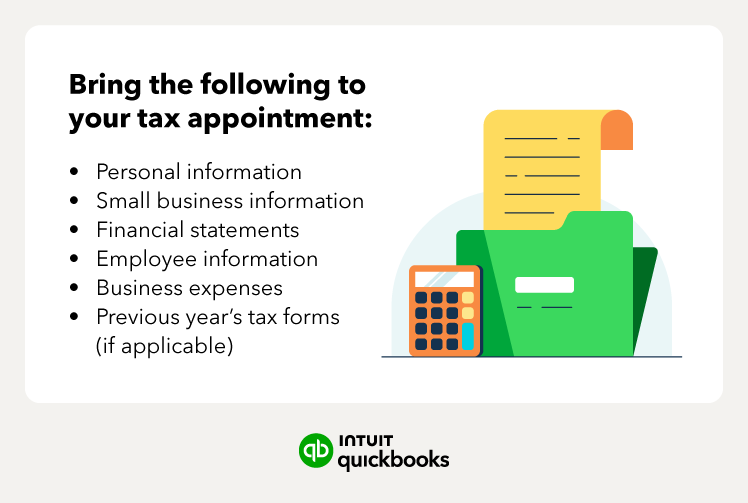
  • Gather necessary forms and documents:
  • Previous year's tax returns (up to three years prior for both state and federal)
  • Accounting journals and ledgers
  • Balance sheet and income statement
  • Transactional supporting documents (bank deposit slips, bank statements, invoices, checkbook, credit card statements)
  • Vehicle and mileage logs
  • Expense receipts
  • Employee tax forms (W-9, I-9, W-2, 1099)
  • Non-employee tax forms (1099-MISC)
  • State tax forms
  • List of home office deductions (if applicable)
  • Understand which tax forms to file: Determine the specific tax forms required for your business structure and tax obligations.
  • Review and verify information: Double-check all information for accuracy before filing.
  • Consider estimated taxes: If required, calculate and pay estimated taxes throughout the year.

Filing and beyond

  • File your tax returns: Submit your tax returns electronically or by mail before the deadline.
  • Request filing extensions (if needed): If you need more time to file, request an extension before the deadline.
  • Keep copies of your tax returns: Store copies of your filed tax returns for future reference.
  • Plan for next year: Start organizing your records and planning for the next tax season.

Commonly missed tax deductions and credits

Take advantage of valuable tax breaks. Many small businesses overlook possible deductions and credits that could significantly reduce their tax liability. Be sure you claim all the deductions and credits you qualify for.

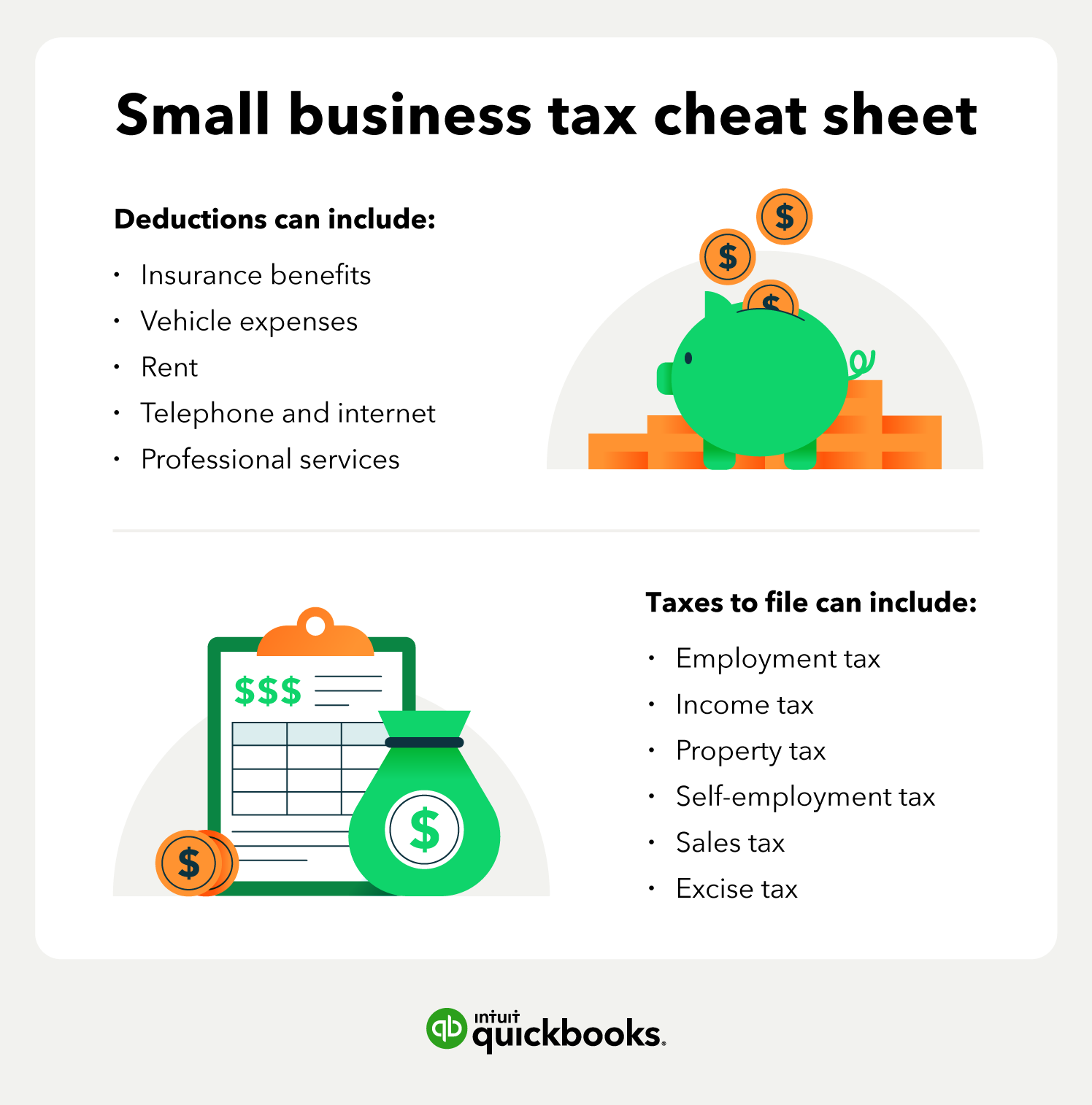
Common business tax deductions

  • Advertising
  • Depreciation of assets
  • Employee salaries and benefits
  • General business expenses
  • Home office expenses
  • Insurance
  • Business loan interest
  • Internet and phone services
  • Legal services
  • Licenses
  • Meals and entertainment (for business purposes)
  • Business-related travel and mileage expenses
  • Commercial property rent 
  • Training and education
  • Cost of goods sold (COGS)
  • Business banking fees

Proper documentation and recordkeeping are essential to justify deductions in case of an audit. Consulting a tax professional can help ensure compliance with tax laws and maximize your eligible deductions.

Small business tax credits

Take time to familiarize yourself with the variety of business tax credits that may be available to you. Here are some common ones: 

For a complete list of federal tax credits and detailed eligibility requirements, visit the IRS website.

In addition to the federal tax incentives, consider if you could qualify for ones specifically for Minnesota businesses, such as:

  • Angel Tax Credit: This is a 25% refundable credit to investors or funds investing in startups focused on high-tech, proprietary technology, or new products, processes, or services in specified fields. The credit caps at $125,000 per person annually ($250,000 for joint filers) and is available to residents and nonresidents, including foreign investors.
  • Research and Development Tax Credit: Minnesota offers an R&D tax credit of 10% on qualifying expenses up to $2 million, and 4% for expenses above that amount. Eligible expenses include research wages, supplies, and contracted work performed in Minnesota, aligning with federal R&D credit requirements. Contributions to qualifying nonprofits that support early-stage tech businesses may also be eligible.
  • Data Center Sales Tax Incentives: Data centers investing $30 million in facilities of 25,000+ square feet within 48 months may qualify for sales tax exemptions for up to 20 years on computers, cooling equipment, energy use, and software. They may also pay no personal property tax.

Check the Minnesota Employment and Economic Development website for additional tax credits and incentives. 

Where do I send my Minnesota tax reports and payments?

You can submit your Minnesota tax reports and payments through the Minnesota Department of Revenue e-Services system. This platform permits online filing and payments. If you prefer, mail your paper filings to the specified address provided on the Department of Revenue's website.

Should I file and pay by paper or electronically?

According to the Minnesota Department of Revenue website, all Minnesota business taxes must be paid electronically if you paid more than $10,000 of any one business tax during the previous fiscal year (July 1 – June 30).

If you are not required to pay electronically and choose to pay by check, you’ll need to complete a payment voucher and mail it with your payment to the designated address.

Common mistakes to avoid when filing business taxes in Minnesota

Doing business taxes can be daunting at first, but with a little preparation, you can avoid costly mistakes and keep your business on the right track. Here are some common pitfalls to watch out for:

Misclassifying workers

Make sure you're correctly classifying your workers as employees or independent contractors. Misclassification can lead to hefty penalties and back taxes.

Missing deductions

Don't leave money on the table. Explore all eligible deductions, such as those for home office expenses, business travel, and equipment purchases.

Ignoring the corporate franchise tax

Remember that Minnesota has a corporate franchise tax, which is a tax on net income for corporations. Make sure you understand the filing requirements and deadlines.

Overlooking sales tax

If your business sells taxable goods or services, ensure you're collecting and remitting sales tax correctly.

Failing to pay estimated taxes

If you expect to owe a significant amount in taxes, make sure you're paying estimated taxes throughout the year to avoid penalties.

By staying organized, understanding the tax laws, and seeking professional advice when needed, you can navigate the Minnesota tax landscape with confidence and keep your business on the path to success.

Find an accountant to help prepare your Minnesota business taxes

Managing business tax filings can be complex. Because of the importance of correct filing to avoid overpayments or fines, consider hiring an experienced accountant or bookkeeper who’s knowledgeable about tax issues and Minnesota tax laws and codes. 

In Minnesota, there are no state-specific licensing requirements for tax preparers. However, you should ensure your chosen professional: 

  • Meets IRS requirements
  • Has a Preparer Tax Identification Number (PTIN) and an Electronic Filing Identification Number (EFIN) for filing e-file returns
  • Completed the Annual Filing Season Program (AFSP), which covers topics such as new tax laws, filing requirements, ethics, and professional conduct

Find an accountant in Minnesota here, and consider using the right small business accounting software to streamline your finances and ensure you're prepared for tax season with accurate reporting.

Frequently asked questions

Disclaimer: 

This content is for information purposes only and information provided should not be considered legal, accounting or tax advice or a substitute for obtaining such advice specific to your business. Additional information and exceptions may apply. Applicable laws may vary by state or locality. No assurance is given that the information is comprehensive in its coverage or that it is suitable in dealing with a customer’s particular situation. Intuit Inc. does not have any responsibility for updating or revising any information presented herein. Accordingly, the information provided should not be relied upon as a substitute for independent research. Intuit Inc. cannot warrant that the material contained herein will continue to be accurate, nor that it is completely free of errors when published. Readers should verify statements before relying on them.


Recommended for you

Mail icon
Get the latest to your inbox
No Thanks

Get the latest to your inbox

Relevant resources to help start, run, and grow your business.

By clicking “Submit,” you agree to permit Intuit to contact you regarding QuickBooks and have read and acknowledge our Privacy Statement.

Thanks for subscribing.

Fresh business resources are headed your way!

Looking for something else?

QuickBooks

From big jobs to small tasks, we've got your business covered.

Firm of the Future

Topical articles and news from top pros and Intuit product experts.

QuickBooks Support

Get help with QuickBooks. Find articles, video tutorials, and more.