





QuickBooks Blog
A man working in a shop
New York

Understanding hiring laws in New York in 2025

To successfully hire in New York, employers must thoroughly understand the state's specific employment laws. These regulations aim to protect both employers and employees, ensuring fair practices and a balanced workplace environment. 

From anti-discrimination laws to wage transparency, New York's hiring laws cover a wide range of issues. Adhering to these mandates is essential for creating a positive workplace culture and avoiding potential legal problems. Whether you’re a small business owner or a hiring manager, this guide will give you key insights on the most important hiring laws in New York state.

Jump to:

Understanding New York hiring laws

New York's employment laws are among the most comprehensive in the nation. They aim to protect workers' rights while promoting fair business practices through the use of non-discrimination statutes, fair hiring practices, and stringent interview guidelines. Let’s get started with some of the new laws everyone running a small business should be aware of. 

New hiring laws in New York for 2025

Employers in New York are responsible for knowing and following their state’s hiring laws, even as these laws change from year to year. Be aware of these new laws that have recently gone into effect for 2025:

  • Minimum wage increase: The minimum wage for all employees in New York state is now $15.50 — except in New York City, Long Island, and Westchester County, where the minimum wage is now $16.50. Businesses in the service industry should make sure to look up the separate rules for tipped employees.
  • Overtime exemption threshold: To be exempt from time-and-a-half requirements for overtime, an employee in New York state must earn at least $60,405.80, or $64,350 for employees in any of the metro areas mentioned above. 
  • Clean Slate Law: This law, which took effect in November 2024, automatically seals certain convictions and prevents employers from using them to influence hiring decisions. We’ll talk more about the Clean Slate Law later. 
  • Freelance Isn’t Free Law: Employers who plan to hire freelance contractors should be aware of this law that took effect in August 2024. The law requires written contracts for freelance work valued at over $800, as well as timely payments by the date specified in the contract. 
  • Paid Prenatal Leave: Employers in NY state are now required to provide an additional 20 hours of paid sick leave to pregnant employees to receive prenatal care.
  • Mental Health Compensation: Employees can now claim workers’ compensation benefits for mental health conditions like PTSD that originate from traumatic experiences in the workplace.

At-will employment

Like most US states today, New York has “at-will employment,” meaning both employers and employees can terminate employment at any time and for any reason. However, employers still can’t terminate employees for reasons prohibited by law, such as race or gender discrimination, or in retaliation for protected actions, such as joining a union.

At-will employment also gives employers some additional responsibilities. First, it’s a good idea to specify at-will employment in the employment contract to avoid any implied obligations and to increase clarity and flexibility. 

Second, remember that even under at-will employment, New York law requires employers to provide a termination notice within five business days of the termination (including employees who self-terminate). The notice must include the exact date on which the termination becomes effective and the date on which benefits terminate.

Non-discrimination hiring in New York

As a business owner, you are responsible for understanding and complying with all applicable New York laws and regulations related to hiring and employee management. The following laws oversee discrimination in the workplace:

New York Human Rights Law (NYHRL)

The New York Human Rights Law (NYHRL) is a broad anti-discrimination law protecting New Yorkers in employment, housing, education, credit, and public accommodations. It prohibits discrimination based on a wide range of personal characteristics, including age, race, creed, color, national origin, sexual orientation, gender identity and expression, military status, sex, marital status, and disability. The NYHRL is enforced by the New York State Division of Human Rights and has expanded over time to provide greater protection.

Civil Rights Act

The Civil Rights Act is a federal law prohibiting discrimination based on race, color, religion, sex, or national origin. While this act sets a baseline for fair employment practices nationwide, New York State and New York City have expanded on these protections with their own human rights laws. These local laws offer broader coverage, encompassing additional protected categories like age, sexual orientation, and gender identity.

Americans with Disabilities Act (ADA)

The Americans with Disabilities Act is a civil rights law that safeguards individuals with disabilities from discrimination in the workplace and other areas of public life. It mandates that employers with 15 or more employees refrain from discriminatory practices in all aspects of employment and provide reasonable accommodations to qualified individuals with disabilities, ensuring a level playing field for all.

Voting Leave

According to New York state’s voting leave law, employees who don’t have four hours available before or after work can request up to two hours of paid leave to vote. If an employee wants to use paid leave to vote, they must request it no fewer than two days in advance. Employers are also required to post a notice of this policy in a conspicuous area until polls close on Election Day.

Paid Family Leave and Breast Milk Expression

New York state has a generous parental leave policy. To qualify, employees must be:

  • A full-time employee who works at least 20 hours per week and has been employed at least 26 weeks, or 
  • A part-time employee who works a regular schedule of less than 20 hours per week and has worked at least 175 days, which don’t have to be consecutive.

Employees who qualify are eligible for up to 12 weeks of job-protected leave to bond with a new baby or provide care for a family member with a health condition. This leave must be paid at 67% of compensation, up to the 2025 cap of $1,177.32. Employers are also required to provide a private location and paid time for employees who are breastfeeding to pump breast milk.

Employees Under 18

New York restricts working hours for all employees under 18 years old. In general, minors may not work during school hours and are limited to working a certain number of hours during times when school is in session. Some exceptions may apply for minors in specific roles, such as babysitting. The specific hours and restrictions imposed vary by the age of the employee and the industry, so check New York state’s guide to work hours for minors for more information.

Drug Testing

Employers in New York generally have broad discretion to drug test employees, whether as a condition of employment or as part of a randomized drug testing program. The exception is drug testing for cannabis, which is allowed only under narrow circumstances. Employers may drug test employees for cannabis under circumstances in which it’s required by federal law or when the employer can articulate specific reasons to believe the employee is under the influence while at work.

Workers’ Compensation and Unemployment

New York requires nearly all employers to carry workers’ compensation insurance, even if they have only one employee (other than the proprietor). This helps ensure that workers who are injured on the job are able to receive appropriate compensation, whether the injury was the employer’s fault, the employee’s, or random chance. Insurance is available through several sources, including private insurers or the New York State Insurance Fund.

Check the New York workers’ compensation rules for more information, including injury reporting obligations and required forms to inform employees about workers’ comp policies. You’ll also find tips on how to comply with the new law that requires workers’ comp for mental health conditions originating from workplace trauma or stress. 

Employers in New York are also required to contribute to the state’s unemployment insurance system via payroll taxes. Rates vary for different employers, although new employers are subject to a 4.1% flat tax rate. Unemployment insurance protects the livelihoods of workers who lose their jobs. 

Fair hiring practices in New York

New York's hiring laws prioritize non-discrimination and equal opportunity throughout the entire recruitment process, including job ads, interviews, and final selections. Recent legislation mandates salary transparency in job postings and regulates the use of artificial intelligence to minimize bias. These protections extend to non-residents seeking employment in New York, underscoring the state's commitment to fair and equitable hiring practices.

Here are some ways the state enforces fair hiring:

Job advertisements

In New York, job advertisements must avoid discriminatory language. Employers must prioritize fairness and inclusivity. To ensure equal opportunity for all applicants, employers must:

  • Use inclusive and gender-neutral language.
  • Focus on job-related skills and competencies.
  • Include an Equal Employment Opportunity (EEO) statement.
  • Make job postings accessible to everyone.
  • Disclose salary ranges as mandated by New York's pay transparency laws.
  • Ensure ads do not contain any unconscious biases related to protected characteristics.

Background check regulations

New York's approach to background checks is designed to balance employer needs with fair chance opportunities for job seekers. Key regulations include:

  • Fair Credit Reporting Act (FCRA): This law protects individuals' credit information, allowing them to access and dispute their reports. It also restricts how long certain information can be reported, typically seven years, except for high-paying jobs or life insurance policies over $50,000.
  • New York Fair Chance Act: This New York City law promotes fair hiring practices by prohibiting employers from asking about criminal history until after a conditional job offer. If a background check reveals a criminal record, employers must consider several factors before withdrawing the offer, including the nature of the offense and its relevance to the job.
  • Clean Slate Act: A recently implemented statewide law that establishes new standards for when employers can consider criminal convictions in making hiring decisions. A misdemeanor conviction is considered “sealed” three years after the conviction or release from jail and a felony eight years after. Several exceptions exist, including serious felonies like murder and sex crimes, as well as specific jobs where a criminal background check is essential.

Interview guidelines

New York's anti-discrimination laws extend to the interview process. To avoid possible legal issues and lawsuits, refrain from discussing the following during interviews:

  • Personal attributes: Do not ask about an applicant's age, race, ethnicity, national origin, religion, gender, sexual orientation, marital status, family status, disability status, or genetic information. These protected characteristics should not influence hiring decisions.
  • Salary history: Inquiring about an applicant's salary history is illegal in New York State. Instead, focus on the candidate's qualifications and how they align with your company's compensation structure.
  • Credit history: New York City generally prohibits employers from using consumer credit history in employment decisions, with limited exceptions.
  • Criminal background: While you can conduct background checks after a conditional job offer, avoid asking about an applicant's criminal history before that stage. 
  • Other sensitive topics: Refrain from asking about citizenship status, military discharge status, arrest records, workers' compensation history, past drug use, and overly personal questions unrelated to the job.

Local Law 144 - Automated Employment Decision Tools (AEDT)

New York City's Local Law 144 aims to make the use of Automated Employment Decision Tools (AEDTs) in hiring and promotion more transparent and fair. The hiring law regulates the use of AI-powered tools in employment decisions, requiring companies to conduct independent bias audits and publicly share the results. 

Employers must also inform applicants or employees about using these tools and offer alternative evaluation methods if requested. This law is a significant step towards ensuring that automated decision-making doesn't perpetuate existing biases in the workplace.

Eligibility to work in New York

Every New York State employer must verify the identity and work authorization of new hires, regardless of citizenship status. This process helps ensure compliance with federal and state laws while fostering a fair and inclusive workplace. Here’s an overview of the verification process:

A picture of a book with a picture of a person.

Step 1: Fill Out Form I-9

Employers must complete Form I-9, Employment Eligibility Verification, within three business days of a new employee's start date.

Step 2: Request Documentation

New hires must present original documents (like a passport or driver's license) establishing their identity and eligibility to work in the U.S. It's illegal to discriminate against individuals based on their citizenship status or the type of documentation they present for verification.

Step 3: Follow Anti-Discrimination Laws

New York's Human Rights Law (detailed above) prohibits pre-employment inquiries about protected characteristics like race, religion, sexual orientation, disability, military status, gender expression or identity, or age unless directly related to job requirements.

Step 4: You Can Ask Permissible Questions

You can inquire if an applicant is legally authorized to work in the United States and inform them that they must submit proof of authorization upon hiring. Don’t ask for specific citizenship or immigration details beyond what's necessary for I-9 compliance.

Step 5: Focus on Job Relevance

Questions about language skills are only allowed if they directly relate to the job's essential functions.

Post-employment offers in New York

When extending a job offer in New York, employers typically use offer letters or formal contracts to clearly outline the terms of employment. To ensure a smooth onboarding process, be sure to include these details in your offer letter or contract:

  • Job title and description
  • Compensation details, including any bonuses or commission structures
  • Benefits
  • Start date
  • Work schedule, whether it's a standard 9-to-5, a flexible schedule, or shift work.

Specify who the new employee will report to within the company.

Contingencies, such as if the offer is contingent upon factors like a background check or drug test

It's important to note that New York is an "at-will" employment state, meaning either the employer or employee can terminate the employment relationship at any time, with or without cause. This should be clearly communicated in the offer letter or contract.

Onboarding

Once a job offer is accepted, employers in New York typically have an onboarding process to integrate new employees smoothly into the company. This often includes orientation sessions, paperwork completion, introductions to team members, and training. New York State also mandates certain training programs for employees, such as annual sexual harassment prevention training.

Staying compliant with New York hiring laws

Good recordkeeping, documentation, and periodic reviews are essential for maintaining compliance with New York’s complex hiring laws. 

Image Alt Text

Required documentation includes:

  • Employment applications and resumes (keep for at least one year for non-hires).
  • Job descriptions and postings.
  • Form I-9 for employment eligibility verification (keep for 3 years after hire or 1 year after termination, whichever is later).
  • Interview records. 
  • Background check results (if applicable).
  • New hire reporting forms.
  • Payroll files (keep for at least six years).
  • Performance evaluations and any disciplinary records.
  • Training documentation, particularly for mandatory trainings like sexual harassment prevention.

Conduct ongoing reviews

Regular reviews and audits help ensure your hiring practices align with New York's regulations. Here are some tips:

  • Verify proper storage of all required forms and records.
  • Scrutinize job postings and applications for any discriminatory language.
  • Ensure interview questions focus solely on job-related skills and experience.
  • Confirm adherence to the Fair Chance Act when conducting background checks.
  • Verify compliance with the Pay Transparency Law by including salary information in job postings.
  • Ensure all new hires have completed all necessary paperwork and training.

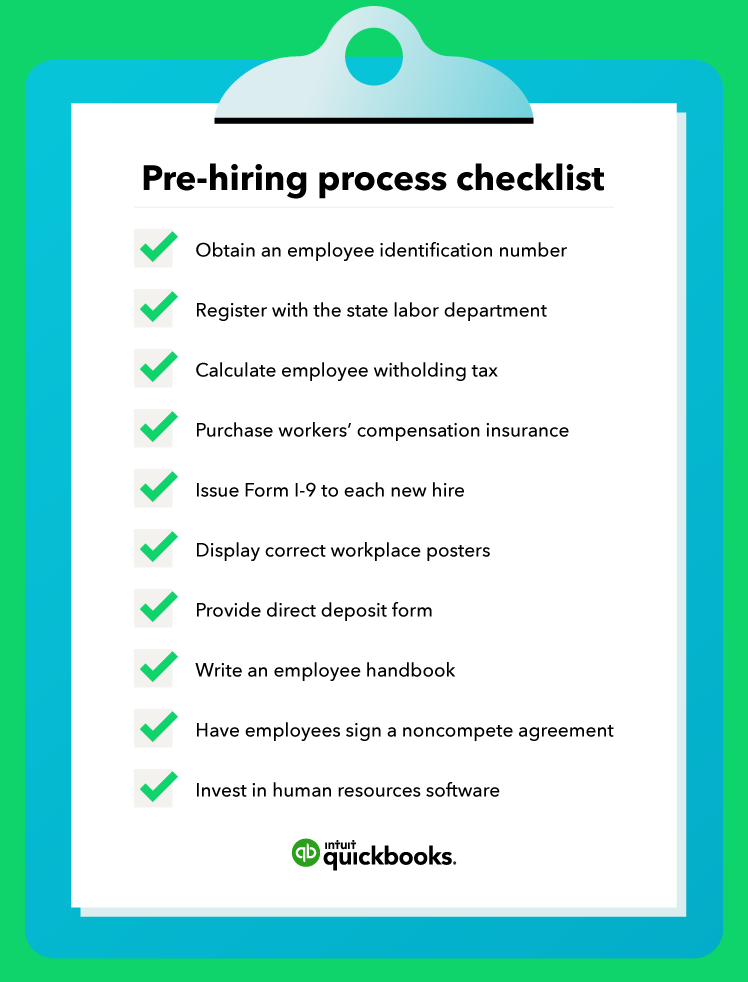
Create compliance checklists

Create and follow checklists to guide your hiring process and ensure everyone follows the same steps. Checklists can include:

  • Appropriate job posting language
  • Legal interview questions and what questions to avoid
  • Background check procedures
  • Salary transparency requirements
  • Onboarding and training protocols

QuickBooks is your resource for hiring, paying, and thriving

Ready to streamline your business processes, from recordkeeping to managing payroll and beyond? QuickBooks offers comprehensive support and solutions tailored to the needs of small businesses. Whether you’re trying to decipher legal requirements for new hires or developing a benefits package to attract top talent, QuickBooks is here for you. Plus, our New York State payroll solutions can help you manage compensation and payroll taxes with ease. Leverage our hiring and management tools and resources and empower yourself with the knowledge you need to take your business to the next level. 

Disclaimer:

This content is for information purposes only and information provided should not be considered legal, accounting or tax advice or a substitute for obtaining such advice specific to your business. Additional information and exceptions may apply. Applicable laws may vary by state or locality. No assurance is given that the information is comprehensive in its coverage or that it is suitable in dealing with a customer’s particular situation. Intuit Inc. does not have any responsibility for updating or revising any information presented herein. Accordingly, the information provided should not be relied upon as a substitute for independent research. Intuit Inc. cannot warrant that the material contained herein will continue to be accurate, nor that it is completely free of errors when published. Readers should verify statements before relying on them.


Recommended for you

Mail icon
Get the latest to your inbox
No Thanks

Get the latest to your inbox

Relevant resources to help start, run, and grow your business.

By clicking “Submit,” you agree to permit Intuit to contact you regarding QuickBooks and have read and acknowledge our Privacy Statement.

Thanks for subscribing.

Fresh business resources are headed your way!

Looking for something else?

QuickBooks

From big jobs to small tasks, we've got your business covered.

Firm of the Future

Topical articles and news from top pros and Intuit product experts.

QuickBooks Support

Get help with QuickBooks. Find articles, video tutorials, and more.