- Start Your BusinessStart Your Business
- Starting a BusinessThe tools and resources you need to get your new business idea off the ground.
- PaymentsEverything you need to start accepting payments for your business.
- Funding & CapitalResources to help you fund your small business.
- Small Business StoriesCelebrating the stories and successes of real small business owners.
- Self-EmployedThe tools and resources you need to run your own business with confidence.
- Run Your BusinessRun Your Business
- Running a BusinessThe tools and resources you need to run your business successfully.
- AccountingAccounting and bookkeeping basics you need to run and grow your business.
- Cash FlowTax and bookkeeping basics you need to run and grow your business.
- PayrollPayroll essentials you need to run your business.
- TaxesTax basics you need to stay compliant and run your business.
- EmployeesEverything you need to know about managing and retaining employees.
- Grow Your BusinessGrow Your Business
- Growing a BusinessThe tools and resources you need to take your business to the next level.
- Sales & MarketingSpread the word: What you need to know about marketing your small business.
- FundingHow to find funding and capital for your new or growing business.
- Midsize BusinessesThe tools and resources you need to manage your mid-sized business.
- Enterprise Suite BlogThe tools and resources you need to grow your own business with confidence.
- E-CommerceHow to start and run a successful e-commerce business.
- TaxesTaxes
- How to fill out a 1099-NEC formLearn how to fill out and file 1099-NEC forms for independent contractors and freelancers.
- How to file small business taxesLearn how to navigate tax season with confidence and minimize your tax liability with this guide.
- Small business 1099: What you need to know for 2025Navigate the complexities of small business 1099 forms and filings with our comprehensive guide.
- 13 documents to give your accountant for small business taxesYour accountant will need these documents to file your small business taxes successfully.
- What's NewWhat's New
- NewsBrowse the latest news, press releases, and reports from QuickBooks.
- AI Resource HubFind the latest on Artificial Intelligence.
- Small Business DataThe latest research and insights for Small Businesses from QuickBooks.
- Small Business StoriesCelebrating the stories and successes of real small business owners.
- Holiday SuccessEverything you need to thrive during your business's busiest seasons.
- AI InnovationsBrowse the latest AI innovations in QuickBooks on the Intuit platform.
- ToolsTools
- All ToolsFree accounting tools and templates to speed up and simplify your workflow.
- AI-Powered Invoice GeneratorTry out this free invoice generator to create an invoice online using Intuit Intelligence.
- Payment Cost CalculatorFind out how much you could save by switching to QuickBooks Payments.
- Paycheck CalculatorAccurately estimate pay for all your employees.











Career ladders for small businesses: Build growth paths with QuickBooks
Small businesses face a unique challenge: attracting and keeping talented employees without the resources of larger companies. When your team members don't see a clear path forward, they start looking elsewhere, and replacing good employees costs time, money, and momentum.
Career ladders offer a solution. They provide transparent pathways that show employees exactly what skills they need to develop, what milestones they need to hit, and what rewards await them as they grow. For small businesses, especially, career ladders bring structure to promotions and pay decisions that can otherwise feel inconsistent or unfair.
This guide will walk you through building practical career ladders for your small business, and show you how QuickBooks helps you implement them without adding administrative burden.
Jump to:
What a career ladder is (and when a lattice makes more sense)
A career ladder is a set of levels within a role that defines expectations for skills, scope, and performance at each level, along with the typical compensation range for that level. It helps employees understand how to grow and helps employers promote and pay people more consistently.
Career ladder vs. career lattice vs. career path
These terms get used interchangeably, but they’re slightly different. Knowing the difference makes it easier to pick what will actually work for your team.
- Career ladder: A clear, step-by-step move up within the same role family (e.g., Support Rep to Senior Rep to Team Lead). This is usually the simplest option for small businesses because it’s easy to explain, manage, and use consistently.
- Career lattice: Growth that can move up, sideways, or into a new specialty (e.g., Customer Support Rep to Implementation Specialist to Customer Success Manager). A lattice is helpful when you can’t always offer a new title right away, but you still want to give people meaningful ways to stretch, learn, and stay engaged.
- Career path: The umbrella term for both ladders and lattices. It’s basically any documented plan that shows how someone can grow in your organization.
For most small businesses, starting with a straightforward ladder in one or two key role families gives you the biggest impact with the least complexity. You can always add lattice-style moves once the basics are working.
What to include on every rung
Each level in your career ladder should clearly specify:
- Title: What the role is called at this level.
- Scope: What someone owns day to day, and how complex or high-impact that work is.
- Required skills: The technical skills and people skills needed to succeed.
- Measurable outcomes: What successful performance looks like in real, concrete terms.
- Examples of work: A few realistic scenarios that show what the level looks like in practice.
- Pay range: The compensation band for that level, including any variations by location or market for the same role.
When you include these basics, you remove a lot of guesswork. Employees get a roadmap they can follow, and managers get a consistent way to coach, promote, and reward growth.
Why career ladders work for small businesses
Small businesses move fast. Roles evolve, priorities shift, and you don’t always have time to build formal HR services from scratch. Career ladders give you a simple structure you can rely on, so growth conversations, promotions, and pay decisions feel clear and consistent, even as your team changes.
Retention and motivation
Employee retention can be a challenge for many teams. According to recent data from QuickBooks Small Business Insights, 30% of U.S. businesses find it difficult to retain skilled workers.
When people don’t know what it takes to grow, they fill in the blanks themselves, and usually assume growth isn’t possible.
A career ladder removes that uncertainty. It answers the “What do I need to do to move up?” question in a way that feels concrete and achievable. When employees can see the next step and understand how to get there, they’re more likely to stay engaged, do their best work, and build a future with your business.
Better hiring and onboarding
Career ladders help you set expectations from day one. During hiring, they make it easier to explain what success looks like in the role and what growth can look like over time. And when it comes to employee onboarding, ladders reduce the guesswork early on. Instead of wondering what to focus on, new hires can prioritize the skills and outcomes that actually matter, which helps them ramp faster and feel confident sooner.
Consistent promotions (and fewer pay surprises)
Without a framework, promotions can turn into one-off negotiations, and that’s where inconsistency creeps in. Career ladders give you repeatable criteria for leveling up, along with clearer pay expectations tied to each level. That makes decisions faster, budgeting easier, and compensation changes less likely to feel random or uneven across the team.
Fairness and risk reduction
Clear, documented criteria help you apply the same standards across employees and managers. That consistency supports fairer decision-making and helps reduce bias, especially when your team grows beyond “everyone knows everyone.” It also creates a paper trail you can point to if questions come up later about why someone was (or wasn’t) promoted, or how compensation decisions were made.
Build a career ladder in 7 rungs
You don’t need a big-company HR department to create career ladders that actually work. What you need is a simple, repeatable process, particularly one you can start small, test, and improve as your business grows. Here’s what you should do:
Rung 1: Pick which roles to ladder first (don’t ladder everything)
Start with roles that have the biggest impact on your business. These might be:
- Positions tied to revenue generation (sales, account management).
- Roles critical to service quality (customer support, operations).
- Roles that protect accuracy and trust (like billing, finance, or payroll jobs).
- Areas with high turnover where retention matters most.
You don't need ladders for every role on day one. Pilot one or two role families, learn what works, then expand. This approach keeps the project manageable and lets you refine your process before scaling.
QuickBooks helps here: Use your payroll data to identify patterns (e.g., frequent pay changes, overtime pay trends, or turnover rates) that point to which roles would benefit most from structured ladders.
Rung 2: Choose your number of levels (keep it small)
For most small businesses, three to four levels per role family is enough to start. More than that, and you create unnecessary complexity. Fewer, and you don't give people meaningful milestones.
Define what changes between levels and focus on:
- Scope: How much territory, how many accounts, or how complex the work is
- Complexity: Routine vs. novel problems.
- Autonomy: Level of supervision required.
- Impact: Individual contributor vs. influencing others.
Avoid tying levels to tenure. Time served doesn't equal readiness to advance.
QuickBooks helps here: Access HR job description resources that help you standardize level definitions and bring clarity to each role's expectations.
Rung 3: Write promotion criteria that are measurable
Replace subjective language like "demonstrates leadership presence" with concrete criteria:
- Observable behaviors: "Leads cross-functional project meetings" instead of "shows initiative."
- Measurable outcomes: "Closes 10+ deals per quarter" instead of "strong performer."
- Examples of meets vs. exceeds: Spell out what the baseline looks like and what going above and beyond means.
Also include what counts as proof, such as completed projects, improved metrics, customer outcomes, or other evidence. That documentation makes promotion conversations clearer and fairer.
QuickBooks helps here: Use employment management resources, such as HR templates or checklists, to standardize documentation across managers, ensuring everyone applies the criteria consistently.
Rung 4: Attach pay bands + promotion pay rules
For each level, define:
- Pay range: Minimum, midpoint, and maximum compensation.
- Midpoint philosophy: Where a fully competent performer should land.
- Guardrails: Parameters that keep pay fair and sustainable.
Also, set rules for promotions:
- Promotion increase minimums: Typical percentage or dollar increase when someone moves up (guidelines, not hard rules).
- Exceptions path: Who approves deviations from standard increases.
- Timing rules: Whether raises happen during annual reviews or off-cycle.
Review your pay bands at least annually, and sooner if market conditions shift or you're hiring rapidly. Competitive pay ranges are critical for retention.
QuickBooks helps here: QuickBooks applies pay updates consistently, keeps records clean, and reduces special-case errors that create inequities over time.
Rung 5: Build the development plan for each rung
Make growth actionable by specifying:
- Skills to build: Technical competencies, software proficiency, and communication abilities.
- Stretch work: Projects or assignments that prepare someone for the next level.
- Mentorship or shadowing: Opportunities to learn from others.
- Training resources: Courses, certifications, or materials that support skill development.
Also, include a “how to prove readiness” checklist so employees know exactly what progress looks like.
QuickBooks helps here: Leverage HR guidance resources to build standardized development plans that managers can reuse to help save time and ensure consistency.
Rung 6: Publish the ladder (so it actually gets used)
Put career ladders where people can find them:
- Company intranet or shared drive.
- Onboarding materials for new hires.
- Manager toolkits for performance conversations.
- Employee handbooks.
It also helps to give managers talk tracks (i.e., simple conversation guides), so career conversations feel natural and consistent. And don’t forget version control: add a date and an owner, so everyone knows they’re using the current ladder.
QuickBooks helps here: Formalize the policies that support your ladders (review cadence, promotion practices) and streamline document acknowledgment workflows where available.
Rung 7: Run ladders with consistency (and know when to get expert help)
The ladder itself is only half the work. The real value comes from using it consistently.
A few ways to keep things fair and aligned:
- Manager calibration sessions: Before promotion decisions happen, bring managers together to discuss how they're applying the criteria. This ensures consistency across the organization.
- Outcome audits: Periodically review who's getting promoted, how quickly, and whether there are patterns around equity, pay compression, or advancement velocity that need attention.
You should also know when to bring in expert help. Career ladders touch on decisions that can get legally complicated, especially when you’re dealing with:
- Worker classification questions (exempt vs. non-exempt employees).
- Compliance-sensitive promotions (especially in regulated industries).
- Terminations or employee relations issues.
- Multi-state employment questions.
- Policy edge cases that don't fit neatly into your framework.
QuickBooks helps here: QuickBooks keeps your promotion decisions aligned with compliance resources and gives you access to HR support when you need it.
Career ladder examples
Here are three simplified career ladder examples to get you started. Each includes three levels with sample criteria you can adapt for your business.
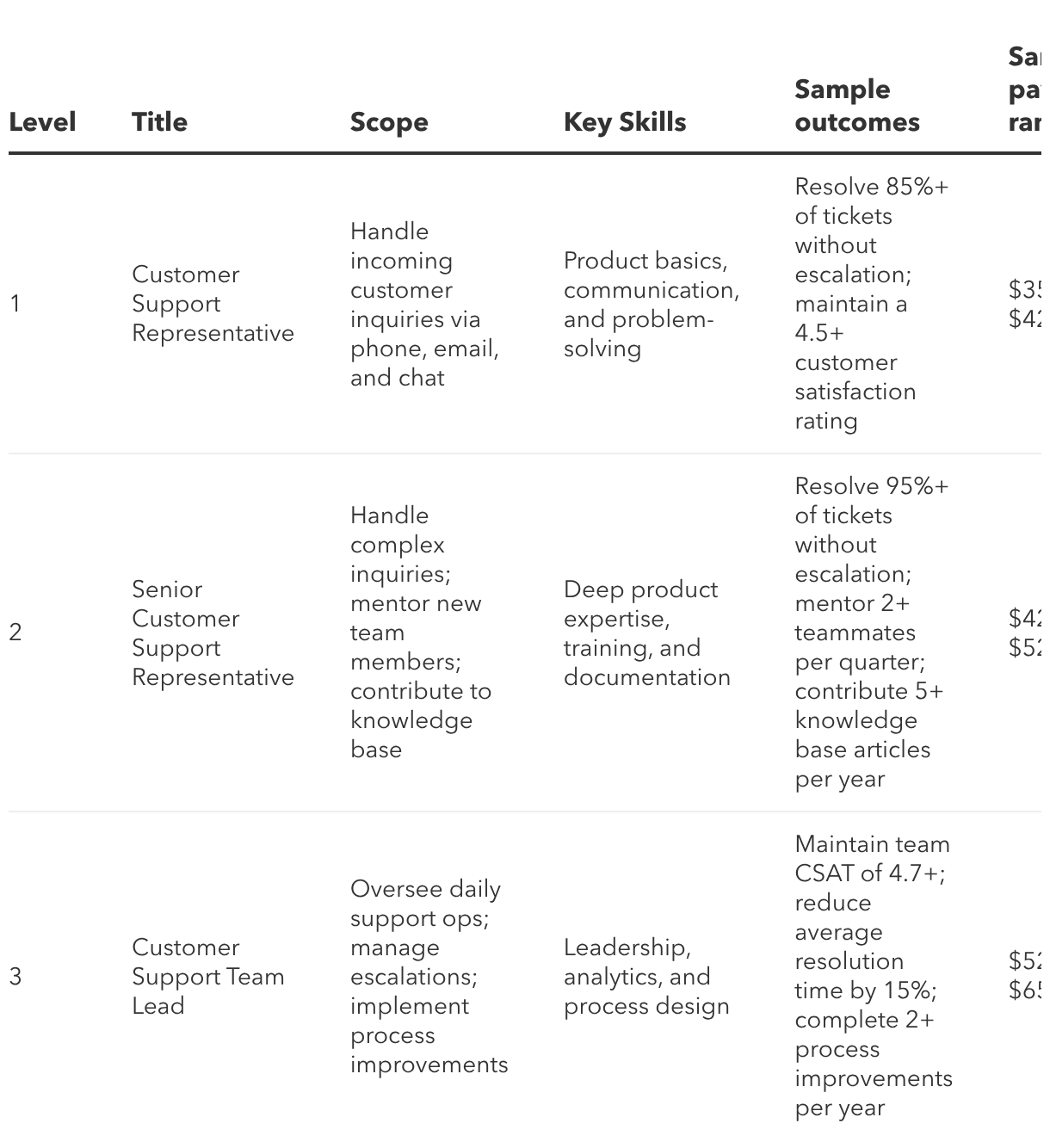
Customer support ladder
Take a look below for a simple progression from handling tickets to mentoring teammates to leading daily support.
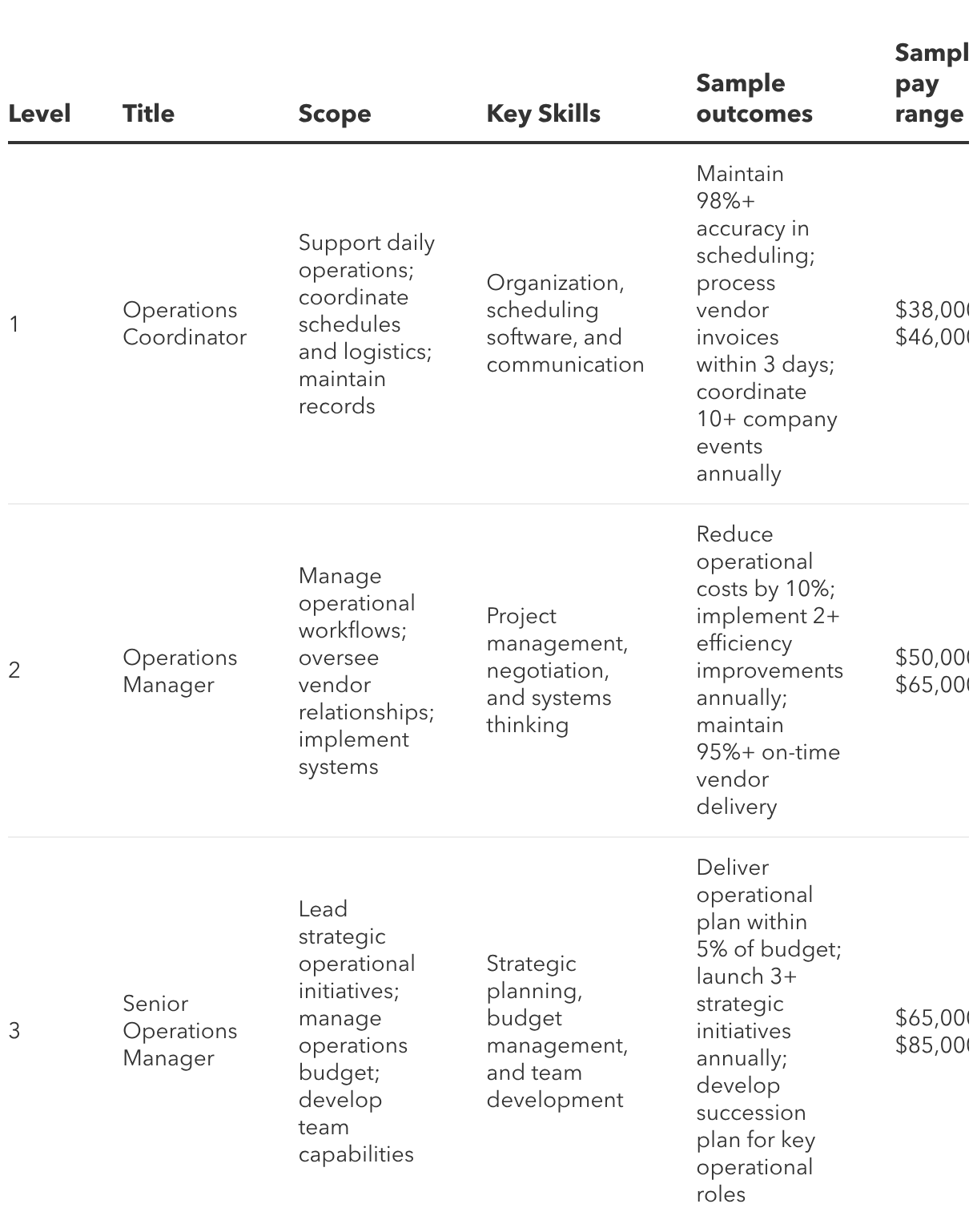
Operations/office manager ladder
Use the table below to map growth from coordinating daily work to improving systems to owning strategy and budgets.
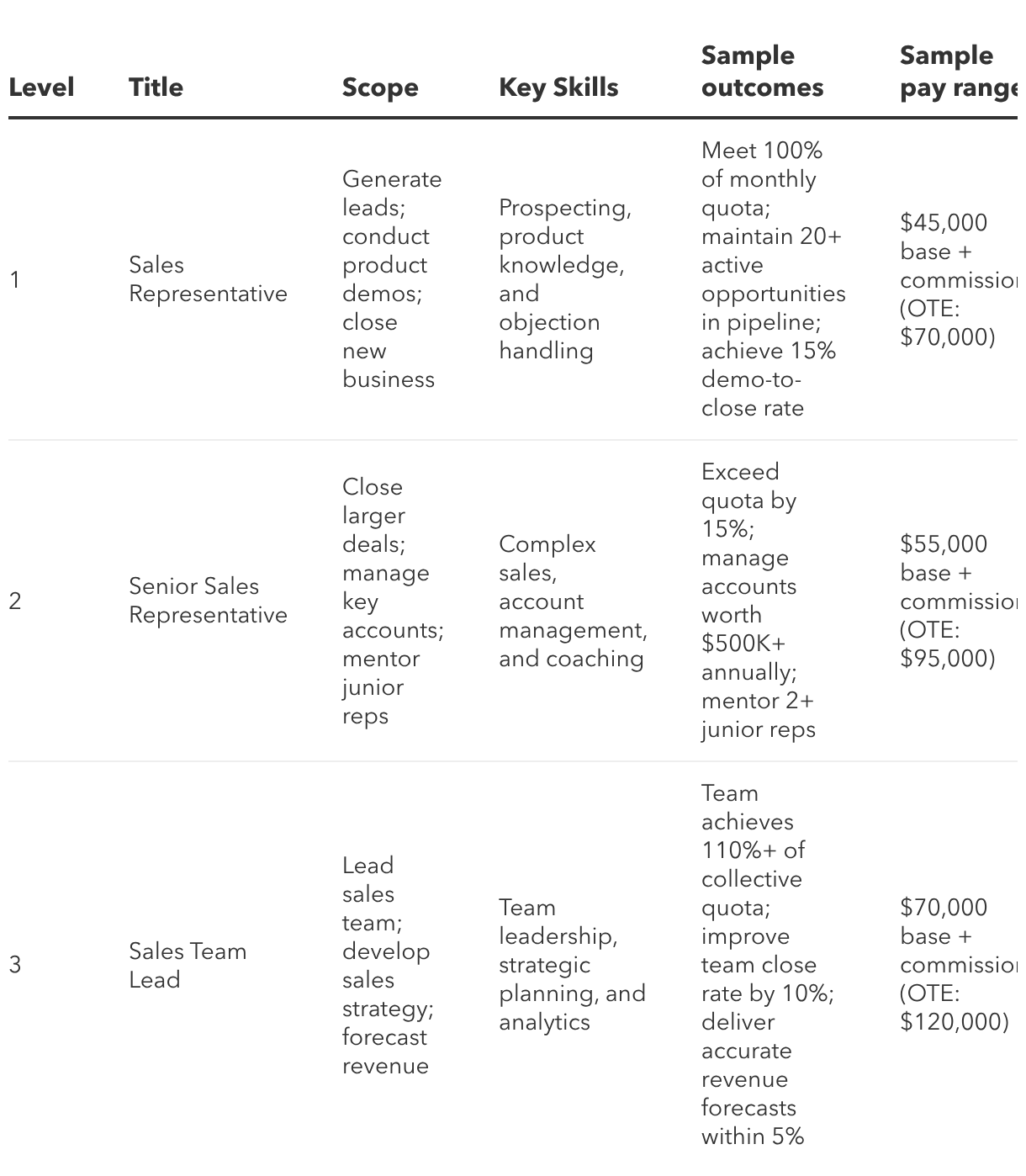
Sales ladder
See the ladder below for a clear path from hitting quota to closing bigger deals to leading team performance and financial forecasting.
Common mistakes (and fixes)
Here are some of the most common mistakes in career ladders, along with straightforward fixes to keep your ladder fair and sustainable.
Too many rungs too soon
Creating six or seven levels in a role family before you have the team size to support it creates confusion and stagnation.
Fix: Start with three to four levels. Expand only when you have enough people at the current levels and a clear business need for more granularity.
Criteria are subjective or inconsistent
"Strong performer" and "team player" mean different things to different managers, leading to promotion decisions that feel arbitrary.
Fix: Use measurable outcomes, concrete examples, and evidence checklists. If you can't observe or measure it, refine the criteria until you can.
Promotions without pay rules
Promoting someone without clear guidelines for the associated pay increase leads to inequities and resentment.
Fix: Define pay bands for each level, establish minimum increase guidelines for promotions, and document your exceptions workflow. If someone gets promoted, they should know roughly what to expect for compensation changes.
Ladders live in a doc nobody uses
Creating beautiful career ladders that sit in a folder no one opens defeats the purpose.
Fix: Integrate ladders into your employee hiring process, onboarding, manager one-on-ones, and annual reviews. Make them living tools, not one-time projects.
Ignoring compliance realities
Career ladders intersect with wage and hour laws, classification rules, and other employment regulations that vary by state and industry.
Fix: Use HR guidance available through QuickBooks and update your ladders when laws or pay requirements change. Consult an HR expert when you're unsure.

Simplify getting paid
Give your customers more convenient ways to pay with recurring payments. Payments get charged on time, automatically making it easier to plan and predict your business cash flow.
Make growth predictable, and make pay changes painless
Career ladders bring clarity to something that can otherwise feel murky. Employees know what’s expected and what they’re working toward. Managers have a consistent way to coach performance and make promotion decisions. And your business gets a steadier, more sustainable approach to growing your team.
The key is making the ladder usable in real life, not just in a document. When someone moves up, you need to update pay accurately, keep the right records, and stay aligned with the rules that apply to your team and your state.
That’s where QuickBooks can help. It helps you put your career ladder into action with:
- Consistent, accurate pay processing when promotions happen
- Centralized documentation so key details don’t get lost across emails and spreadsheets
- HR resources and support to help you navigate tougher decisions
- Compliance tools to help you stay up to date with changing employment requirements
Your team deserves transparency about how they can grow. Your business deserves systems that make managing that growth simpler. Career ladders, backed by the right tools, deliver both.
Ready to build career ladders that work for your small business? Explore QuickBooks to see how we can help you implement growth paths without adding complexity.
Recommended for you




Explore what you can do with QuickBooks
Explore what you can do with QuickBooks

See profit at a glance


Track and manage time
Looking for something else?
Firm of the Future
Topical articles and news from top pros and Intuit product experts.
QuickBooks Support
Get help with QuickBooks. Find articles, video tutorials, and more.
Call Sales: 1-800-285-4854





© 2026 Intuit Inc. All rights reserved.
Intuit, QuickBooks, QB, TurboTax, Credit Karma, and Mailchimp are registered trademarks of Intuit Inc.
Money movement services are provided by Intuit Payments Inc., licensed as a Money Transmitter by the New York State Department of Financial Services. For details about our money transmission licenses, or for Texas customers with complaints about our service, please click here.
By accessing and using this page you agree to the Website Terms of Service.