
You could save up to 25% on transaction costs².
Speak with us now to see if you qualify.
Talk to sales 1-800-515-8366
Monday - Friday, 6 AM to 4 PM PT

Table of contents
Table of contents
First in, first out (FIFO) assumes the business sells the oldest items first, leading to lower cost of goods sold (COGS), higher net income, higher ending inventory value during inflation, and increased tax liabilities.
Last in, last out (LIFO) assumes the newest items are sold first, resulting in higher COGS, lower net income, and lower ending inventory value during inflation, which can reduce tax liabilities.
First in, first out (FIFO) assumes the business sells the oldest items first, leading to lower cost of goods sold (COGS), higher net income, higher ending inventory value during inflation, and increased tax liabilities.
Last in, last out (LIFO) assumes the newest items are sold first, resulting in higher COGS, lower net income, and lower ending inventory value during inflation, which can reduce tax liabilities.
Inventory is often the most significant asset on the balance sheet. If you operate a retailer or wholesale business, inventory may require a large investment, and you need to carefully track the inventory balance. Managing inventory requires the owner to assign a value to each inventory item, and the two most common accounting methods are FIFO and LIFO.
The average cost is a third accounting method that calculates inventory cost as the total cost of inventory divided by the total units purchased. Most businesses use either FIFO or LIFO, and sole proprietors typically use average cost. Accounting standards allow companies to use all three methods.
FIFO (first in, first out) is an inventory costing method where the oldest inventory items are assumed to be sold first. This means that the cost of goods sold (COGS) on your income statement reflects the cost of your oldest inventory, while your remaining inventory on the balance sheet reflects the cost of your newest items.
FIFO is the most common inventory valuation method, and it's often preferred because it aligns with the natural flow of goods in many businesses. According to the IRS, FIFO is an acceptable method for valuing inventory for tax purposes as long as it's consistently applied.
This inventory method is often used in industries dealing with perishable goods, such as food and beverage. FIFO naturally aligns with the physical flow of these goods, where it's crucial to move older stock before it spoils, becomes outdated, or loses significant value.
LIFO (Last In, First Out) is an accounting method used for inventory valuation, where the most recently acquired items are assumed to be sold or used first. Under LIFO, the cost of the latest inventory purchased is the first to be recorded as the cost of goods sold (COGS), leaving older inventory as ending stock.
This method is often used during periods of inflation, as it results in higher COGS and lower taxable income, but it may not reflect the actual physical flow of inventory. LIFO is permitted under US Generally Accepted Accounting Principles (GAAP) but not allowed under International Financial Reporting Standards (IFRS).
Before you plug numbers into FIFO or LIFO formulas, make sure you have three key pieces of information:
1. Inventory layer: An inventory layer is a group of units purchased on the same date at the same cost. For example, if you buy 100 units at $10 and, later, 150 units at $12, you’ve created two layers: a $10 layer and a $12 layer. FIFO and LIFO simply decide which layer you treat as sold first.
2. Units sold in the period: You’ll need accurate sales quantities for the period you’re analyzing (month, quarter, or year). This tells you how many units to assign to COGS and how many remain in ending inventory.
3. Chosen cost flow method: You must choose an inventory costing method and apply it consistently. Changing methods back and forth makes it hard to compare performance over time and can trigger additional tax and disclosure requirements. Work with your accountant before switching methods.
Together, these three inputs drive how inventory costs flow from your balance sheet to COGS, net income, and even operating cash flow over time.
It really depends on how you operate. Be sure to think about:
A CPA or tax professional can help you weigh these trade-offs based on your industry, growth plans, and regulatory requirements.
Inflation is one of the main reasons businesses debate these two methods.
With FIFO, you sell older, cheaper stock first. This lowers your COGS and increases your paper profit. While this looks good to investors, it also means a higher tax bill.
With LIFO, you sell the newer, more expensive stock first. This raises your COGS and lowers your reported profit. The benefit? You pay less in taxes now, keeping more operating cash flow in the business.

FIFO works by assuming that the first units you bought are the first units you sell. To calculate it, you’ll sort your purchases into layers, work through them from oldest to newest, and assign the right costs to COGS and ending inventory.
Below’s a simple step-by-step framework you can follow for any product.
Start by writing down every batch of inventory you bought during the period, plus any beginning inventory you carried in. Each batch should include:
Cost per unit
These batches are your cost layers, and FIFO will always pull from the oldest one first.
Next, calculate how many units you had available to sell, and their total cost:
Beginning inventory + purchases = Goods available for sale
This helps you confirm you’re working with accurate totals before you assign costs to COGS or ending inventory.
Pull this from your POS system, sales dashboard, or sales journal. FIFO only works if you know exactly how many units left in inventory during the period.
Now, work through your cost layers in order:
1. Start with the oldest layer.
2. Use as many units from that layer as needed until it’s fully “sold.”
3. Move to the next-oldest layer and repeat until you’ve assigned all units sold.
Every unit you match to a layer becomes part of COGS.
For each layer you pulled units from, multiply:
Units sold from the layer x cost per unit
Add up all those amounts to get your FIFO COGS. This number flows to your income statement.
Any units you didn’t assign to COGS stay in the more recent layers.
Multiply the remaining units in each layer by their cost per unit, then add them up. That total is your ending inventory, which appears on your balance sheet.
To explain inventory valuation in detail, assume that Sterling Fashions sells a line of men’s shirts and that the store had no beginning inventory balance on March 1st. Here’s the inventory activity for March:

The store purchased 250 shirts for a total cost of $13,100 and sold 120 shirts, leaving 130 in ending inventory. A company’s bookkeeping tracks the total cost of inventory items, as well as the units bought and sold.
FIFO assumes the first units purchased are the first ones sold. Here’s how to calculate inventory using FIFO:
1. Calculate cost of goods sold (COGS): Since 120 units were sold, we assume the first 100 units purchased ($50 each) were sold, plus 20 units from the second purchase ($54 each).
2. Calculate ending inventory: The remaining 130 shirts (250 total - 120 sold) are assumed to be from the most recent purchase.
Notice how FIFO's higher ending inventory ($7,020) during inflation can improve balance sheet ratios like the current ratio (current assets / current liabilities), potentially enhancing perceived liquidity.
LIFO (last in, first out) assumes that the newest inventory you buy is the first inventory you sell. That means your most recent (and usually higher-cost layers) flow into COGS, while older layers remain in ending inventory.
Before you walk through the steps, it’s important to understand the two ways LIFO can be applied: periodic and perpetual.

Important: Because purchases and sales happen throughout the period, perpetual LIFO can produce different COGS and ending inventory than periodic LIFO, even with the same total purchases and sales.
Once you know which version you’re using, you can follow the LIFO steps below
Start by writing down every batch of inventory you bought during the period. These batches (i.e., layers) should include:
Under LIFO, the newest layer is the one you use first.
Pull this number from your sales reports or POS system. This tells you how many units you’ll need to remove from your layers.
Now apply the LIFO rule:
Every unit you assign becomes part of COGS.
In a perpetual system, this assignment happens at each sale date using whatever layers exist at that time.
For each layer you pulled units from, calculate:
Units taken from that layer x cost per unit
Then add everything together to get the total LIFO COGS.
Any units you didn’t assign to COGS remain in the older layers.
To calculate ending inventory:
1. Multiply the remaining units in each layer by that layer’s cost per unit.
2. Add all those amounts together.
That total becomes your ending inventory number on the balance sheet.
LIFO assumes the last units purchased are the first ones sold. Let’s use the same Sterling Fashions example in the “Example of calculating FIFO” section.
Since 120 units were sold, we assume they all came from the most recent purchase of 150 units ($54 each).
The remaining 130 shirts consist of the entire first batch (100 units) and the leftover units from the second batch (150 purchased - 120 sold = 30 units).
Notice that while COGS and ending inventory values differ, the total cost ($13,100) is fully allocated under both methods.
Choosing between FIFO and LIFO involves weighing their respective advantages and disadvantages. Let's look at each method individually.
FIFO offers several benefits that make it a popular choice for many businesses:
However, FIFO also presents some drawbacks, particularly concerning taxes during inflation.
Consider these potential downsides before deciding on FIFO:
This potential for higher taxes and a less conservative income figure leads some businesses to consider LIFO. Evaluating these aspects helps determine if FIFO aligns with your financial goals.
LIFO's primary benefits often relate to taxes and cost matching during periods of rising prices:
Despite these benefits, LIFO has significant limitations and complexities.
The drawbacks of LIFO often relate to regulatory acceptance, financial reporting effects, and complexity:
Here’s a quick side-by-side comparison:
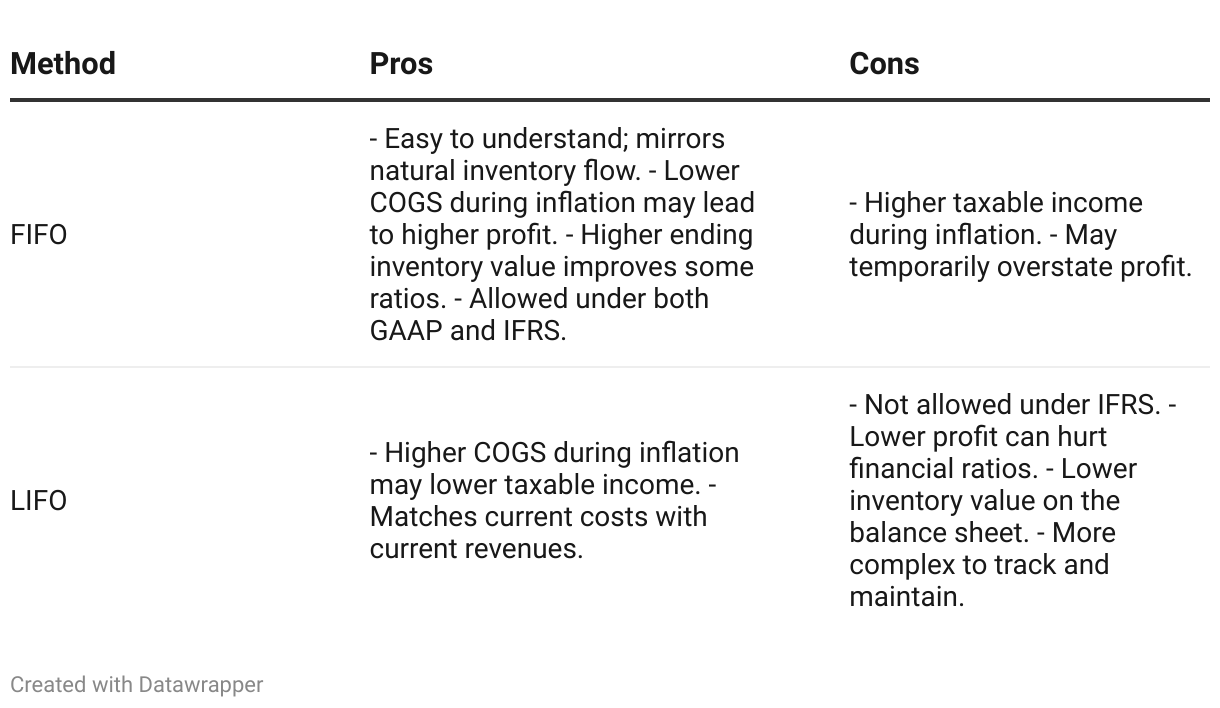
Since FIFO assumes that the oldest inventory is sold first, it will impact your income statement and balance sheet as follows:
The cost of goods sold (COGS) reflects the cost of the oldest inventory, resulting in a lower COGS and a higher gross profit during periods of rising prices.
Inventory is valued based on the cost of the newest items, leading to a higher inventory value on the balance sheet.
LIFO, on the other hand, assumes that you sold the newest inventory first. Your income statement and balance sheet will reflect the numbers this way:
COGS reflects the cost of the newest inventory, resulting in a higher COGS and a lower gross profit during periods of rising prices.
Inventory is valued based on the cost of the oldest items, leading to a lower inventory value on the balance sheet.
It's important to note that these effects are reversed in periods of falling prices, where LIFO would result in lower COGS and higher inventory values compared to FIFO. This reversal occurs because in a deflationary environment, the newest inventory (used first in LIFO) is less expensive than older inventory.
There are certain industry, regulatory, and tax considerations to keep in mind when deciding which inventory valuation method to use.
Deciding whether to use FIFO or LIFO involves assessing several complex factors, one of which is the industry.
Accountants use “inventoriable costs” to define all expenses required to obtain inventory and prepare the items for sale. For retailers and wholesalers, the largest inventoriable cost is the purchase cost.
On the other hand, manufacturers create products and must account for the material, labor, and overhead costs incurred to produce the units and store them in inventory for resale.
You should also know that Generally Accepted Accounting Principles (GAAP) allow businesses to use FIFO or LIFO methods. However, International Financial Reporting Standards (IFRS) permits firms to use FIFO, but not LIFO. Check with your CPA to determine which regulations apply to your business.
The inventory method you choose may impact your income tax liability. To explain, assume that Sterling sells 300 shirts on December 31.
The FIFO and LIFO methods compute different cost of goods sold balances, and the amount of profit will be different on December 31. As a result, the annual profit on shirt sales will be different, along with the income tax liability. Again, these are short-term differences that are eliminated when all of the shirts are sold.
FIFO is the easiest method to use, regardless of industry, and this inventory valuation method complies with GAAP and IFRS. Use the FIFO method for your inventory transactions.
Accounting for inventory is essential—and proper inventory management helps you increase profits, leverage technology to work more productively, and reduce the risk of error.
Using FIFO simplifies the accounting process because the oldest items in inventory are assumed to be sold first. When Sterling uses FIFO, all of the $50 units are sold first, followed by the items at $54.
Let’s expand the example and assume that the store-bought items at five different prices, rather than two. Here are the prices in order: $50, $54, $55.60, $57, $58.25. FIFO still assumes that the $50 items are sold first.
LIFO is more difficult to account for because the newest units purchased are constantly changing. In the example above, LIFO assumes that the $54 units are sold first. However, if there are five purchases, the first units sold are at $58.25.
The LIFO method requires advanced accounting software and is more difficult to track. Keep your accounting simple by using the FIFO method. You’ll spend less time on inventory accounting, and your financial statements will be easier to produce and understand.
The Sterling example computes inventory valuation for a retailer, and this accounting process also applies to manufacturers and wholesalers (distributors). The costs included for manufacturers, however, are different from the costs for retailers and wholesalers.
You also need to understand the regulatory and tax issues related to inventory valuation. FIFO is the more straightforward method to use, and most businesses stick with the FIFO method.
The FIFO and LIFO methods impact your inventory costs, profit, and tax liability. Keep your accounting simple by using the FIFO method of accounting, and discuss your company’s regulatory and tax issues with a CPA.
Use accounting software to account for inventory using less time and with more accuracy. QuickBooks allows you to use several inventory costing methods, and you can print reports to see the impact of labor, freight, insurance, and other costs. With QuickBooks, you’ll know how much your inventory is worth so you can make real-time business decisions.

Call Sales: 1-800-285-4854