









You could save up to 25% on transaction costs².
Speak with us now to see if you qualify.
Talk to sales 1-800-515-8366
Monday - Friday, 6 AM to 4 PM PT

Table of contents
Table of contents
Royalties are payments you earn when others use your creative work. You may receive income from multiple clients across different platforms at the same time.
However, fees and commissions are often taken out before the money reaches your account, but tax is rarely withheld at source. That makes it complicated to work out what you earned, what was withheld, and what you still owe the IRS.
That's also a real concern for 23% of small business owners who told QuickBooks their biggest tax fear is underpaying.
When your intellectual property starts generating passive income, you need to know how to properly account for it. This guide explains how to handle royalty payments, tax obligations, and bookkeeping so you can stay focused on your craft.
Royalties are recurring payments you receive when someone uses something you own, like a book, a song, or a patent. They're usually calculated as a percentage of the sales or revenue your work generates.
Unlike a flat-fee project, like a web design brief or consulting day rate, royalties provide a recurring stream of revenue based on sales or usage volume.
Literary royalties are payments from a publisher for every sale of an e-book, a printed book, an audiobook, or a foreign translation. You receive a percentage of the retail price or net receipts, after returns and discounts.
Some publishers pay an upfront advance plus earned royalties on each sale. Monitor your advance against your earned royalties, because you won't receive any further payments until your earned royalties have exceeded the advance.
Music royalties are income from streaming services, radio airplay, and public performances in venues. These payments are typically split between the songwriter and the performing artist, so if you write and record your own material, you may be entitled to both shares.
The digital distributors that place your music on platforms like Spotify and Apple Music usually provide detailed reports showing exactly what you earned.
Visual arts royalties come from licensing assets like stock photography, digital illustrations, or fonts through agencies like Getty Images or Adobe Stock.
Many agencies only pay out when earnings pass a minimum threshold, so creators often need to track royalties earned separately from cash received. This helps you distinguish between income reported on a platform statement and money that has actually been deposited into your bank account.
Pay attention to whether your agreements are:
The type of agreement you sign affects how your income is categorized for tax purposes.
 What are royalties in business? Royalties aren't limited to creative works. Software developers, for example, earn a percentage of revenue through licensing agreements when others use their code or platforms.
Franchise royalties are payments you receive from a franchisee, a person or company licensing your business name and model to run at their own location.
Franchising is a powerful way for consultants and creators to package their business model to scale without running each location themselves. Franchisees often pay an upfront fee, followed by a monthly flat fee, a percentage of gross sales, and other charges, such as marketing levies and training fees.
Patent royalties are compensation for the use of a patented process, product design, or specialized software code.
Only registered inventions qualify for protection, so make sure your intellectual property is properly registered before entering into any licensing agreement.
These contracts often involve complex legal contracts with specific payment milestones, like a product launch or reaching an agreed sales target. Your financial recordkeeping needs to reflect the specific terms of the licensing duration.
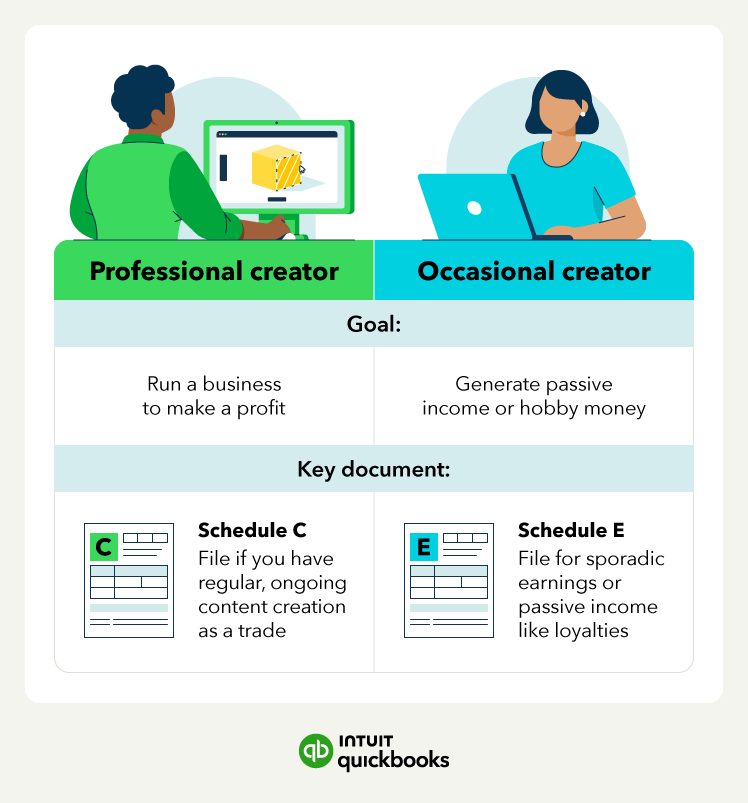
How you record royalty income depends on your role as a creator. The IRS distinguishes between royalties earned in a trade or business and those earned passively, as a hobbyist or investor. This distinction changes which tax forms you use and whether you owe self-employment tax on those earnings.
If you are a professional author, musician, or creator who actively works to generate royalty income, the IRS treats those earnings as active business income.
Report these earnings on Schedule C (the tax form used to declare profit and loss for a sole proprietorship) to allow for business expense deductions. Payments are subject to the 15.3% self-employment tax, which covers Social Security and Medicare for people who work for themselves.
What are mechanical royalties? Mechanical royalties are payments you earn when a business or platform makes your song available through streaming, digital downloads, or physical formats like CDs. They are different from performance royalties, which cover live or broadcast use of your music.
If you earn royalties from something you are not actively working on, such as an inherited patent or a one-time side project, the IRS may treat that as passive income.
Report these earnings on Schedule E of your tax return. Schedule E is the form for supplemental income, like rent and investments.
You will generally not owe self-employment tax on passive royalties, but you can only offset losses from passive royalties against other passive income, not against your regular earnings.
When royalty checks arrive, they often have taxes or fees already deducted. Recording the net amount might seem easier, but tracking the gross amount and the deductions separately gives you a much more accurate view of your business finances.
Your chart of accounts is the list of categories you use to record every item of income and expenditure in your books. Each chart records a different category, such as income and operating expenses, including advertising costs.
Setting up your accounts correctly from the start makes it much easier to track where your money is coming from and what has been deducted:
To record royalty and licensing fees in QuickBooks, follow these steps:

Recording both what you earn and what is deducted is known as double-entry bookkeeping. By keeping your balance sheet up-to-date at the same time, you get a snapshot of your overall financial position at any point in the year.
Tax season is much easier to manage when you know which forms to expect. Preparing a handy small business tax preparation checklist can keep you and your accountant organized so that you file with the IRS accurately and on time.
Any business or platform that pays you more than $10 in royalties during a calendar year is required to report it to the IRS on a 1099 form.
Freelancers use Box 2 of Form 1099-MISC to report royalty payments. This is different from the 1099-MISC vs 1099-NEC, which covers standard independent contractor payments.
Always check your 1099-MISC against your own records before filing to make sure the totals agree with each other.
For freelancers managing agent fees and 1099s alongside their royalty income, QuickBooks Bill Pay handles outgoing costs. It includes unlimited 1099 e-filing, so your payments and your tax records stay in the same place.
Royalties arrive without any tax withheld, which means you are responsible for setting money aside to cover your tax bill throughout the year. The IRS requires freelancers to pay quarterly estimated taxes, four payments spread across the year, to avoid penalties at filing time.
Use QuickBooks to estimate your tax liability based on your royalty earnings to date, so you always know exactly what you owe.
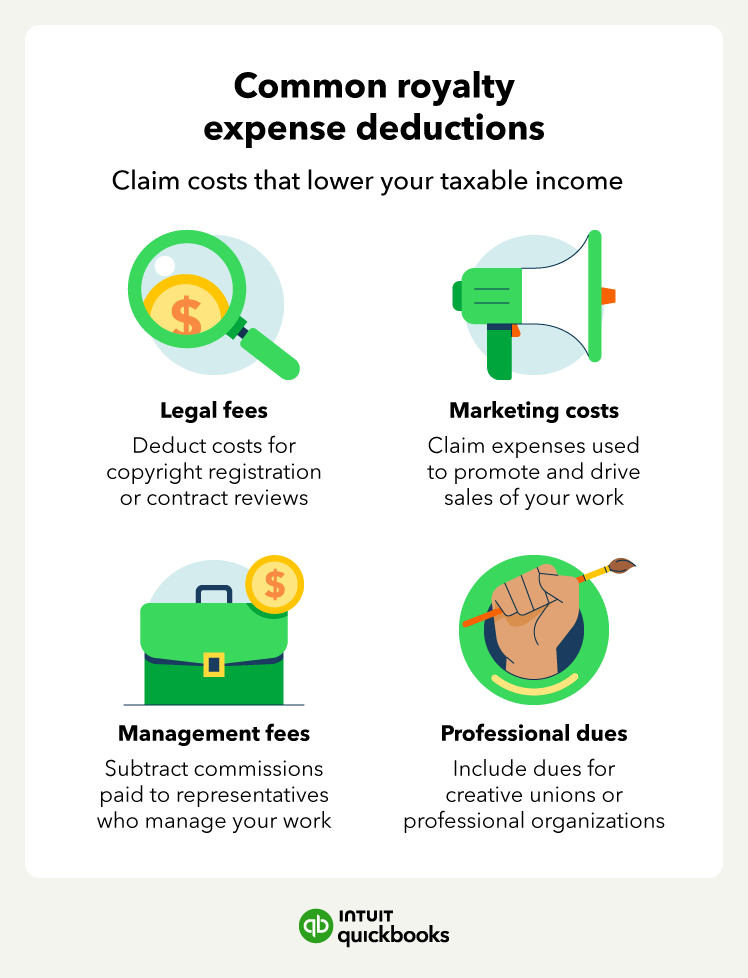
Earning royalties often comes with costs that can reduce your taxable income. Knowing which expenses qualify for deduction and recording them correctly means you only pay tax on your actual profit.
Most costs you pay when creating, protecting, and promoting your royalty-earning work are claimable. It’s easier to track and record them throughout the year rather than gather them all together as the filing deadline approaches.
Common tax deductions for freelancers include:
Make sure you're claiming every available small business tax break.
If your work is sold or used in other countries, you may have extra obligations to follow, like foreign tax withholding and currency exchange rates.
Many countries withhold a percentage of royalties paid to non-residents before the money leaves their borders. Where this applies, you may be able to claim a Foreign Tax Credit on your US return to avoid double taxation.
Save copies of all foreign taxes paid as shown on your international statements, as you'll need these to back up your claim.
When you receive royalties in a foreign currency, record the income using the exchange rate on the day you got paid. Exchange rates change daily, so a payment in UK sterling or euros can be worth a different amount in dollars each time it arrives.
Keeping an accurate accounting ledger ensures you record these differences consistently. QuickBooks can automatically track currency gains and losses, using the same conversion method each time to keep your reporting accurate.
Royalties can generate income long after the initial work is completed. By analyzing your royalty data, you can find which creative projects are worth investing more energy in and where returns are declining.
Run a profit and loss report by class in QuickBooks to see which assets generate the most income for you once expenses have been met. Comparing this year's figures against previous years shows you whether your royalty income is growing, steady, or declining.
Monitor your cash flow statement to see when royalty payments typically peak and dip throughout the year. Knowing when you’re likely to have less money coming in means you can plan your spending accordingly.
Managing royalty income across multiple sources, currencies, and tax categories introduces the potential for human error. The cost of getting it wrong is higher than the time it takes to get it right. Get your bookkeeping right from the start, and when it's time to file your small business taxes, you'll know exactly what you owe.
QuickBooks Online records your gross royalty income, tracks deductions by source, and monitors your tax liability throughout the year so you know your quarterly payment in advance. Start a free trial today.

Call Sales: 1-800-285-4854