QuickBooks Blog
A solopreneur researching common self-employed tax deductions.
taxes

23 common self-employed tax deductions for lowering your tax bill in 2026


Key 2026 self employed tax season updates:

  • The Qualified Business Income (QBI) deduction is now a permanent 20% deduction, increasing to 23% in 2026.
  • The State and Local Tax (SALT) deduction cap for married couples filing jointly is temporarily increased from $10,000 to $40,000.
  • The Section 179 deduction limit for equipment purchases rises to $2.5 million.
  • The 1099-K reporting threshold for third-party payment networks increases to $20,000 AND 200 transactions.


54% of Americans are thinking about starting a new business this year. For many, that means navigating self-employment taxes for the first time.

If you’re self-employed, filing taxes means more than just gathering your 1099 forms. It’s also about knowing which deductions you qualify for. By maximizing deductions, you can lower your taxable income and keep more of your hard-earned money.

We’ll walk you through 23 common self-employed tax deductions every business owner should know about—and give you the tools to stay organized year-round.

1. Home office

2. Self-employment tax

3. State and local taxes

4. Vehicle use

5. Retirement contributions

6. Qualified business income

7. Health insurance

8. Travel

9. Startup costs

10. Depreciation

11. Advertising and marketing

12. Meals

13. Business gifts

14. Software and subscriptions

15. Office supplies

16. Internet and phone

17. Membership dues

18. Professional fees

19. Business insurance

20. Interest expenses

21. Bank fees

22. Rent and utilities

23. Education

Tips for maximizing your deductions

Find peace of mind come tax time

While tax rules can be complex, self-employed professionals can deduct many business-related expenses. You’ll want to take advantage of all the legal tax deductions you can. This will help reduce your tax bill and ensure you maximize profits. 

Let's start with six of the most common tax deductions:

1. Home office

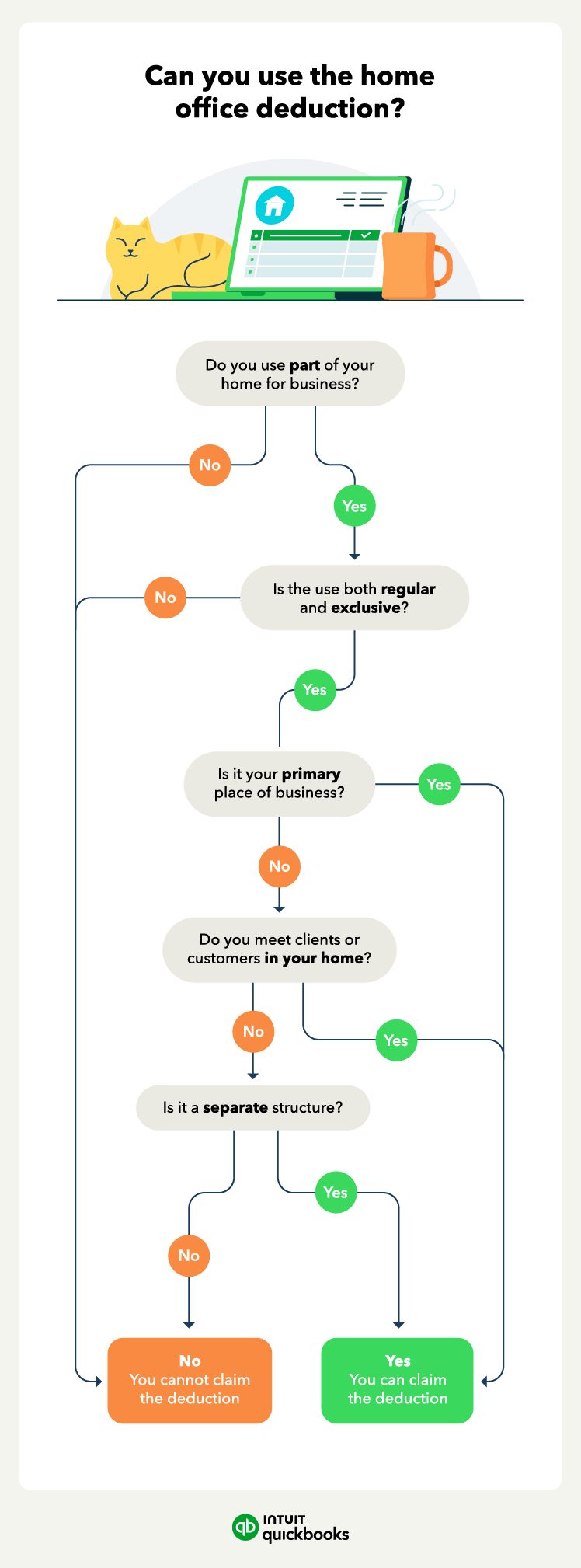
If you use part of your home for business purposes, you can take a deduction based on the square footage of your office. This deduction is available to those who use part of their home regularly and exclusively for business purposes.


To decide whether or not you can use the home office deduction, work through the following flowchart:

A decision tree exploring if you can use the home office deduction.

After determining whether you can take the home office deduction, it’s time to figure out which method to use. You can use either method, so it’s best to use the method that gives you the highest deduction.

Regular method

There are two methods to choose from—regular and simplified. The regular method allows you to deduct part of your home expenses, such as rent, mortgage interest, repairs, and utilities. 

To calculate the home office deduction using the regular method:

  • Add up all your home-related expenses, such as rent and repairs. 
  • Measure the square footage of your office area. 
  • Divide your home office square footage by your total home square footage. 
  • Multiply that percentage by your total home expenses. 

For example, say your home office is 150 square feet, your home is 2,000 square feet, and your yearly home expenses are $15,000. 

Your home office deduction using the regular method is: 

  • (Office square footage / total home square footage) x home expenses 
  • (150 / 2,000) x $15,000 = $1,125

One thing to note as well, if you do sell your home in the future, your gain may also be subject to depreciation recapture. The simplified method is a bit simpler. 

Simplified method

For the simplified method, you measure the square footage of your office area and multiply it by $5. From our above example, your home office deduction for a 150-square-foot office would be: 

  • Office square footage x $5 
  • 150 x $5 = $750 

In our example, the regular method has a higher deduction amount, but it does take more work. Also, note that the simplified method has a $1,500 deduction limit. Even if your home office is more than 300 square feet, you can only deduct $1,500.


lightbulb icon  You can deduct a percent of your total home expense OR $5 per square foot (up to $1,500).

2. Self-employment tax

If you’re self-employed, you’re responsible for paying self-employment taxes, also known as the Federal Insurance Contributions Act (FICA). The FICA tax amount pays for Social Security and Medicare contributions. Unlike payroll deductions, which are automatically withheld by employers, self-employed individuals must manually track and remit their tax payments.

The current self-employment tax rate is 15.3%, which includes 12.4% for Social Security and 2.9% for Medicare. So, if you make $10,000, you’ll need to pay $1,530 in self-employment taxes. 

However, 50% of what you pay in self-employment taxes is deductible. For example, if you pay $1,530 in self-employment taxes, you will be able to reduce your taxable income by $765.


lightbulb icon  You can deduct 50% of your self-employment taxes.


Maximize savings by learning about the 1099 tax deductions

3. State and local taxes

You might be able to deduct some of your state and local taxes, but there are limitations. Since 2017, the deduction for state and local income, sales, and property taxes is capped at $10,000 per household. This means you can't deduct the full amount if your total state and local taxes exceed that limit.  

Be sure to check with your state's tax agency for specific rules in your area.


lightbulb icon  You can potentially deduct state and local taxes up to a limit of $10,000.


4. Vehicle use

Do you regularly drive to meet clients or suppliers? If so, you can take advantage of the tax deductions for self-employed individuals to account for vehicle mileage or normal vehicle wear and tear. 

You can choose between two types of vehicle-related deductions: the standard mileage option or the actual expense option.

Standard mileage rate vs. actual use

The standard mileage rate calculation for your vehicle-use deduction is: 

Standard mileage rate deduction = business miles x IRS standard mileage rate 

The IRS standard mileage rate for business use of your vehicle is $0.70 per mile. To compute your deduction:

Example:

If you drive 6,000 business miles:

6,000 miles × $0.70 = $4,200

This deduction covers all vehicle-related expenses, including depreciation, lease payments, maintenance, fuel, insurance, and registration fees. However, you cannot claim these expenses separately if you use the standard mileage rate.

Or you can track all your car expenses and multiply that by the amount of business-related miles you drove. The formula for the actual use deduction is: 

Actual use deduction = total vehicle expenses x (business miles / total miles)

If your total vehicle expenses are $7,000 for the year, and you drove 6,000 miles for business and 4,000 miles for personal use (10,000 total miles):

$7,000 × (6,000 ÷ 10,000) = $4,200

This method allows you to deduct actual expenses such as fuel, repairs, insurance, and depreciation. However, it requires meticulous record-keeping and may involve more complex calculations.

Both the ‌standard mileage and actual use methods both require you to track the miles you drive for business.


lightbulb icon  You can deduct a percentage of your total vehicle expenses OR the standard mileage rate.


5. Retirement contributions

If you contribute to a retirement plan for yourself, you may be able to deduct these contributions. This includes the individual retirement account (IRA), Simplified Employee Pension (SEP) plan, and 401(k) contributions. 

Note that the annual retirement contribution limit will vary based on the retirement account—be sure not to overcontribute, or you could face a tax penalty.


lightbulb icon  You can deduct 100% of your retirement contributions, e.g. 401(k) or IRA contributions.


6. Qualified business income

The qualified business income (QBI) deduction is a valuable tax break for self-employed individuals and small business owners. It allows you to deduct up to 20% of your qualified business income, which can significantly lower your tax bill. This deduction is available in addition to the standard deduction, so it can make a real difference to your bottom line. 

But what exactly is qualified business income? 

It generally refers to your business's net income—your business income minus your allowable business expenses—though it excludes certain types of income, like capital gains and dividends from investments.  

This deduction has two main parts:

  • QBI Component: This is the core of the deduction. It equals 20% of your QBI from a domestic business operated as a sole proprietorship or through a partnership, S corporation, trust, or estate. The amount you can deduct depends on your taxable income and can be affected by factors like the type of business you operate and whether you paid W-2 wages to employees. Your deduction might also be reduced if you're a patron of an agricultural or horticultural cooperative. 
  • REIT/PTP Component: This component applies to income from Real Estate Investment Trusts (REITs) and Publicly Traded Partnerships (PTPs). It equals 20% of your qualified REIT dividends and qualified PTP income. The amount of PTP income that qualifies might be limited based on your taxable income and the type of the PTP's business.

To ensure you're maximizing this deduction, it's crucial to be aware of the specific income thresholds and limitations that apply to your situation. These can vary based on your filing status (single, married, etc.) and the nature of your business. 


lightbulb icon  You can potentially deduct up to 20% of your qualified business income.


7. Health insurance

Many full-time employees receive health insurance through their employers. However, many professionals need to find their own self-employed health insurance. Those monthly premiums can add up to a hefty chunk of change every month.

Self-employed individuals who meet certain criteria may be able to deduct the cost of health insurance premiums. You can deduct premiums (for yourself and your family) if your business is generating a profit and you’re not eligible to enroll in an employer’s health plan.


lightbulb icon  You can deduct 100% of your health insurance premium payments.


8. Travel

Other tax write-offs available to self-employed individuals are travel expense tax deductions. If you travel to visit clients or attend conferences, you may be able to deduct the cost of travel. Business travel expenses include transportation and accommodation costs. 

For example, if you are a freelancer who travels to attend networking events, you can deduct the cost of these trips. And if you are a consultant who visits clients, you can also deduct travel costs.

To be eligible for this deduction, you must be able to prove that the travel was ordinary and necessary for your business. When deducting your business travel expenses, you shouldn’t attempt to deduct any expenses associated with sightseeing and leisure travel.


lightbulb icon  You can deduct 100% of your travel expenses, e.g., plane tickets and hotels.


Get organized with simple tools right sized for your one person business

Let QuickBooks streamline your books and your business, so you can focus on what you do best.

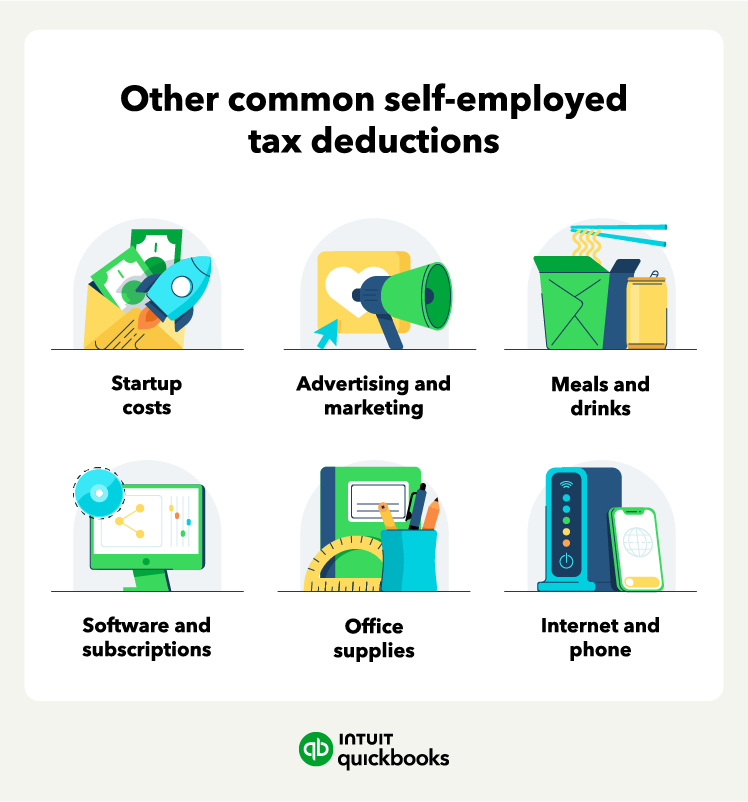
Those are six of the most common deductions that almost all business owners can use. Now, let's take a look at some other common deductions for self-employed individuals.

An illustration of common self-employed deductions like meals and drinks.

9. Startup costs

If you are just starting your business, you can deduct your startup costs from your taxes. This includes things like legal and professional fees for registering as a self-employed business owner.

It is important to note that you can only deduct up to $5,000 of your startup costs from your self-employment taxes. You will need to write off any costs over the $5,000 deduction over 15 years.


lightbulb icon  You can deduct 100% (up to $5,000) of your startup costs, e.g., incorporation fees and website building costs.


10. Depreciation

If you've invested in expensive equipment for your business, like computers, machinery, or vehicles, you don't have to deduct the entire cost the year you buy it. Depreciation allows you to spread out the cost over the asset’s useful life. This can result in significant tax savings over time.

The IRS has specific rules and depreciation methods (like straight-line or accelerated depreciation) depending on the type of asset. Be sure to check IRS Publication 946 for the details.

But here's an even better option for many small business owners:

Section 179: This section of the tax code allows you to deduct the full purchase price of qualifying equipment and software the same year it's placed in service rather than depreciating it over time. This can be a huge advantage for your cash flow and tax liability.


lightbulb icon  You can deduct a portion of the cost of qualifying assets each year over their useful life.


11. Advertising and marketing

Self-employed people typically engage in marketing to grow their business. If you spend money on advertising for your business, you can deduct these expenses from your taxes.

The IRS allows small business owners to deduct the cost of items like flyers, web advertisements, business cards, and print ads, along with other marketing expenses.


lightbulb icon  You can deduct 100% fof your ad and marketing expenses, e.g., social media ads.


12. Meals

Another tax deduction available to self-employed individuals is the meal deduction. This deduction allows you to deduct the cost of meals necessary for your business. You can write off things like meals while entertaining clients.


However, the catch is that you can only deduct 50% of business meals with clients, meals for employees, and office snacks. For meals at companywide parties or food provided for free to the public, you can deduct 100%.


lightbulb icon  You can deduct 50% of your business-related meals and 100% for companywide parties.


13. Business gifts

Want to show your appreciation to clients or business associates? You can actually deduct the cost of business gifts, but there are some rules. The IRS places a limit on how much you can deduct per client per year—currently $25.

Here's what you need to know:

  • What counts as a gift? Generally, it's something tangible with a clear value, like a gift basket, a book, or a company-branded item.
  • What's the $25 limit? You can deduct up to $25 for gifts given directly or indirectly to each person during the tax year. If you and your spouse both give gifts to the same person, you're treated as one taxpayer for the $25 limit.  
  • What about extras? Incidental costs like engraving, gift wrapping, or shipping aren't included in the $25 limit as long as they don't add significant value to the gift.
  • Exceptions to the rule: There are a few exceptions to the $25 limit, such as gifts that cost $4 or less and have your company name clearly and permanently imprinted on them. Also, gifts given to a company (rather than an individual) for use in the business aren't subject to the limit.
  • Keep good records: Keep detailed records of all your business gifts, including the date, recipient, cost, and description of the gift.

With a good understanding of the rules, business gifts can be a smart way to express gratitude and potentially reduce your tax burden. 


lightbulb icon  You can deduct up to $25 per client per year for business gifts..


14. Software and subscriptions

With many shoppers turning to the internet to research services and products, creating a website can be key to success. Self-employed individuals can deduct costs for their business websites, such as domain and hosting fees.  

Other software and subscription expenses you might be able to deduct include accounting software and cloud storage subscriptions. Self-employed individuals can deduct the full cost of any software or subscription if it's entirely for business use.


lightbulb icon  You can deduct 100% of your software and subscription expenses, e.g., accounting software and cloud storage.


Smarter automation. Expert support.

From clean books to more leads, QuickBooks agents work for you when you need them.

15. Office supplies

If you spend money on office supplies for your business, you can deduct these expenses. Typical office supplies may include postage and stationery, but almost any repeat-purchase items you regularly use for your business can be office supplies. For example, highlighters, staplers, paper clips, dry-erase markers, and tape.


lightbulb icon  You can deduct 100% of your office supplies, e.g., pens and paper, printing supplies.


16. Internet and phone

Small business owners who work at home—whether you consider yourself self-employed or a freelancer—can deduct part of their internet and phone costs. If you only use your internet or phone for business purposes, you can deduct the entire bill. But if you use either for personal use, you can only deduct the business use part.

For example, you’ll want to track your time if you use your cellphone for personal and business use. If you use your personal cell phone for business 50% of the time, you can deduct half your cell phone bill.


lightbulb icon  You can deduct 100% of your business-related internet and phone use.


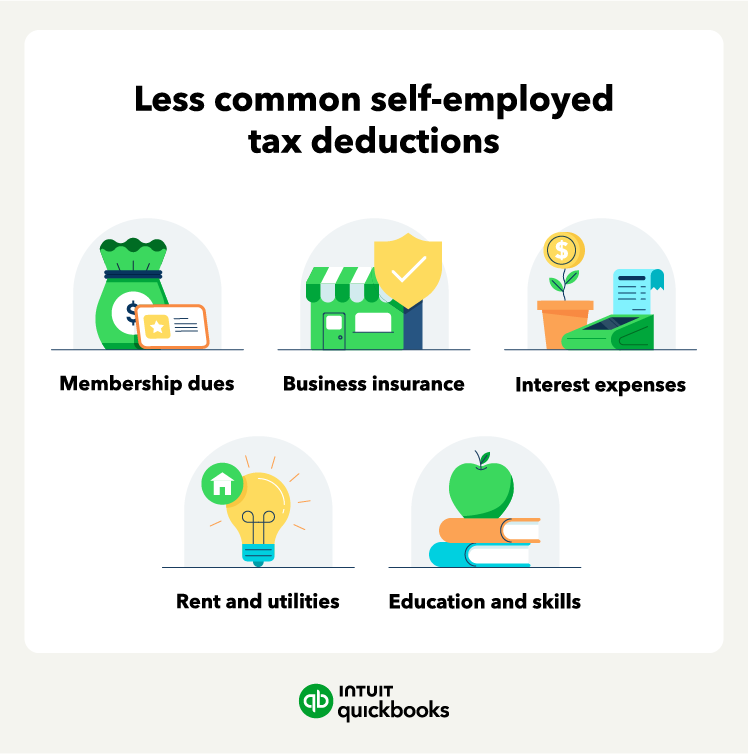
There are even more tax deductions self-employed individuals can take—although these next five might be less common given the nature of self-employed businesses. However, they’re still worth capitalizing on if available to you.

The less common self-employed deductions like membership dues.

17. Membership dues

If you spend money on dues for professional organizations, you can use those expenses to lower your tax burden. Memberships must be for your business, however. 

For example, an accountant may consider the National Society of Accountants or the American Accounting Association as necessary memberships. You should keep detailed records of both your education expenses and dues.


lightbulb icon  You can deduct 100% of your membership dues, e.g., nonprofit organization dues.


18. Professional fees

Running a business often requires seeking help from professionals, and the good news is that you can often deduct the related fees. This includes:

  • Legal advice for things like setting up your business structure or reviewing contracts
  • Accounting and bookkeeping services to manage your finances and prepare tax documents
  • The cost of getting your taxes done professionally

If you need help with broader aspects of your business, like strategic planning or marketing, you can also deduct fees paid to business consultants. 

These expenses are all considered ordinary and necessary for running a business, making them eligible for deduction. Just be sure to keep invoices and records of all professional fees paid.


lightbulb icon  You can deduct 100% of your professional fees.


19. Business insurance

Any type of insurance you have for your business is tax-deductible. For example, some businesses have to carry liability insurance, and any permits you pay for it are deductible. 

You can also deduct insurance premiums that are helpful to your business, such as business income coverage or cybersecurity insurance. Note that premiums for life insurance are typically not tax-deductible.


lightbulb icon  You can deduct 100% of your business insurance, e.g., liability and cyber insurance.


20. Interest expenses

If you have a business credit card, you can likely deduct any interest you pay. This also goes for business loans. For example, if you took out a loan to buy equipment for your business, any interest paid would be tax-deductible.

But you can only take an interest deduction that’s up to 30% of your adjusted taxable income. For example, if your adjusted taxable income is $50,000, your interest expense deduction cannot exceed $15,000.

Note the loan or credit card charges must be for your business. Interest paid for charges or loans related to personal use is not deductible.


lightbulb icon  You can deduct 100% (up to 30% of adjusted taxable income) of your travel interest expenses, e.g., credit card and loan interest.


21. Bank fees

Many of the fees associated with your business bank accounts are deductible, helping you recoup some of those costs. This includes:

  • Monthly maintenance fees: If your bank charges a monthly fee to maintain your business account, you can deduct it.
  • Transaction fees: Fees for things like wire transfers, ATM withdrawals (if for business purposes), and exceeding transaction limits can be deducted.
  • Overdraft charges: While it's best to avoid overdraft fees, they can happen. The good news is that you can usually deduct them.
  • Stop payment fees: If you have to stop payment on a check for business reasons, the fee is deductible.
  • Account closing fees: If you close a business account and incur a fee, that's also deductible.

These fees must be related to a business bank account, not your personal account. It's also crucial to keep thorough records of all bank fees throughout the year.

While these deductions can be helpful, minimizing bank fees altogether is always a smart strategy. With no monthly fees or minimum balance requirements, QuickBooks Checking business bank accounts help you keep more of your hard-earned money.


lightbulb icon  You can deduct 100% of your business bank fees.


22. Rent and utilities

If you rent office space, you can deduct the rent and utilities you pay. Or, if you rent space for other things related to your business, such as a warehouse, storage facility, or manufacturing plant, you can deduct those as well. 

Note that your deduction for prepaid rent may be limited. You can deduct the full amount paid if the period of benefit is 12 months or less. Otherwise, your deduction is limited to the time the property is in use during the tax year.

For example, say you pay $12,000 for a year of rent on July 1. You can deduct the full $12,000 in the year you pay it.

However, if you pay $24,000 for two years of rent on July 1, your deductions will be as follows: $6,000 for the first year, $12,000 for the second year, and $6,000 in the third year for the final six months of rent.


lightbulb icon  You can deduct 100% oof your rent and utilities, e.g., warehouse and storage rent.


23. Education

​​As a small business owner, finding ways to stand out from your competition is key. To stay ahead of the pack, many self-employed individuals attend online business courses and educational seminars.

The cost of these expenses can help you and your business, so the IRS lets freelancers deduct professional development expenses in full. This includes things like books and webinars as well. But they cannot be for general education—they must be related to your business.


lightbulb icon  You can deduct 100% of your education expenses, e.g., webinars and workshops.


If you’re self-employed, you can write off many expenses. Here’s a recap of the 23 best tax write-offs for self-employed individuals:

Tips for maximizing your self employed tax deductions

Knowing what’s deductible is only half the battle, how you track and manage expenses makes a big difference at tax time.

Keep detailed records year-round

The IRS requires proof for every deduction you claim. That means keeping receipts, mileage logs, and invoices. Organizing these in real time avoids scrambling during tax season.

Separate business and personal finances

Open a dedicated business bank account and use a business credit card for expenses. This creates a clear paper trail and reduces the risk of missing deductions or misclassifying personal expenses.

Use accounting software to automate tracking

Spreadsheets can work, but they leave room for error. Tools like QuickBooks Self-Employed automatically categorize expenses, track mileage, and even estimate quarterly tax payments, saving you time and stress.

Common tax deduction mistakes to avoid

Even small errors on your taxes can cost you money or trigger an IRS audit. Here are a few common mistakes to watch out for:

  • Mixing personal and business expenses: Keep your bank accounts and credit cards separate so you don’t accidentally deduct non-business costs.
  • Overstating your home office use: Only deduct the square footage used exclusively for work. Shared or personal space doesn’t qualify.
  • Forgetting to track receipts and mileage: Without proper records, you can’t back up your deductions if the IRS asks.
  • Overlooking smaller deductions: Subscriptions, software, and even business books may be deductible. Don’t leave money on the table.

Find peace of mind come tax time

Self-employment comes with freedom—but also extra tax responsibilities. The good news is that you have more deductions available than traditional employees, which can help lower your tax bill and boost your bottom line.

The key is to stay organized. By keeping records, separating finances, and using tools like QuickBooks Self-Employed, you’ll make filing smoother and ensure you don’t leave money on the table.

Take control of your finances now, and tax season will feel less like a scramble and more like a smart business move.

This information is intended to outline our general product direction but represents no obligation and should not be relied on in making a purchasing decision.

*Customer testimonial based on usage of QuickBooks Solopreneur Beta.

**Product Information

QuickBooks and Intuit are a technology company, not a bank. Banking services provided by our partner, Green Dot Bank, member FDIC.

QuickBooks Payments: QuickBooks Payments account subject to eligibility criteria, credit, and application approval. Subscription to QuickBooks Online required. Money movement services are provided by Intuit Payments Inc., licensed as a Money Transmitter by the New York State Department of Financial Services. For more information about Intuit Payments' money transmission licenses, please visit https://www.intuit.com/legal/licenses/payment-licenses/.

QuickBooks Checking Account opening is subject to identity verification and approval by Green Dot Bank.

QuickBooks Checking account: Banking services provided by and the QuickBooks Visa® Debit Card is issued by Green Dot Bank, Member FDIC, pursuant to license from Visa U.S.A., Inc. Visa is a registered trademark of Visa International Service Association. Green Dot Bank operates under the following registered trade names: GoBank, GO2bank and Bonneville Bank. Registered trade names are used by, and refer to, a single FDIC-insured bank, Green Dot Bank. Deposits under any of these trade names are deposits with Green Dot Bank and are aggregated for deposit insurance coverage up to the allowable limits. Green Dot is a registered trademark of Green Dot Corporation. ©2022 Green Dot Corporation. All rights reserved. QuickBooks products and services, including Instant Deposit, QuickBooks Payments, Cash flow planning / forecasting are not provided by Green Dot Bank.

Users must apply for both QuickBooks Payments and QuickBooks Checking accounts when bundled.

Instant Deposit: Instant deposit is an additional service offered by QuickBooks Payments subject to eligibility criteria, including delayed eligibility for new users and availability for only some transactions and financial institutions. The service carries a 1.75% fee in addition to standard rates for ACH, swiped, invoiced, and keyed card transactions. This 1.75% fee does not apply to payments deposited into a QuickBooks Checking account. Deposits are sent to the financial institution or debit card that you have selected to receive instant deposits. Scheduled instant deposits are run automatically; QuickBooks checks for eligible funds up to 5 times per day. Non-scheduled instant deposits are sent within 30 minutes. Transactions between 2:15 PM PT and 3:15 PM PT are excluded and processed next day. Deposit times may vary due to third party delays.

No minimum balances or monthly fees: There are no minimum balance requirements to open or maintain this account or obtain the listed APY. Other fees and limits apply. See Deposit Account Agreement for details.

Mileage tracking: Mileage tracking is only available to the master administrator of the QuickBooks Online account. Requires QuickBooks Online mobile (“QBM”) application. The QuickBooks Online mobile app works with iPhone, iPad, and Android phones and tablets. Devices sold separately; data plan required. Not all features are available on the mobile apps and mobile browser. QuickBooks Online mobile access is included with your QuickBooks Online subscription at no additional cost. Data access is subject to cellular/internet provider network availability and occasional downtime due to system and server maintenance and events beyond your control. Product registration required.

Syncing bank and cards: Online services vary by participating financial institutions or other parties and may be subject to application approval, additional terms, conditions, and fees.

QuickBooks Live Tax: Powered by TurboTax, is an integrated service available to one-person businesses / sole proprietors who file Schedule C (form 1040). Additional terms and eligibility applies; fees may apply. Some tax situations may not be supported. For guarantee information, see: https://turbotax.intuit.com/corp/guarantees/

Requires QuickBooks Online mobile (“QBM”) application. QuickBooks Mobile app works with iPhone, iPad, and Android phones and tablets. Devices sold separately; data plan required. Not all features are available on the mobile apps and mobile browser. Data access is subject to cellular/internet provider network availability and occasional downtime due to system and server maintenance and events beyond your control. Product registration required.

For more information about the services provided by QuickBooks Live Tax, refer to the  QuickBooks Terms of Service and TurboTax Terms of Service.

# Claims

Get paid 4x faster: Four times faster based on U.S. customers using QuickBooks Online invoice tracking and payment features, compared to customers not using these features, from Aug 2022 to July 2023.


Recommended for you

Mail icon
Get the latest to your inbox
No Thanks

Get the latest to your inbox

Relevant resources to help start, run, and grow your business.

By clicking “Submit,” you agree to permit Intuit to contact you regarding QuickBooks and have read and acknowledge our Privacy Statement.

Thanks for subscribing.

Fresh business resources are headed your way!

Looking for something else?

QuickBooks

From big jobs to small tasks, we've got your business covered.

Firm of the Future

Topical articles and news from top pros and Intuit product experts.

QuickBooks Support

Get help with QuickBooks. Find articles, video tutorials, and more.