- Start Your BusinessStart Your Business
- Starting a BusinessThe tools and resources you need to get your new business idea off the ground.
- PaymentsEverything you need to start accepting payments for your business.
- Funding & CapitalResources to help you fund your small business.
- Small Business StoriesCelebrating the stories and successes of real small business owners.
- Self-EmployedThe tools and resources you need to run your own business with confidence.
- Run Your BusinessRun Your Business
- Running a BusinessThe tools and resources you need to run your business successfully.
- AccountingAccounting and bookkeeping basics you need to run and grow your business.
- Cash FlowTax and bookkeeping basics you need to run and grow your business.
- PayrollPayroll essentials you need to run your business.
- TaxesTax basics you need to stay compliant and run your business.
- EmployeesEverything you need to know about managing and retaining employees.
- Grow Your BusinessGrow Your Business
- Growing a BusinessThe tools and resources you need to take your business to the next level.
- Sales & MarketingSpread the word: What you need to know about marketing your small business.
- FundingHow to find funding and capital for your new or growing business.
- Midsize BusinessesThe tools and resources you need to manage your mid-sized business.
- Enterprise Suite BlogThe tools and resources you need to grow your own business with confidence.
- E-CommerceHow to start and run a successful e-commerce business.
- TaxesTaxes
- How to fill out a 1099-NEC formLearn how to fill out and file 1099-NEC forms for independent contractors and freelancers.
- How to file small business taxesLearn how to navigate tax season with confidence and minimize your tax liability with this guide.
- Small business 1099: What you need to know for 2025Navigate the complexities of small business 1099 forms and filings with our comprehensive guide.
- 13 documents to give your accountant for small business taxesYour accountant will need these documents to file your small business taxes successfully.
- What's NewWhat's New
- NewsBrowse the latest news, press releases, and reports from QuickBooks.
- AI Resource HubFind the latest on Artificial Intelligence.
- Small Business DataThe latest research and insights for Small Businesses from QuickBooks.
- Small Business StoriesCelebrating the stories and successes of real small business owners.
- Holiday SuccessEverything you need to thrive during your business's busiest seasons.
- AI InnovationsBrowse the latest AI innovations in QuickBooks on the Intuit platform.
- ToolsTools
- All ToolsFree accounting tools and templates to speed up and simplify your workflow.
- AI-Powered Invoice GeneratorTry out this free invoice generator to create an invoice online using Intuit Intelligence.
- Payment Cost CalculatorFind out how much you could save by switching to QuickBooks Payments.
- Paycheck CalculatorAccurately estimate pay for all your employees.











A quick overview of accounts receivable management:
- Effective AR management improves your business cash flow by ensuring customers pay their invoices on time.
- Standardized billing procedures reduce the risk of disputes and administrative errors that delay payments.
- Automated payment reminders and digital payment options help small businesses get paid faster with less manual effort.
- Tracking key metrics, like Day Sales Outstanding (DSO), allows you to measure the health of your collections process.
- Clear credit policies help set expectations with customers and protect your business from potential bad debt.
Maintaining a healthy business requires more than just making sales. You need to ensure the money from those sales actually makes it into your bank account. The stakes are higher than many realize: a single late payment threatened payroll or bills for 39% of owners in the past year.
Accounts receivable (AR) management is the backbone of this process. It involves tracking every outstanding invoice and staying on top of collections to keep your cash flow steady.
When you manage your AR effectively, you spend less time chasing payments and more time growing your business. This guide explains how the process works, key metrics to watch, and how to modernize your approach for 2026.
Jump to:
How accounts receivable management works
Accounts receivable management is the system your business uses to track outstanding invoices and monitor customer payments. It’s a lifecycle that begins the moment you offer credit to a customer and ends when the funds are fully settled in your account.
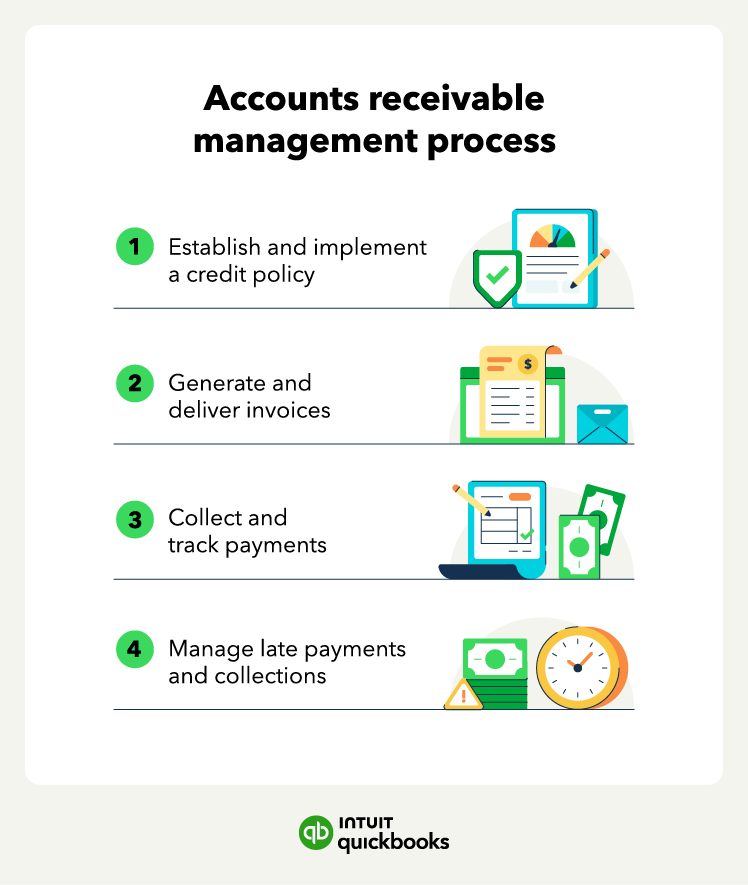
Accounts receivable management involves various steps to ensure timely payment collection, including:
- Establish credit management: Before offering terms, evaluate a customer's creditworthiness. This helps you decide how much credit to extend and reduces the likelihood of nonpayment.
- Generate accurate invoices: Create and send invoices immediately after providing goods or services. Detailed invoices that clearly list items, taxes, and totals help prevent confusion or disputes.
- Streamline payment collection: Offer various ways for customers to pay. Digital and mobile-first payment options are now the standard for speeding up the collection process.
- Handle past due accounts: Have a consistent process for following up on late payments. This requires clear communication to resolve issues or disputes quickly.
Regularly reconciling your payments with outstanding invoices is also a necessity. Once you receive a payment, recording it immediately in your accounting software ensures your financial reports remain accurate.

Accept payments all in one place
Accept cards, ACH, Apple Pay®, PayPal, and Venmo payments. No matter how you get paid, manage it all in QuickBooks so you never miss a thing.
5 ways to improve receivables management
Receivables management helps keep your cash flow healthy. By implementing the right strategies, businesses can improve their accounts receivable management process and minimize issues, such as bad debts, late payments, and outstanding invoices.
Here are five tips to enhance your receivables management and optimize payment collection.
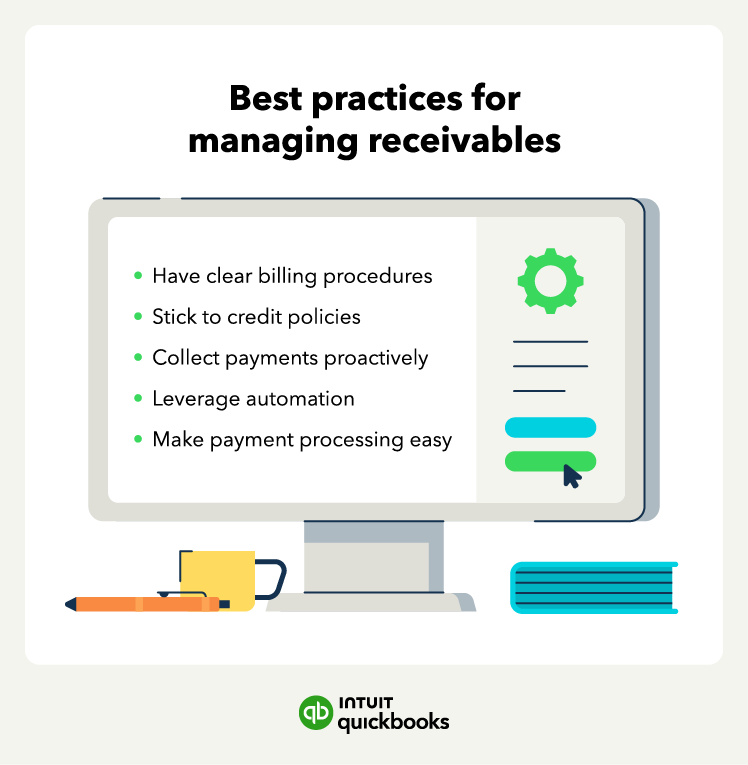
1. Have clear billing procedures
Consistency is the key to getting paid. When your billing follows a strict schedule, your customers know when to expect an invoice.
3 steps you can take:
- Standardize your layout: Use a professional template that clearly highlights the amount due and the due date.
- Itemize everything: Break down products, services, and fees so there is no guesswork for the customer.
- Send invoices immediately: Don't wait until the end of the month. Sending invoices as soon as you’ve completed the work triggers the payment clock sooner.
2. Set and stick to your credit policies
Clear credit terms and conditions ensure clients understand your customer financing requirements. This helps set expectations and avoid confusion regarding payment deadlines and methods.
It’s important to tailor credit policies to your cash flow and business. Larger companies may have more flexibility and can offer longer payment terms to their clients, whereas smaller businesses may need to have shorter payment periods.
3. Be proactive about collecting payments
Waiting for an invoice to become 30 days past due before reaching out is a common mistake. Instead, stay ahead of the deadline:
- Send a reminder three days before a payment is due.
- Follow up immediately the day after a missed deadline.
- Provide a direct link to pay within every reminder email.

Clearly define payment terms on your invoice. Include the due date, accepted payment methods, and any late payment penalties to encourage on-time behavior.
4. Automate where you can
Manual processes can be time-consuming. Implementing automation software or tools allows you to automate repetitive tasks and free up valuable time to focus on more strategic activities.
With an AI-powered accounting assistant, like Intuit Intelligence, you can help automate accounting tasks such as invoicing, payment reminders, and payment collection.
5. Make the payment process as easy as possible
Ensure your payment process is easy and user-friendly for customers. You can make things easy by providing multiple payment options, such as credit cards and ACH payments. Flexibility increases the likelihood of receiving timely payments but also enhances customer satisfaction.
What are the common challenges of managing receivables?
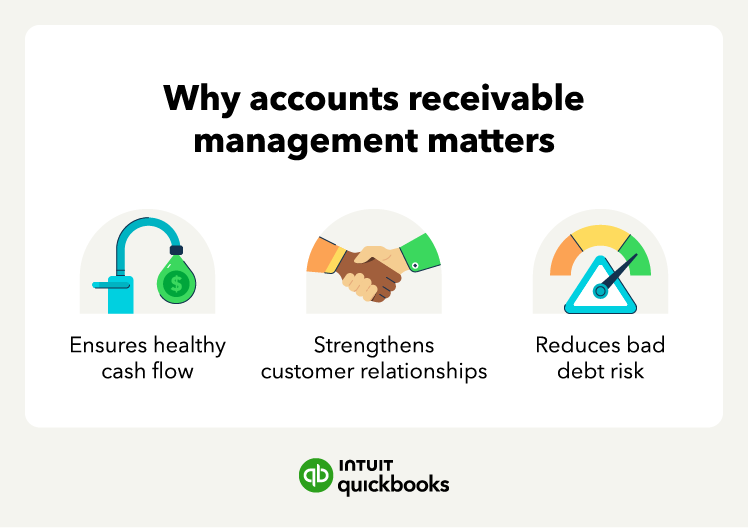
One of the primary goals of accounts receivable management is to ensure the timely collection of outstanding invoices. This ensures strong cash flow and can strengthen your customer relationships.
However, collecting payments can come with challenges. The table below shows how common challenges can impact your business and shares proactive solutions:
Measuring the effectiveness of your AR management
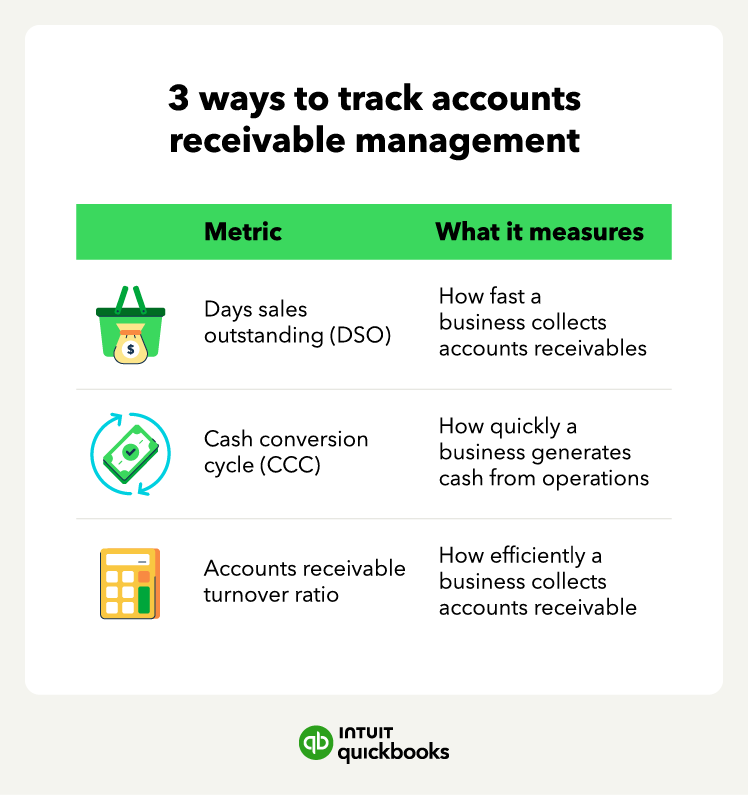
To successfully manage accounts receivable, you’ll want to focus on three metrics: days sales outstanding (DSO), cash conversion cycle, and accounts receivable turnover ratio.
DSO impacts cash flow
Day sales outstanding (DSO) measures the average number of days it takes for a business to collect payment on its accounts receivable. The DSO formula is:
(Average accounts receivable / net credit sales) * Number of days in period
Lower DSO ratios mean you’re collecting receivables quickly. This can improve cash flow.
Cash conversion cycle shows cash generation
Cash conversion cycle (CCC) measures how quickly a business is able to convert its cash into sales and then collect the proceeds from those sales. The CCC formula is:
Days inventory outstanding (DIO) + Days sales outstanding (DSO) - Days payable outstanding (DPO)
A shorter CCC is generally better, as it means that the business can generate cash more quickly.
Accounts receivable turnover measures collection
Accounts receivable turnover ratio is how efficiently you collect your accounts receivable. The accounts receivable turnover formula is:
Net credit sales / Average accounts receivable
The higher the ratio, the more efficient you are at collecting receivables. And while not a traditional metric, customer satisfaction is important in assessing the effectiveness of AR management.
Satisfied customers are more likely to pay on time and maintain a positive business relationship. Clear communication and efficient payment processes contribute to higher customer satisfaction levels.
Strategic considerations for your AR process
As your business grows, your approach to managing receivables will likely need to evolve. Beyond the daily tasks of invoicing and collections, there are high-level decisions regarding software and staffing that can impact your long-term efficiency. Understanding these core objectives helps you choose the right path forward.
Evaluating outsourcing versus in-house management
Deciding whether to keep your collections in-house or hire an external service depends on your volume and complexity. Outsourcing can bring specialized expertise and improved performance, which allows you to focus more on operations.
However, many modern small businesses find that using automation software provides similar efficiency gains while allowing them to maintain a direct, personal relationship with their customers.

Get paid on time, every time
Create a recurring payment and put your payments on auto pilot. Simply set the schedule and amount and share with your customer.
Focusing on core AR objectives
The primary goal of any accounts receivable strategy is to ensure the timely collection of payments. By staying focused on this objective, you naturally minimize the risk of bad debt and reduce the number of overdue accounts.
This focus ensures your business has the cash on hand necessary to cover operating expenses and invest in new opportunities.
Selecting the right automation tools
When you are ready to scale, choosing the right software is essential. Look for tools that reduce manual efforts by automating the lifecycle of an invoice. Key features to prioritize include automatic payment reminders, recurring billing, and digital payment portals that allow customers to pay instantly.
In 2026, the best tools also offer predictive insights to help you identify which accounts might require a more personal touch.
Choose the best payment setup for your business
A successful accounts receivable strategy relies on having the right tools in place. When your accounting software and payment processing work together, you get a real-time view of your business's health.
Using an integrated system like QuickBooks Online allows you to accept digital payments, automate your bookkeeping, and keep your cash flow moving in the right direction.
Recommended for you



Explore what you can do with QuickBooks
Explore what you can do with QuickBooks

See profit at a glance


Manage money
Looking for something else?
Firm of the Future
Topical articles and news from top pros and Intuit product experts.
QuickBooks Support
Get help with QuickBooks. Find articles, video tutorials, and more.
Call Sales: 1-800-285-4854





© 2026 Intuit Inc. All rights reserved.
Intuit, QuickBooks, QB, TurboTax, Credit Karma, and Mailchimp are registered trademarks of Intuit Inc.
Money movement services are provided by Intuit Payments Inc., licensed as a Money Transmitter by the New York State Department of Financial Services. For details about our money transmission licenses, or for Texas customers with complaints about our service, please click here.
By accessing and using this page you agree to the Website Terms of Service.