

You could save up to 25% on transaction costs².
Speak with us now to see if you qualify.
Talk to sales 1-800-515-8366
Monday - Friday, 6 AM to 4 PM PT

Table of contents
Table of contents
More than 5 million business applications are filed in the U.S. each year, according to the U.S. Census Bureau. And one of the first decisions new business owners have to make is choosing a business structure. It affects everything from your taxes and personal liability to how you manage your business.
For many small business owners, an LLC offers a balance of protection and simplicity. It provides more legal protection than a sole proprietorship, without many of the added requirements that come with a corporation.
A limited liability company (LLC) is a business structure created under state law that helps protect your personal assets if your business is sued or owes money. The people who own an LLC are called members. In most cases, members aren't personally responsible for the company's debts or legal obligations.
LLCs are created at the state level, so the rules for forming and maintaining one vary depending on where you do business. State requirements, filing fees, and annual reporting obligations can all differ.
Most states allow single-member LLCs, so you can form an LLC on your own or with one or more co-owners.

Every LLC relies on a few key documents and ongoing requirements to define ownership, establish how the business is managed, and remain in good standing with the state.
It's also important to keep your business and personal finances separate. Using separate bank accounts and records helps preserve your LLC's liability protection and makes bookkeeping and taxes easier.
LLCs are commonly described by the number of owners they have and how they're managed. Here's a look at the most common ownership and management structures.
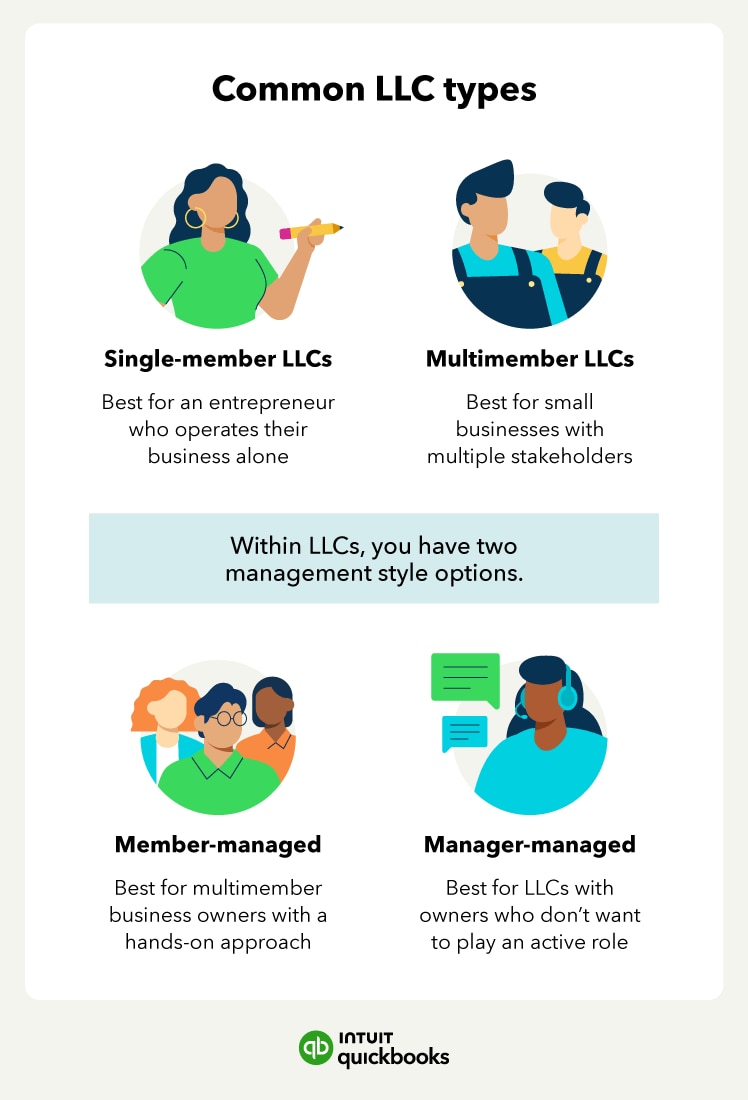
Best for: solo business owners, freelancers, and independent consultants
A single-member LLC has one owner. It offers liability protection while keeping ownership simple. Unlike a sole proprietorship, a single-member LLC creates a legal separation between you and your business.
Best for: businesses with two or more owners who want shared ownership and liability protection
A multi-member LLC works similarly to a single-member LLC. Members typically use an operating agreement to establish ownership, decision-making, profit sharing, and what happens if a member leaves.
Best for: owners who want direct involvement in day-to-day operations
Owners run the business directly. Each member votes on business decisions. This structure may suit small, closely-held businesses where everyone wants involvement.
Best for: owners who prefer a more passive role
Members elect one or more managers—who can be members or outside parties—to handle daily operations. Owners retain authority over major decisions without day-to-day involvement.
By default, LLCs use pass-through taxation. That means the LLC generally doesn't pay federal income tax at the entity level. Instead, business income passes through to the owners, who report it on their personal tax returns.
How that works depends on the number of owners:
Single-member LLCs. The IRS treats a single-member LLC as a "disregarded entity." You report business income and expenses on your personal tax return.
Multi-member LLCs. By default, the IRS taxes a multi-member LLC as a partnership. The LLC files an informational return, and each member reports their share of the business's income or losses on their personal tax return.
If the default tax treatment isn't the best fit, an LLC can also elect to be taxed as an S corporation or C corporation. Depending on your income and business goals, an S corporation election may help reduce self-employment taxes, but it also comes with additional rules and requirements.
If you're unsure which LLC tax option makes sense for your business, consider talking with a CPA or tax advisor before making an election.
An LLC offers a mix of liability protection, tax flexibility, and relatively simple management, making it a popular choice for many small business owners. But it's not the right fit for every business. Before you decide, weigh the potential benefits and drawbacks.
Choosing a business structure means weighing factors like liability protection, taxes, ownership, and how you plan to grow. Here's how an LLC compares with other common business structures.
A sole proprietorship doesn't create a legal separation between you and your business, so you're personally responsible for business debts and liabilities. An LLC provides liability protection by creating a separate legal entity, but it also requires state filing fees and ongoing compliance.
A general partnership allows two or more people to own a business together, but partners can be personally liable for the business's debts and for each other's actions. An LLC also supports multiple owners while providing liability protection and flexible management.
Both LLCs and corporations provide liability protection, but LLCs generally offer more flexible management and fewer administrative requirements. Corporations may be a better choice for businesses planning to issue stock, attract investors, or eventually go public.
Comparing an LLC to an S corporation can be confusing because they serve different purposes. An LLC is a business structure, while an S corporation is a federal tax classification that eligible businesses can elect with the IRS.
Consider an LLC if you:
An LLC business structure may not be optimal for you if you:
Still deciding if an LLC is best for your business? A CPA, attorney, or business advisor can help you compare your options based on your state's rules and your long-term goals.
Starting an LLC generally involves choosing a business name, appointing a registered agent, drafting an operating agreement, filing articles of organization with your state, obtaining an EIN, and opening a business bank account.
For the full walkthrough, read our how to start an LLC step-by-step guide.
Once your LLC is up and running, managing your finances becomes part of your day-to-day life. Having the right tools can help you save time and stay organized.
QuickBooks accounting software helps LLC owners:
Being a business owner comes with enough decisions. With the right foundation and tools to support it, you can stay focused on what matters most: serving your customers and clients and growing your business.








Call Sales: 1-800-285-4854