QuickBooks Blog
Man with curly hair focused on a laptop surrounded by tax-related icons including dollar signs and question marks, indicating uncertainty about sales tax matters.
taxes

Do I need to charge sales tax? A simplified guide for 2026

Table of contents

Table of contents


Everything you need to know about sales tax:

  • What are sales taxes? Sales taxes are a type of tax imposed on the sale of goods and services. The seller is responsible for collecting sales tax, typically a percentage of the purchase prices added to the final cost.
  • Five states currently do not have a statewide sales tax: Alaska, Delaware, Montana, New Hampshire, and Oregon.
  • Proper licensing is mandatory, meaning you must obtain a seller’s permit from your state’s Department of Revenue before you begin collecting tax from customers.


Staying on top of your tax obligations is a fundamental part of running a healthy small business. However, the fear of getting it wrong is widespread: owners are nearly twice as likely to fear underpaying taxes as overpaying.

Knowing whether you need to charge sales tax can be complex, especially since laws can differ from state to state. Let’s look at when to charge sales tax and how much you need to collect in 2026, depending on where you do business.

With QuickBooks, get every tax deduction you deserve.

When to charge sales tax

Whether or not you need to charge sales tax depends on various factors, like your business location and the type of goods or services you sell.

Most of the time, sales tax will depend on what your business offers because tax obligations differ between physical goods, services, and digital products.

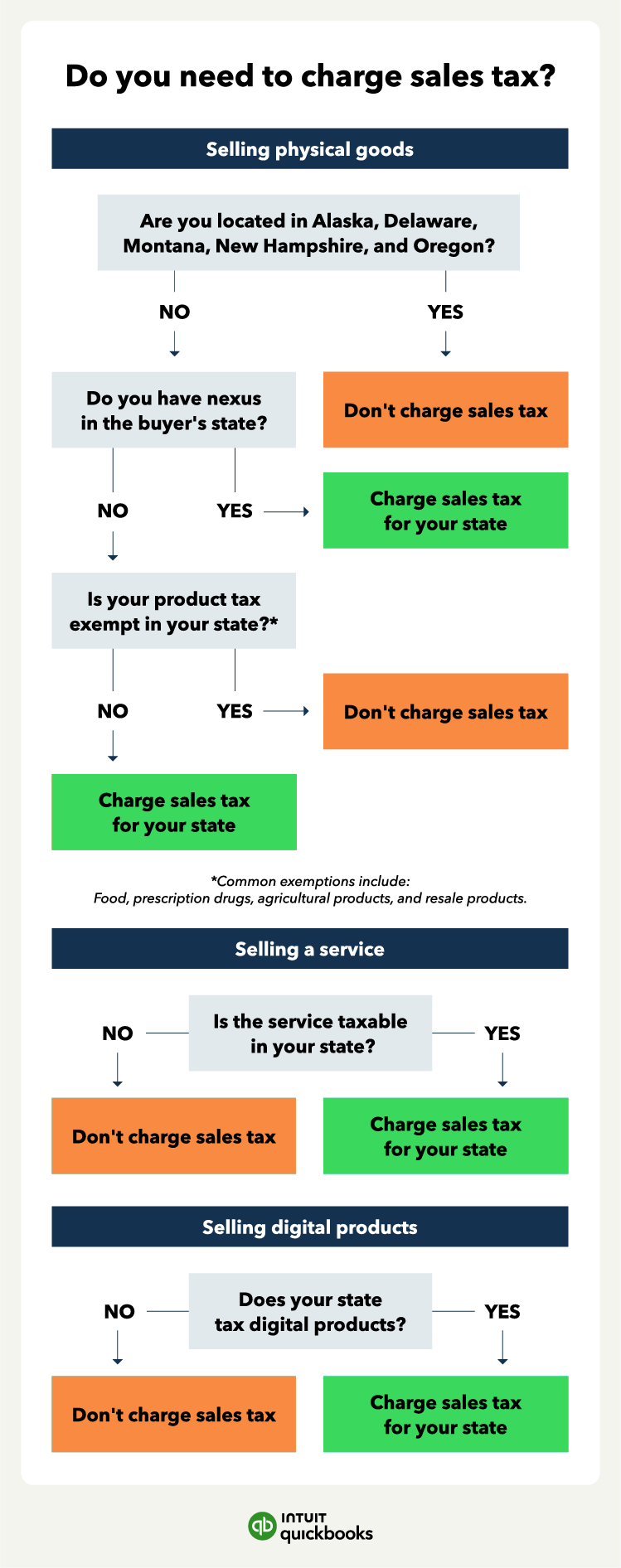
A flowchart guiding readers to answer the question "Do I need to charge sales tax" including selling physical goods, location, nexus, tax exemptions, and digital products, with 'Yes' or 'No' options.

Physical goods

If you sell physical products, you’ll likely have to collect sales tax in any nonexempt state where you have a business presence. Only five states (Alaska, Delaware, Montana, New Hampshire, and Oregon) don’t have a statewide sales tax.

Even in states with sales tax, certain categories of goods are exempt to reduce the burden of essential items:

Services

Sales tax used to only apply to tangible personal property, but Hawaii, New Mexico, South Dakota, and West Virginia now apply it to most services by default. In other states, taxability depends on the category of the service, which typically includes one of the following common areas:

  • Admission to parks, theaters, or concerts
  • Professional help for companies, such as janitorial work or pest control for an office
  • Services for individuals, like haircuts or dry cleaning
  • Licensed expertise, such as legal counsel or accounting
  • Repairs or improvements to physical items, like fixing a car or a watch
  • Improvements to land or buildings, like landscaping or roof repairs

Taxes will depend on the type of service they offer, so it’s best to consult an accountant for advice. States will tax those categories differently or not at all. For example, Alabama charges sales tax only for amusement and recreation services, while Virginia charges sales tax only for services to TPP.

Most religious and nonprofit organizations are exempt from sales tax. Check with an accountant or tax professional in your state to confirm whether your service-based business has a sales tax exemption.

Digital products

The digital economy has moved faster than some tax laws, but in 2026, most states have established clear guidelines for digital goods. This includes:

  • Ebooks
  • Streamed movies
  • Downloadable music
  • Software as a Service (SaaS)

Some states treat a digital download the same as a physical DVD or book. Others distinguish between permanently downloaded products and subscription-based services.

These laws change frequently, so check your state’s specific Revenue Department website to make sure your business is tax-compliant.

Out-of-state

Out-of-state sellers, also called remote sellers, generally won’t need to collect taxes from their customers unless they have a nexus within that state. Literally translated as a “connection,” a nexus means that your business meets one or more of the following criteria:

  • Your business has a physical location in that state
  • Some of your employees reside in and work in that state
  • Your business has property (including intangible property like trademarks, copyrights, and patents) in that state
  • Your employees regularly seek or perform business in that state (for example, you have an active salesperson in that state)

So, many online sellers can ship goods out of state without charging or collecting sales tax, provided they don’t have a physical presence in that state.

However, a number of states have enacted nexus laws that require payment of sales tax when sales to that state from an out-of-state buyer exceed a specific dollar threshold or number of transactions.

There’s one more term you might come across as you research your state tax rates. Use tax is a type of excise tax imposed on the sale of specific goods or services or certain uses.

Use tax is often used for out-of-state purchases but is generally not the seller’s responsibility. In most cases, the purchaser should declare and file this tax in their home state.


How much sales tax do I need to collect?

State tax rates in 2026 generally range from 0% to over 7%. However, the total amount you collect is often higher because many cities, counties, and special districts add their own local taxes on top of the state rate.

Origin-based vs. destination-based states

When you sell to a customer in your own state, you need to know which rate to use. This depends on whether your state is origin-based or destination-based:

Origin-based states currently include:

  • Arizona
  • California (for certain taxes)
  • Illinois
  • Mississippi
  • Missouri
  • Ohio
  • Pennsylvania
  • Tennessee
  • Texas
  • Utah
  • Virginia

All other states with sales tax generally follow destination-based rules.

If you sell goods in one of the 45 states with sales tax, you’re responsible for collecting and filing these taxes with your state government. Since the state tax rates fluctuate monthly, this can be a moving target.

State tax rates range from 0% to 7.25%. For example, you can determine the exact tax rate for a specific address in your state with a sales tax calculator.

Sales tax by state

As we mentioned, deciding if you need to charge sales tax will depend on the type of service or product you sell and your business location. Although some states don’t impose sales taxes, others have state and local tax rates.

Here are the 2026 sales tax rules by state and the method the state uses:

How to handle sales tax paperwork and filing

Before you can legally collect a single cent of sales tax, you’ll need a seller’s permit (sometimes called a sales tax license) from the state’s Department of Revenue. Using a permit lets the state know you’re authorized to collect funds on their behalf.

Sales tax on invoices

When you issue an invoice, you should list the sales tax as a separate line item to provide transparency and simplify bookkeeping. This practice is especially helpful when reconciling your Amazon seller tax data with your overall business records at year-end. Whether you need to include tax on an invoice depends on whether the item is taxable and whether you have nexus in the customer's state.

Hobby vs. business

If you sell items as a hobby, you may still have to collect and remit sales tax. While the IRS treats hobbies and businesses differently for income tax purposes, state sales tax departments generally focus on the individual transactions. 

If you’re selling taxable goods to the public, you likely need a permit and must collect tax, regardless of whether you intend to make a profit.


Filing and frequency

Once you have your permit, the state will assign you a filing frequency—usually monthly, quarterly, or annually. Your sales volume will typically determine this. High-volume sellers file more frequently.

Most states set payment and tax return due dates for the 20th of the month following the reporting period. However, you should confirm this with your local tax authority to avoid late fees.

Find peace of mind come tax time

Navigating the web of state and local tax laws is a significant task for any business owner. While the rules are detailed, the process becomes more manageable when you use the right tools.

Accounting software like QuickBooks helps you remain compliant as your business grows by automating sales tracking, identifying the correct tax rates based on customer location, and generating reports for your filings. If you have specific questions about your business structure, consulting with a tax professional can provide tailored advice for your unique situation.

Ask about discounts

You could save up to 25% on transaction costs².

Speak with us now to see if you qualify.

Talk to sales 1-800-515-8366

Monday - Friday, 6 AM to 4 PM PT

More about payments

Recommended for you

Mail icon
Get the latest to your inbox
No Thanks

Get the latest to your inbox

Relevant resources to help start, run, and grow your business.

By clicking “Submit,” you agree to permit Intuit to contact you regarding QuickBooks and have read and acknowledge our Privacy Statement.

Thanks for subscribing.

Fresh business resources are headed your way!

Looking for something else?

QuickBooks

From big jobs to small tasks, we've got your business covered.

Firm of the Future

Topical articles and news from top pros and Intuit product experts.

QuickBooks Support

Get help with QuickBooks. Find articles, video tutorials, and more.