QuickBooks Blog
An image of a small business owner reviewing their SALT tax deductions.
taxes

What is the 2025 SALT tax deduction? Tax strategy for business owners


Key takeaways:

  • The 2025 SALT deduction cap rises from $10,000 to $40,000 in 2025.
  • It goes up 1% each year from 2026 to 2029, after which the maximum SALT deduction returns to $10,000.
  • The cap decreases by 30% for each dollar over $500,000 annual modified adjusted gross income, dropping back to $10,000 at $600,000.
  • 35 states offer Pass-Through Entity Tax which, depending on your circumstances, may offer better savings.


The federal state and local tax (SALT) tax deduction cap has gone up from its previous $10,000 to $40,000. Below, find out about the new rule and whether it may be a better option than choosing its alternative, the Pass-Through Entity Tax (PTET), instead.

The deductions let you subtract certain state and local taxes for your federal income so you don’t pay tax on the same income twice.

You need to keep your books up-to-date and accurate to see whether you qualify for SALT or PTET. This can be an issue for many business owners as, according to our Entrepreneurship in 2025 report, more than three in ten report mistakes on their tax returns.

Jump to:

What is the 2025 SALT deduction?

The SALT tax deduction is a deduction on Form 1040, Schedule A that allows taxpayers to deduct state income/sales taxes and property taxes paid from their federal taxable income.

The 2025 SALT deduction amendment has raised the maximum deduction. It’s now $40,000 (or $20,000 each if a married couple files separately (MFS). If your modified adjusted gross income (MAGI) is higher than $500,000, the cap begins to decrease by 30% per dollar above that limit.

The cap and thresholds increase by 1% each year from 2026 through 2029. Here’s how this affects the figures year by year:

To qualify, you need to itemize your deductions on Schedule A of Form 1040. You can’t claim it if you use the standard deductions. It’s also not worth claiming if your total deductions are less than $15,750 for a single person or $31,500 for a married couple if you save more with the standard deduction.

The state and local taxes you can deduct on Schedule A include:

  • Local and state income taxes or local and state general sales taxes (like internet sales taxes), but not both
  • State and local property taxes on real estate
  • Where applicable, state and local personal property taxes, like yearly taxes on the value of a car or boat, when imposed.
An image listing the 2025 SALT OBBBA caps through 2030.

Key facts about the SALT 2025 deduction:

  • Goal: The aim of the SALT deduction is to stop citizens from being taxed twice on the same income.
  • Eligibility: Taxpayers claim SALT only when they itemize their deductions. It’s not available if you take the standard deduction.
  • Previous cap: Before the amendment, deductions were $10,000 a year, or $5,000 for married filing separately.
  • 2025 increase: This raised the cap to $40,000, or $20,000 for married filing separately, for tax years 2025–2029.
  • Plans for 2030: The cap rises 1% per year until 2029, before dropping back to $10,000, unless Congress extends the legislation.

How the 2025 OBBA tax law impacts the SALT deduction

The 2025 One Big Beautiful Bill Act (OBBA) introduced a SALT phase-out for earnings over $500,000.

For every dollar your modified adjusted gross income (MAGI) is over $500,000 (or $250,000 MFS), the value of the deduction falls by 30%. At $600,000 or more, your maximum SALT deduction is $10,000.

Here are a couple of examples of how the phase-out works:

Example 1: Your MAGI is $550,000, or $50,000 over the threshold. You lose 30% of that so that’s $15,000 off your SALT cap. So, instead of a $40,000 deduction, your cap drops to $25,000.

Example 2: At $600,000, your deduction is fully phased out. Your cap drops back to $10,000, which is where it was before the 2025 change.

Certified public accountant Jeff Levine called the cap the “SALT torpedo” on LinkedIn. He noted that every extra dollar of income between $500,000 and $600,000:

  • Gets taxed at your marginal rate
  • Reduces your SALT deduction by 30 cents

In other words, you lose out. Let’s say you pay 35% federal tax and pay state taxes of $40,000.

Each extra dollar you earn between $500,000 and $600,000 will cost you 45.5 cents in federal tax. 35 cents of that is the direct tax itself and 10.5 cents is because you lost 30 cents of SALT deductions on that dollar.

So, on a MAGI of $575,000, you pay $34,125 in federal tax on the extra $75,000 of income. Of that, $26,250 is the regular 35% tax and $7,875 is extra tax because your SALT deduction shrinks.


note icon Modified Adjusted Gross Income (MAGI) is the income figure the IRS uses to decide whether you get the full or a capped SALT deduction. MAGI starts with your Adjusted Gross Income (AGI) and adds a few extras on, like income from certain U.S. territories and foreign earned income.


PTET vs SALT: Which should you choose?

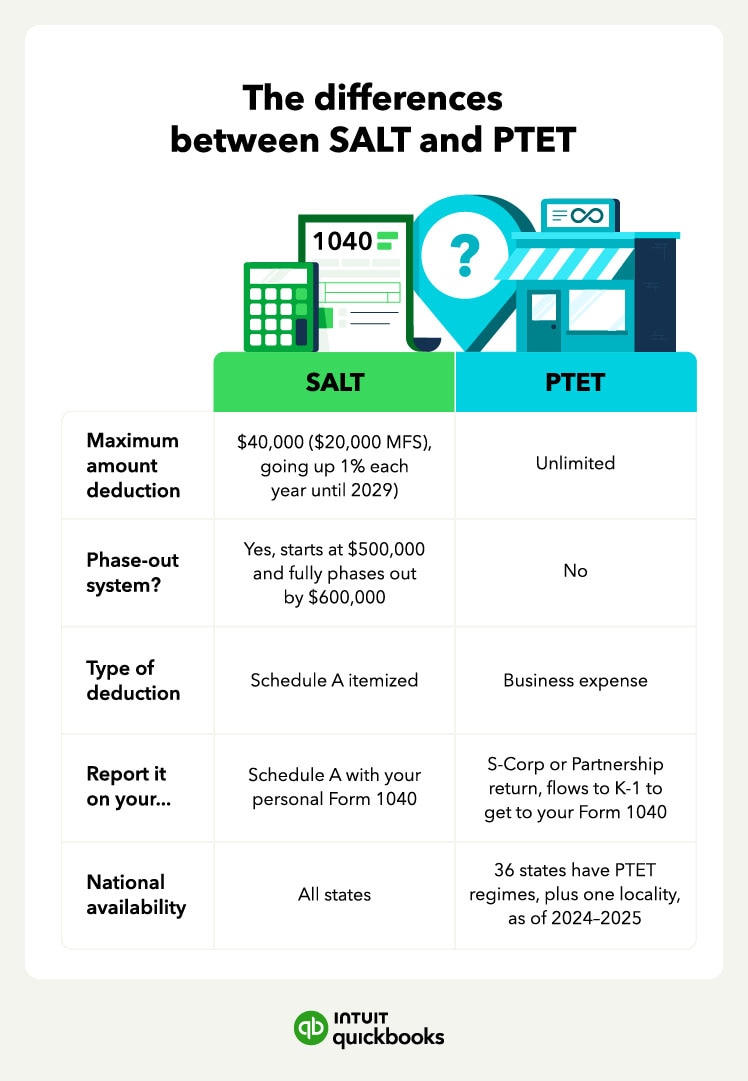
The PTET is an alternative many states offer for S-Corps and Partnerships. PTET is a business expense with no cap, while SALT is a personal itemized deduction with a maximum claim limit.

Here’s how SALT and PTET compare:

A chart comparing the differences between SALT and PTET.

The benefits of PTET for business owners

PTETs allow owners of S-Corps and Partnerships to cut their federal income bill by paying state taxes through the company.

So, instead of you paying, for example, a quarterly estimated payment of your personal state tax, your business pays it for you. When you do this, it becomes another business expense, just like wages or rent. That reduces your share of income from the company, lowering how much personal tax you pay.

Example: Let’s say your S-Corp makes $750,000 in net income. Your state charges 8% income tax, meaning your bill is $60,000. Your combined wages and S-Corp income put you in the 37% bracket.

Your SALT deduction is capped at $10,000 because of your high income. At 37%, you’d only cut your federal tax bill by $3,700.

If your state offers PTET and your S-Corp joins it (or elects into it), the company can deduct that $60,000 at entity level, saving $22,200 in federal tax. That’s an $18,500 difference.

The bigger your income and state tax bill, the more PTET can save you.

You need to be aware of these caveats:

PTET can reduce your qualified business income (QBI), which may shrink your Section 199A deduction. But in many cases, the PTET benefit outweighs the loss, though you should still test it.

If your income is between $500,000 and $600,000, the numbers get trickier due to SALT phase-outs. Run the numbers with your accountant on both SALT and PTET before you decide.

Your accounting, your taxes. All in one place.

Save time by seamlessly moving from books to taxes in QuickBooks, then file your return with unlimited expert help and your maximum refund.*

How to get ready for 2026 taxes for small business owners

If you want to use SALT or PTET to reduce your federal tax bill, you need to start your planning in the same year, not the year after. Take the next three steps:

Forecast income and check the MAGI trigger

First, work out roughly the level of MAGI you expect to report as the current tax year comes to an end.

Here’s how to do this. Run a profit and loss report in your accounting software from January to the end of the last full month. After that:

  • Add any remaining invoices, payments, and bonuses due before 31 December you’re expecting to come in. This can also include any rental profit, W-2 wages, and taxable interest income.
  • Subtract any adjustments you’re planning to claim like deductible retirement contributions or self-employed health insurance.

This gives you an estimate of your adjusted gross income (AGI). MAGI is AGI plus certain niche deductions which, if you don’t claim them, means you can treat AGI and MAGI as the same for planning.

These aren’t your year-end figures, but you’ll see enough to help you decide whether SALT deductions or PTET rules can save you more.

Depending on your estimate, one of the following may be the best course of action:

If your accounting software has a forecasting function, use it to test small changes to income and expenses so you can see where your MAGI is likely to land at year end.


note icon Ask your accountant whether cash or accrual accounting works better for you for SALT and PTET planning. Cash accounting gives you more control over the timing of income and expenses but accrual accounting often gives a clearer picture of business performance when you’re making decisions.


Coordinate state estimated tax payments

To take advantage of PTET, you need to sign up for it in your state.

Bear in mind, you usually only get the federal deduction in the year the PTET or state tax is actually paid. If you pay a PTET installment or state estimated tax bill in December 2025, it goes on your 2025 federal return. If you wait and pay the same bill in January 2026, it counts as a 2026 payment instead.

Each state has its own deadline and rules for PTET applications, for example:

  • New York: You must register between 1st of January and 15th of March in New York.
  • California: You need to make a qualifying PTET prepayment by 15 June of the tax year, then make the election on a timely filed return.
  • New Jersey: You need to register and send in a business alternative income tax (BAIT) return by the 15th day of the third month after year-end and also pay by that date. New Jersey also expects quarterly BAIT estimates during the year.

If PTET is available in your state, contact your accountant to make sure you pay your taxes at entity level (that is, by your S-Corp or Partnership). They’ll be able to advise you on sign-up dates, prepayments, and any small business tax forms you have to submit.

If PTET is not available, ask your accountant to help you make the most of the higher $40,000 SALT threshold by timing your personal payments carefully. They might suggest paying an estimated 2026 tax installment or property tax bill due in December 2025 so it falls in this year.

Get help with your taxes

The interplay between the amended SALT rules and the different variations of PTET between states is complex. With more than 35 states offering some form of PTET, work with a tax professional to choose the route with the greatest savings.

An experienced adviser can model SALT versus PTET outcomes for your situation. They will test different income and payment timings to work out the most tax-efficient option for you and your business entity while helping you see how different choices affect your overall liability.

The investment is worth it as the savings you make can easily reach five figures over a few years if your income and state tax bills are high.

Keeping your financial records in QuickBooks current is key. Your adviser can then log in, run Profit and Loss and tax reports, and base their advice on real-time data.

Find peace of mind come tax time

The quadrupling of the SALT deduction cap gives you a chance to lock in bigger state and local tax deductions and cut your 2025 federal bill. But some taxpayers risk missing out by waiting until filing season is over or by not taking advantage of PTET instead. Working with a proactive accountant and the right accounting software makes it easier to model both options and take the right course of action.

When it comes to more small business tax tips, check out our comprehensive knowledge base. Also, find out more about our latest pricing plans and the range of services QuickBooks can offer your business.


Recommended for you

Mail icon
Get the latest to your inbox
No Thanks

Get the latest to your inbox

Relevant resources to help start, run, and grow your business.

By clicking “Submit,” you agree to permit Intuit to contact you regarding QuickBooks and have read and acknowledge our Privacy Statement.

Thanks for subscribing.

Fresh business resources are headed your way!

Looking for something else?

QuickBooks

From big jobs to small tasks, we've got your business covered.

Firm of the Future

Topical articles and news from top pros and Intuit product experts.

QuickBooks Support

Get help with QuickBooks. Find articles, video tutorials, and more.