BLACK FRIDAY SALE  
70% OFF 
QuickBooks
for 3 months  Ends 11/30
QuickBooks Blog
A business owner reviewing small business tax brackets.
taxes

Understanding small business tax brackets for 2025


Key small business tax bracket changes in 2025: 

  • Inflation adjustments increase individual income thresholds; pass-through entities (like sole proprietorships) may benefit.
  • Deduct up to $1.25 million for qualifying business equipment; phase-out begins at $3.13 million.
  • Several 2017 Tax Cuts and Jobs Act provisions expire at the end of 2025, potentially impacting individual tax rates and the QBI deduction in 2026.


Understanding small business tax brackets is one of the most fundamental steps in filing your business taxes correctly. Whether you operate as a sole proprietor or an established S corporation, filing taxes correctly requires some familiarity with the tax code. This knowledge lets you accurately predict your tax bill and better manage your finances. 

Understanding your small business tax bracket is crucial for effective tax planning. Utilizing professional tax services can help you navigate these brackets and identify strategies to minimize your tax liability.

The IRS continually changes tax laws and brackets to reflect economic changes—for example, adjusting for inflation in 2025—and staying ahead of these adjustments can save you stress and money. 

Ready to demystify your small business tax obligations? Let's dive into how your business is taxed and what you need to know for 2025. 

Jump to:

What are small business tax brackets?

At its core, a tax bracket defines a range of income taxed at a specific rate. You're probably already familiar with how this works for individuals—as your income rises, your earnings are taxed at incrementally higher rates. That's pretty simple.

For businesses, however, your tax bracket depends on your business structure. Some types of companies are taxed as entities and have their own tax brackets, while others "pass through" to your personal tax return. These will use whatever tax bracket your personal tax return falls within.

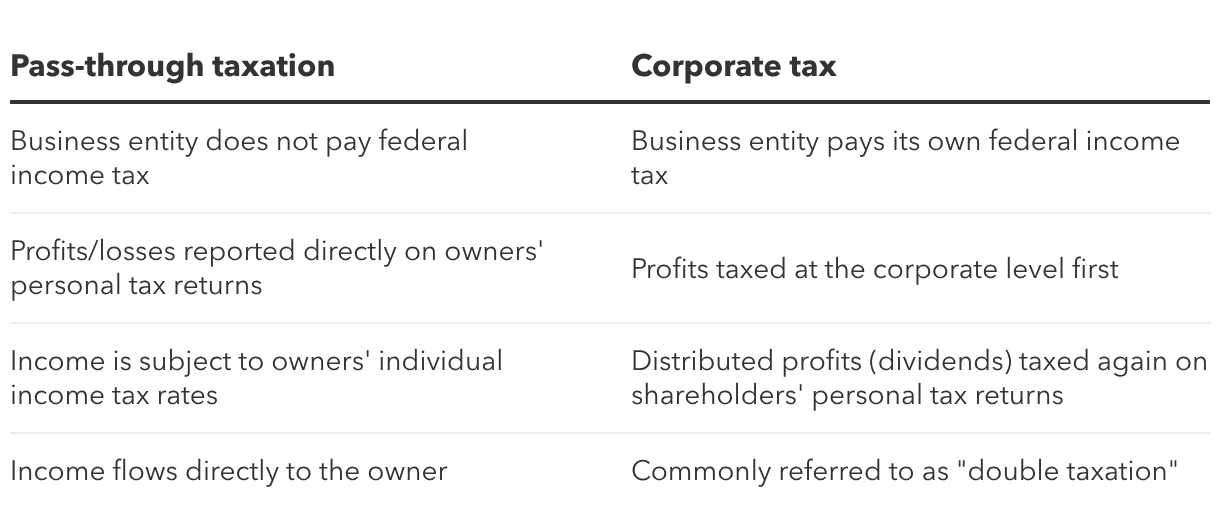
This is called either corporate tax or pass-through taxation.

Key features of each type of tax include:

Your business structure is not just a legal decision—it also has tax implications. You'll want to choose it carefully when starting your business, as it impacts your tax obligations and the tax brackets that apply to your income.


note icon

If you operate as a sole proprietor or limited liability company (LLC), your business's income goes directly to your personal tax return. 

If you structure as a C corp, your business pays its own distinct tax rate. This is a very important distinction during tax season.


2025 federal small business tax brackets

Let's break down the federal tax rates for small businesses in 2025. The first thing to keep in mind is your business structure, as your federal tax rate will vary accordingly. 

C corporations: 21% flat rate

The federal income tax landscape remains straightforward for C corporations. The Tax Cuts and Jobs Act permanently set the federal corporate income tax rate at 21%.

This means your C corporation's taxable income consistently faces a 21% federal rate, regardless of whether it earns $100,000 or $10 million. 

Pass-through entities: Taxed based on individual income brackets

If your small business operates as a sole proprietorship, partnership, S corporation, or a Limited Liability Company (LLC) that has elected to be taxed as one of these structures, then your business functions as a pass-through entity. This means the business itself does not pay federal income tax. 

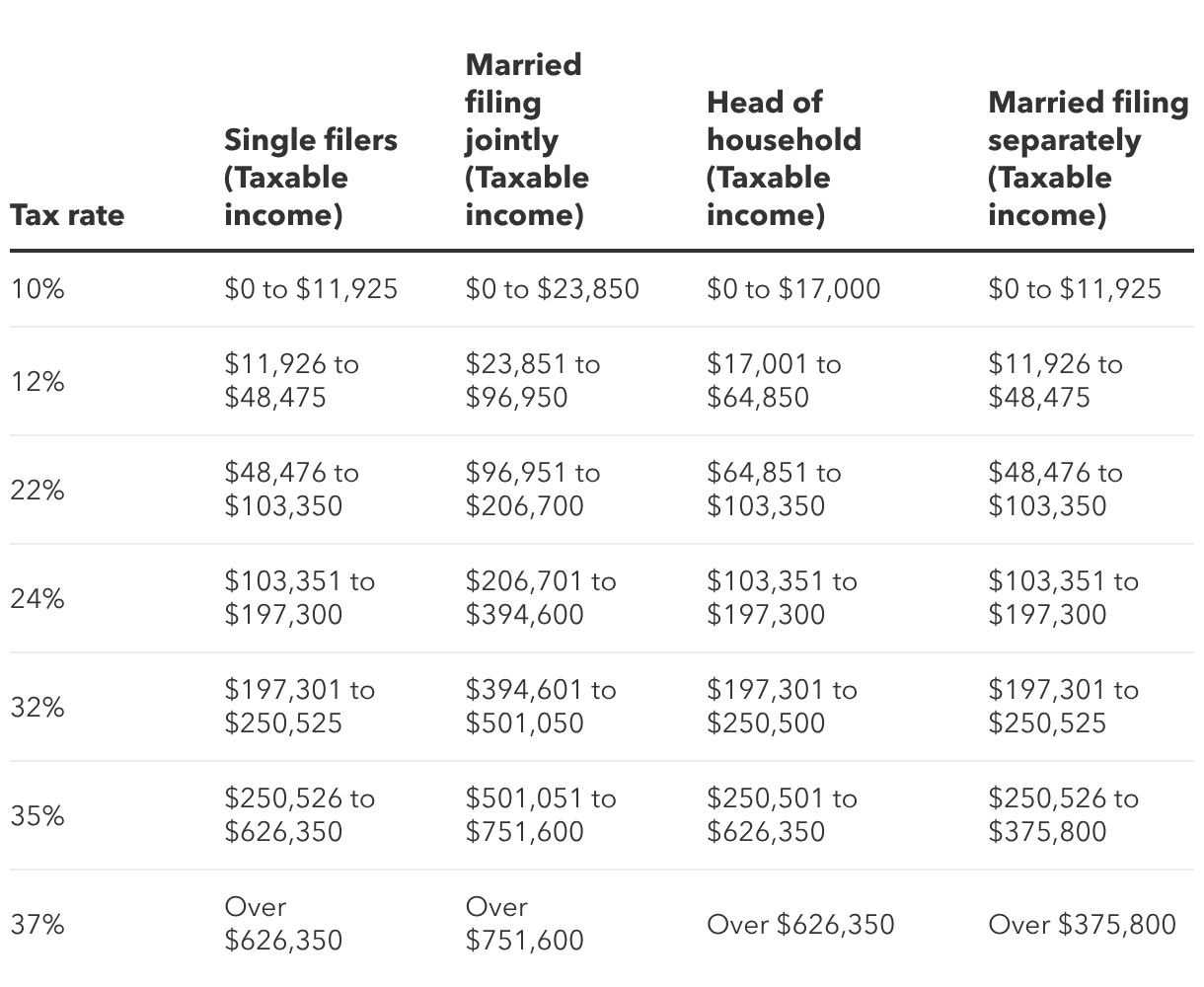
Instead, the profits and losses are "passed through" to the owners and reported on their individual federal income tax returns (Form 1040). To determine your tax rate, you can peruse the table below. 

Here are the updated 2025 individual income tax brackets:

Small business tax brackets by business type

Each business entity type has different rules for taxation, which IRS forms you file, and what deductions you can leverage. If you're looking for a straightforward answer when it comes to small business tax rates, unfortunately, it's not that simple. 

Let's look at the tax brackets and available deductions for each common small business type.

An infographic showing how each type of business is taxed

Sole proprietorship

As a sole proprietor, you and your business operate as the same entity for tax purposes. This structure offers the most straightforward setup.

Taxation: Your business income and expenses report directly on Schedule C Profit or Loss from Business (and Schedule SE if you're self-employed) of your personal federal income tax return (Form 1040). Your net profit then becomes subject to your individual income tax rate.

Common deductions: Leverage business expenses (like home office, supplies, business mileage), and the Qualified Business Income (QBI) deduction.

Partnership

A partnership involves two or more owners who share in the profits or losses of a business.

Taxation: Partnerships are pass-through entities. The partnership files an informational return (Form 1065) showing its income but pays no tax. Each partner receives a Schedule K-1 detailing their share. Partners then report this on their personal Form 1040, paying tax at their individual rate.

Common deductions: Claim business expenses and the QBI deduction.

LLC (single-member and multi-member)

The flexibility of an LLC allows it to choose various tax treatments.

By default, a single-member LLC operates as a sole proprietorship for tax purposes.

Taxation: You report income and expenses on your personal taxes using Form 1040 (with Schedule C) and Schedule SE.

Common deductions: Access the same deductions as a sole proprietorship.

On the other hand, a multi-member LLC functions as a partnership for tax purposes.

Taxation: The LLC files an informational return, and each member reports their share of income on their personal taxes.

The LLC files Form 1065, you receive a Schedule K-1, and then use your individual Form 1040.

Common deductions: Utilize the same deductions as a partnership.

LLC Electing to be taxed as an S-corp or C-corp: 

An LLC can choose to be taxed as an S corporation or a C corporation by filing specific forms with the IRS.

Taxation: As an S corporation, income passes through to owners. As a C corporation, the LLC itself pays taxes.

Forms vary based on your election (Form 1120-S or Form 1120).

Common deductions: Deductions align with the chosen S-corp or C-corp structure.

S corporation

An S corporation offers a special tax election, allowing a corporation to pass its income through to its shareholders for federal tax purposes. This structure helps avoid the "double taxation" of C corporations.

Taxation: An S corporation files Form 1120-S, providing an informational return. Like partnerships, shareholders receive a Schedule K-1 that reports their share of the S corporation's income or losses. Shareholders then report this on their personal Form 1040 and pay tax at their individual income tax rate. 

Common deductions: Take business expenses, the QBI deduction, and potentially realize self-employment tax savings on distributions.


note icon

A key advantage of S-corps is that they can pay owners a reasonable salary and then take distributions, potentially lowering the overall tax burden.


C corporation

A C corporation operates as a separate legal entity from its owners, offering distinct liability protection.

Taxation: The C corporation pays federal income tax on its profits at the flat 21% corporate tax rate. 

If the corporation distributes profits to shareholders, those dividends are taxed again at the shareholder's individual income tax rate, also known as "double taxation." The C corporation files Form 1120 (U.S Corporation Income Tax Return).

Common deductions: Utilize business expenses and specific corporate deductions and credits unavailable to pass-through entities.

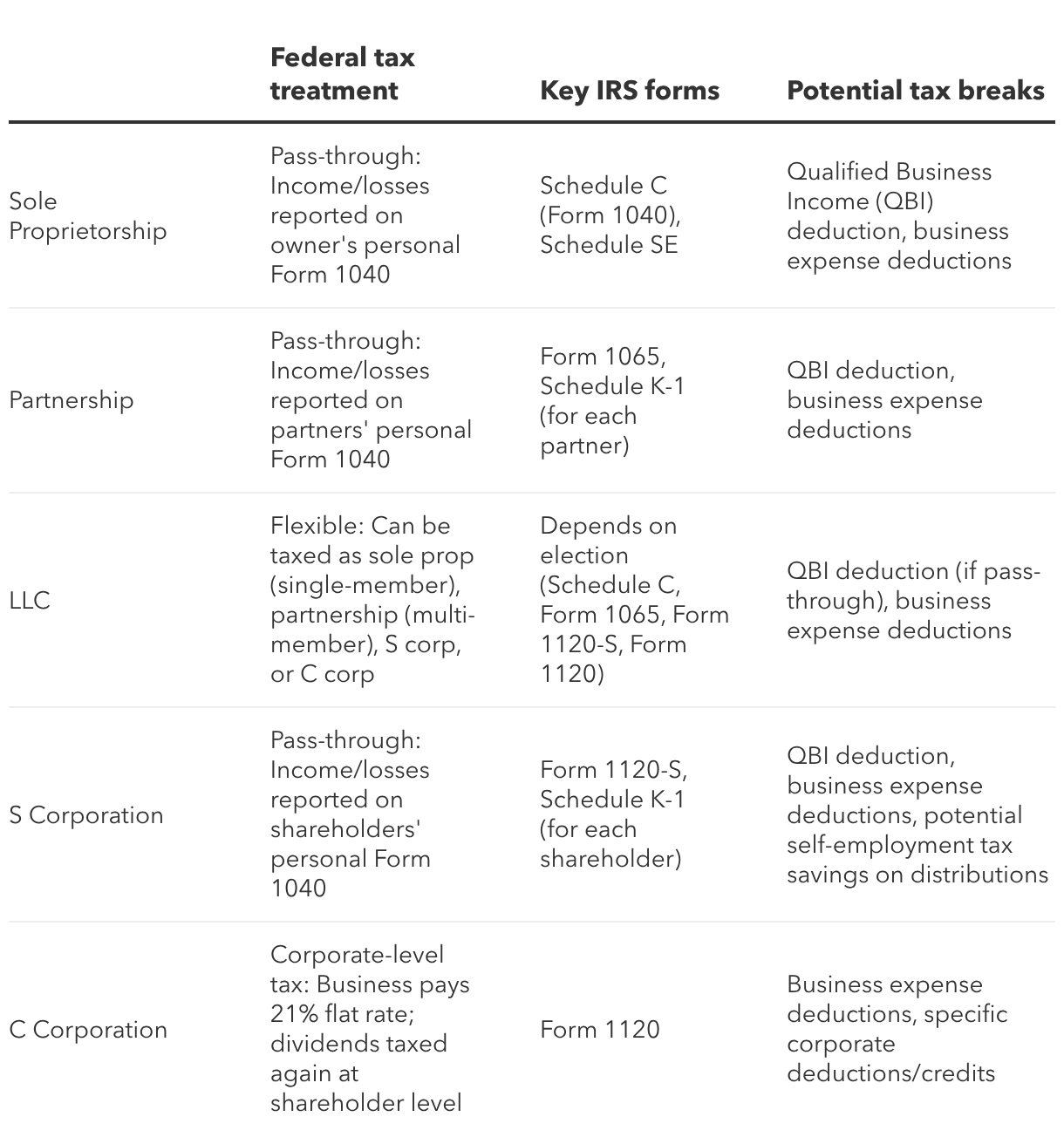
A quick reference guide to business types, appropriate forms, and the corresponding potential tax breaks: 

Do states have small business tax brackets?

The short answer is yes. Most states impose income taxes on businesses, and how they do so varies significantly across the country. It's far from a one-size-fits-all scenario, so you'll want to check your state's rules to know what applies to you. 

State income taxes for small businesses can generally be categorized in a few key ways:

States with no income tax

Alaska, Florida, Nevada, New Hampshire, South Dakota, Tennessee, Texas, Washington, and Wyoming. 

Progressive individual income tax states

Many states tax pass-through entities based on the owner's personal income tax rates, similar to the federal system, with rates increasing as income rises.

This includes: California, Hawaii, New York, and New Jersey.

Flat individual income tax states

Some states apply a single, flat tax rate to all individual income, regardless of the amount.

This includes: Pennsylvania, Illinois, Colorado, Georgia, Indiana, Michigan, North Carolina, Utah. Iowa and Louisiana are transitioning to flat tax systems soon.

Corporate income tax states

Most states (around 44) levy a corporate income tax on C corporations. These rates vary widely, from as low as 0% to nearly 10%. 


note icon

If your business is selling across state lines, you might owe taxes there. Use a sales tax automation software like QuickBooks to help you track and remit state tax obligations accurately.


Additional taxes small business owners should know about

Beyond federal and state income taxes, small business owners often encounter several other tax obligations. Knowing these can prevent unwelcome surprises, which is one of the best small business tax tips for first-time filers. You never want to be surprised by your tax bill.

Here are some additional common tax obligations that you should know about: 

  • Self-employment tax: If you operate as a sole proprietor, partner, or an LLC member, you are responsible for paying self-employment taxes. This covers your contributions to Social Security and Medicare. For 2025, the self-employment tax rate remains 15.3% on your net earnings.
  • Payroll tax (FICA): If you employ staff, you must withhold and remit FICA taxes (Social Security and Medicare) from their wages and pay a matching employer portion. 
  • Capital gains tax: If your business sells assets (like property, equipment, or investments) for a profit, that profit may be subject to capital gains tax. 
  • Sales tax: If your business sells tangible goods or specific services, you likely need to collect sales tax from your customers and remit it to the appropriate state and local tax authorities. Rules vary significantly by state and locality.
  • Property tax: If your business owns real estate or property (like equipment), you will likely owe local property taxes to your local government.
  • Excise tax: These are additional taxes on the sale of specific goods or services. Examples include taxes on fuel, alcohol, or tobacco. You may need to pay extra taxes if your business deals with these items or services. 
  • Dividend tax: If your business operates as a C corporation and distributes profits to shareholders as dividends, those dividends are taxed at the shareholder's individual level.

note icon

Many cities and counties impose their own business taxes, including local income taxes, property taxes, and business license fees. Always check with your local government to ensure you cover all necessary obligations.


Tax deadlines and filing tips for small businesses

Meeting your tax deadlines is critical for small businesses to avoid penalties. Mark these key federal dates for 2025 on your calendar:


Payroll and sales tax filing schedules vary significantly by state, locality, and the amount of tax you owe. Check with your specific state's revenue department and local tax agencies for your precise filing calendar.

For a comprehensive list of all federal tax dates, consult the IRS Tax Calendar.

Tax tips to reduce your small business tax burden

No one likes paying more in taxes than is absolutely necessary. The good news: You can employ (legitimate!) strategies to reduce your taxable income.

1. Track expenses year-round

We've all been there, but don't wait until tax season to gather receipts. Learn how to track your business expenses and record every legitimate business expense. Each documented expense reduces your taxable income, saving you money.

2. Separate personal and business finances

This is fundamental for accurate record-keeping and tax preparation. Delineate income and expenses using a separate business bank account and credit card, which will simplify tax preparation and provide a clean paper trail.

3. Leverage available deductions

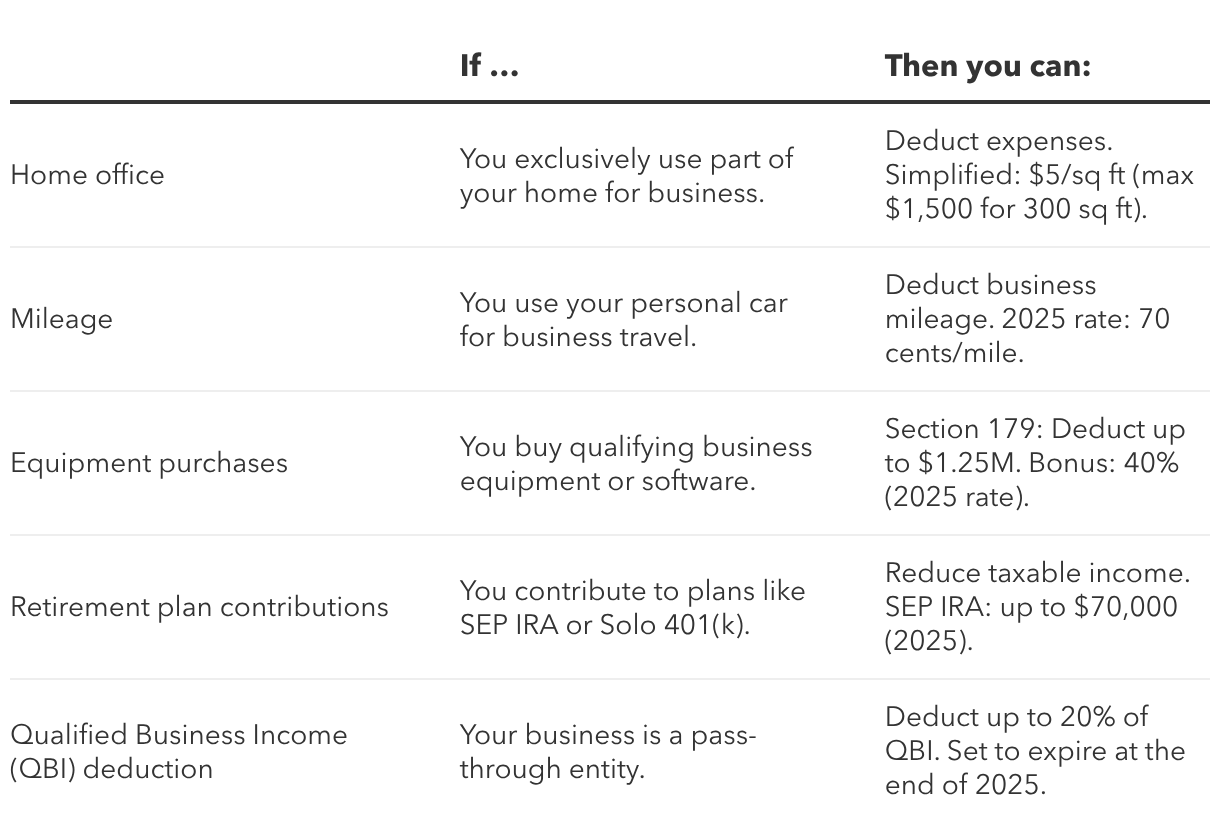
The tax code offers numerous deductions for small businesses. When you prepare your taxes, you'll want to ensure you claim every one you qualify for.

Some common small business deductions include: 

E-commerce and remote business tax considerations

If your small business operates online or remotely, taxes can get complicated. You may even owe taxes in a state where your business doesn't have a location. 

If you sell online, you'll need to become familiar with these tax concepts: 

Your business gains "nexus" in a state if you have a significant connection, obligating you to collect sales tax. This includes economic nexus, meaning sales exceeding certain thresholds (often $100,000) trigger tax duties even without a physical presence.

Keep in mind that states set sales thresholds for nexus. Crucially, most states shift sales tax responsibility to marketplace facilitators (like Amazon) for platform sales, but you still collect tax on direct sales. 

Finally, selling products or services to customers outside the U.S. introduces international tax complexities like Value-Added Taxes (VAT) or Goods and Services Taxes (GST).

That's a lot of rules to be aware of, but tax automation accounting software like QuickBooks can help you track where you will owe taxes based on your sales.

An infographic showing the nexus tax threshold for California, New York, Texas, and other states

Common mistakes to avoid when filing business taxes

Avoid these frequent missteps to ensure a smoother, more accurate tax filing process for your small business.

  • Missing deadlines: This is one of the most costly errors. The IRS imposes strict penalties for late filings and payments, including for quarterly estimated taxes.
  • Using incorrect tax forms: Filing on the wrong form causes delays and requires refiling. Confirm you use the correct IRS forms for your specific business structure.
  • Forgetting to file quarterly estimated taxes: Many small business owners must pay taxes throughout the year. Underpaying or failing to pay estimated taxes results in penalties.
  • Underreporting income: Accurately reporting all income is paramount. Even if the discrepancy was unintentional, it can trigger IRS scrutiny and potential audits. 
  • Not keeping supporting documentation: The IRS requires records to substantiate all reported income, deductions, and credits. Without proper documentation for your expenses, the IRS can disallow your deductions, increasing your tax bill. Always maintain meticulous records.

Tools plus experts, together

Confidently manage your finances with QuickBooks experts by your side.*

How QuickBooks helps you stay on top of small business taxes

Small business taxes can be stressful, but managing them doesn't have to be. QuickBooks is designed to simplify the entire process, helping you organize your financial data and stay compliant.

Using QuickBooks to simplify your accounting can benefit you come tax season in the following ways: 

  • Automatically track income and expenses: Connect your bank accounts and credit cards, and QuickBooks automatically categorizes transactions. This gives you a real-time overview of your finances, eliminating manual data entry.

  • Run reports to estimate tax liability: With all your income and expense data neatly organized, QuickBooks generates essential financial reports like Profit & Loss statements and Balance Sheets. These reports are invaluable for estimating your tax liability throughout the year.

  • Separate business and personal transactions: QuickBooks categorizes transactions as business or personal, maintaining clear financial separation. This simplification streamlines your tax preparation significantly.
  • Integrate with TurboTax or your tax professional: When tax season arrives, you can seamlessly export your QuickBooks data directly to TurboTax for easy DIY filing. Alternatively, securely share your organized financial information with your tax professional.
  • Stay ahead of deadlines automation: QuickBooks also offers features that help you manage payroll and sales tax obligations. It provides reminders and automation tools to meet deadlines without a last-minute scramble.

Know your bracket, avoid surprises

Understanding your small business tax brackets is more than a chore—it's a step towards financial freedom. After all, the goal is to pay only what you legitimately owe and take advantage of every available benefit. The more comprehensive and accurate your bookkeeping, the more of an asset you'll have come tax season. 

Ready to take control of your small business tax prep? Let QuickBooks simplify your tax preparation, from tracking expenses to generating essential reports with Live Expert Assisted Bookkeeping. Get started today to take charge of your business finances.


Recommended for you

Mail icon
Get the latest to your inbox
No Thanks

Get the latest to your inbox

Relevant resources to help start, run, and grow your business.

By clicking “Submit,” you agree to permit Intuit to contact you regarding QuickBooks and have read and acknowledge our Privacy Statement.

Thanks for subscribing.

Fresh business resources are headed your way!

Looking for something else?

QuickBooks

From big jobs to small tasks, we've got your business covered.

Firm of the Future

Topical articles and news from top pros and Intuit product experts.

QuickBooks Support

Get help with QuickBooks. Find articles, video tutorials, and more.