QuickBooks Blog
An image of a small business owner filing taxes that include a miscellaneous expenses section.
expenses

What are miscellaneous expenses?


What are misc. expenses? Miscellaneous expenses are small, business-related costs that don’t fall into standard accounting categories like advertising, payroll, or rent. They’re usually tax-deductible, so it’s worth tracking them carefully to make sure you claim everything you’re entitled to.


Small costs sneak up on you. A $10 spare charging cable here. A $25 tool there. On their own, they’re not a big deal, but together, they add up. These are your business’s miscellaneous expenses.

In our Small Business Insights survey, you told us your biggest challenge is rising costs. Tracking every item of expenditure means you stay on top of spending and make the most of eligible tax breaks. Your accounting software will help you see where these small expenses are going.

In this article, discover the most common types of miscellaneous expenses and how to claim them.

Understanding miscellaneous expenses in accounting

What are some examples of miscellaneous expenses that could be written off?

How to claim miscellaneous business expenses

Find peace of mind come tax time

Understanding miscellaneous expenses in accounting

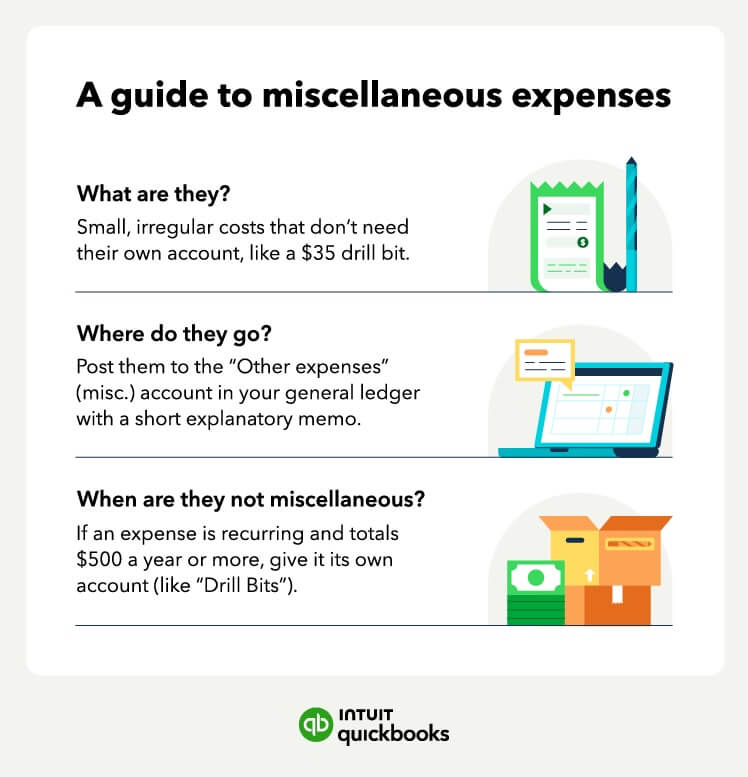
Miscellaneous expenses are small transactions that do not fit within the specified accounts in your ledger. They don’t fall into a specific tax category, but they must be recorded and accounted for in your business’s general ledger. If your miscellaneous expenses increase in size and frequency, you should create a separate account for them.

An image showing the basics of miscellaneous expenses, including what they are, where they go, and how to handle them.

The miscellaneous expenses category offers an easy, concise way to record minor expenditures that are too small to warrant their own account. These expenses are combined into a single general account.

This category is presented as a separate line on an income statement account to ensure clarity and simplicity when filing taxes. Depending on your country’s regulations, you may be able to claim a tax deduction for business-related miscellaneous expenses.

What are some examples of miscellaneous expenses that could be written off? 

Deductible miscellaneous expenses vary by country and depend on local regulations. Below are examples of expenses that can be written off, although these differ based on your country:

  • Clothing or job uniforms
  • Advertising
  • Subscription services for work
  • Accounting and legal fees
  • Interest and bank charges
  • Tools and supplies
  • Job search costs
  • Home office supplies

Clothing or job uniforms

Small, periodic, or one-off costs related to clothing required for your work, such as a uniform or protective gear, may qualify for tax deductions. However, these miscellaneous clothing expenses can only be written off in certain instances and as dictated by your country’s regulations. 

For example, you could claim a tax deduction for work clothes required for safety reasons, such as personal protective equipment (PPE). However, a new wardrobe of nice dress clothes for an office job would not qualify for a deduction.

Advertising

For businesses with a small advertising budget, the advertising costs are classified as miscellaneous expenses and are eligible for deductions.

In most cases, advertising expenses are only deductible if they are associated with your local market. If you hire a firm based outside of your country, you may not be able to claim these advertising expenses.

Subscription services for work

You can claim tax deductions on certain work-related expenses. Periodic publications and subscription services, such as business journals or industry-related courses, fall under this miscellaneous category.


note icon Can I deduct expenses from 1099-MISC? Yes, you can claim allowable business expenses to bring down your taxable income on Schedule C.


Tools and supplies

Tools and supplies include items that are necessary for the operation of your services (such as small tool expenses) and can be categorized as miscellaneous expenses. Typically, tools with a lifespan of one year or less and worth less than $200 fall into this category.

Essential tools that cost more than a few hundred dollars and last longer than one year are generally considered capital expenses and must be considered for depreciation instead.

Job search costs

You may not be able to claim back the time you spent looking for the perfect employee. However, you can still categorize costs associated with finding and hiring a new employee under miscellaneous expenses. Job search costs may qualify for tax deductions under your local regulations.


note icon Hiring staff or working with contractors? Keep a record of your hiring costs—they’re a deductible business expense. If you’re paying contractors, read our tax tips for 1099 contractors and check the 1099 deadline so you send the proper forms on time.


Home office supplies

Self-employed individuals and certain salaried employees can claim the cost of home office supplies on their income tax returns. Due to the COVID-19 pandemic, the guidelines for claiming home office expenses have changed in most countries, as more people are now working from home. Check IRS regulations for more information on what can be claimed as a home office expense.

Accounting and legal fees

Keep track of the fees you pay to consultants and small business tax service providers. These accounting and legal costs may be considered miscellaneous expenses and may be tax-deductible.

  • Your deductions include accounting, legal, and tax preparation fees, such as the costs of preparing and filing your GST/VAT returns and your income tax returns.
  • Suppose you pay accounting or legal fees for professionals to prepare an objection or appeal of an income tax assessment or employment insurance premiums. In that case, you can categorize them as miscellaneous business expenses.
  • Before claiming your deduction, make sure you subtract any reimbursements you receive from the total amount of these fees.

You can’t deduct legal and other fees related to purchasing capital property, but you can add those fees to the property’s cost.


note icon What can you put on itemized deductions lists? Standard itemized deductions include mortgage interest, charitable donations, state and local taxes (within the annual cap), and medical expenses. Check out the differences between standard and itemized deductions to see which approach works best for you.


Interest and bank charges

You can usually deduct interest on a business loan as a business expense. The way you deduct it depends on how you use the loan. Different rules apply to property, vehicles, land, and home offices, so be careful when recording these costs.


note icon If you receive a lot of card or app payments, your payment processor might send you a 1099-K form. Keep it with your tax records, as it shows how much you were paid. Payment charges are not miscellaneous expenses.


Your accounting, your taxes. All in one place.

Save time by seamlessly moving from books to taxes in QuickBooks, then file your return with unlimited expert help and your maximum refund.*

How to claim miscellaneous business expenses

 If you’re a sole proprietor or small business owner filing with the IRS, here’s how to claim miscellaneous expenses: Keep accurate accounting records by saving every receipt and noting the amount, date, vendor, and the purpose of the expense in your accounting software. 

The IRS allows deductions for these two types of costs:

  • Ordinary: Expenses that are common in your line of work, like software subscriptions for a graphic designer
  • Necessary: Expenses that are useful and appropriate for your business, such as mileage to visit a client as a consultant

Remember, you can only claim expenses that are directly related to your business operations.

An image showing the three steps of claiming miscellaneous expenses.

1. Establish an "other expenses" account

In your accounting software, open your chart of accounts and add a new Expense account. You could call it Other expenses, Miscellaneous expenses, or Sundry expenses

In the description field, write something like, “Small, irregular business costs that don’t fit another category,” to remember which expenses belong there. Then, save the account. 

2. Categorize costs throughout the year

Log and categorize small, non-recurring costs that don’t belong in another expense category as they happen in your Other expenses (misc.) account. Do this daily to stay on top of your accounts. 

For example, here’s how a family photography business could record these miscellaneous expenses:

  • Park permit: Smith session ($25)
  • Snack: Keep the child calm during the Jones session ($3)

Make each category easy to understand. This helps you track costs accurately and spot patterns in your spending. For instance, if the photographer noticed multiple costs in the “Park permit” category over the course of a year, they could give it its own named account.

Take time back with AI agents in your corner

Let QuickBooks AI agents handle the busywork so you and your team can focus on what really matters.

3. Maintain documentation

Along with categorizing each expense, keep proof as well. Take note of the amount, date, vendor, and business purpose. Save the receipt, invoice, or statement with the entry.

In your miscellaneous expenses account, an entry might look like:

  • Amount: $25
  • Time: July 14, 2025
  • Place: City Parks Dept., New York City
  • Category: Park permit
  • Business purpose: Little Jimmy’s 4th birthday party at Central Park

This level of detail helps ensure you’re prepared if your accountant or the IRS ever requests supporting documentation for your expenses.

4. Determine total miscellaneous expenses

When it’s time to file your taxes, run a report on your Other expenses account for the year. Add up the small, one-off costs and remove any duplicates, refunds, or personal expenses you’ve accidentally included.

5. Report categorized expenses on Schedule C, Part II

Some items may start in the Other expenses account but later fit a specific category. Move those to the correct account so they appear on the correct line in Part II of Schedule C.

Here are a few common examples:

  • Advertising: Line 8
  • Legal and professional services: Line 17
  • Interest on business loans: Line 16b
  • Supplies (non-inventory, used in the same year): Line 22

Remember that bank fees aren’t considered interest, so don’t include them on Line 16b. Record them in a “Bank charges” account in your accounting software instead, or report them with other miscellaneous items in Part V if you don’t have a separate line.

6. Report remaining uncategorized expenses on Schedule C, Part V

Part II of Schedule C includes lines for many types of costs, such as Advertising, Legal, and Professional Services. If there isn’t a line for a particular expense, report it in Part V (Other expenses) instead. 

Write each type of expense on its own line with an easy-to-understand label that matches your records, such as “Bank charges,” “Small tools,” and “Regulatory fees.” Add up all the items in Part V and enter the total on Line 48. Copy the Line 48 total to Line 27a (Other expenses) on Schedule C.

You’re now ready to calculate your income for tax purposes. Subtract your total expenses, including Line 27a, from your business income to find your net profit or loss on Line 31. That net amount then carries over to your Form 1040.


note icon Set a clear threshold for when to retire the Misc. account for a cost type. If a cost type appears three times or totals $500 in a year (about 1% of your total costs), create a separate account for it. This keeps your other expenses account tidy and makes it easier to record costs on Schedule C correctly.


Find peace of mind come tax time

Keep good records throughout the year, and you’ll have everything you need to claim your tax deductions without stress. Individual miscellaneous expenses are often small, but over the course of a year, they add up. Fewer missed deductions mean a lower tax bill and more cash to reinvest in your business.

QuickBooks accounting software can help you stay organized by automatically tracking your miscellaneous expenses. It can also manage your taxes from start to finish, including sales tax, mileage, and all your other business expenses.


Recommended for you

Mail icon
Get the latest to your inbox
No Thanks

Get the latest to your inbox

Relevant resources to help start, run, and grow your business.

By clicking “Submit,” you agree to permit Intuit to contact you regarding QuickBooks and have read and acknowledge our Privacy Statement.

Thanks for subscribing.

Fresh business resources are headed your way!

Looking for something else?

QuickBooks

From big jobs to small tasks, we've got your business covered.

Firm of the Future

Topical articles and news from top pros and Intuit product experts.

QuickBooks Support

Get help with QuickBooks. Find articles, video tutorials, and more.