
You could save up to 25% on transaction costs².
Speak with us now to see if you qualify.
Talk to sales 1-800-515-8366
Monday - Friday, 6 AM to 4 PM PT

Table of contents
Table of contents
What you need to know about no tax on overtime:
If your employees regularly work overtime, you've probably heard about "no tax on overtime" and wondered what it actually means for your business and your team.No tax on overtime is a federal tax deduction, not an exemption and eligible employees can deduct part of their overtime pay when they file, but nothing changes in their paycheck.
Despite the name, overtime pay isn't tax-free, and your payroll process doesn't change because of this deduction. Employers still have to withhold taxes on overtime throughout the year, the same as before.
The deduction shows up later, on their individual tax return, not in their paycheck. As an employer, your role is tracking overtime accurately so employees have what they need to claim it, especially alongside the other tax breaks available to small businesses this year.
Here's what employers need to know: how the deduction works, who qualifies, and what it means for payroll and reporting going forward.
No tax on overtime is a tax deduction created by the One Big Beautiful Bill Act (OBBBA), also known as H.R. 1, available for tax years 2025 through 2028. Despite the name, it isn't a full tax exemption on overtime pay. Eligible employees can deduct a portion of their overtime earnings when they file their federal tax return, which reduces the income they're taxed on.
The deduction only applies to the premium portion of your overtime pay, the extra half-time required under the Fair Labor Standards Act (FLSA), not the full-time-and-a-half amount.
If an employee is paid time-and-a-half for overtime, that rate is made up of two parts:
Example: Say an employee's regular rate is $20/hour, and they earn $30/hour for overtime. The $10/hour difference is the overtime premium. If they work 100 hours of overtime in a year, that's $1,000 in qualified overtime (not $3,000).
Their take-home pay doesn't change because of this deduction. Overtime is still taxed the same way throughout the year, including Social Security and Medicare withholding. The benefit shows up later, when they file their return and claim the deduction.
To claim the overtime deduction, you generally need to meet all of the following criteria:
A few groups that typically don't qualify include exempt salaried employees, self-employed workers, and anyone whose overtime pay isn't required under FLSA, even if it's required by a union contract or state law.

Non-exempt doesn't always mean hourly. Some salaried employees who earn under $684/week are also classified as non-exempt under the FLSA and may still qualify for this deduction.
Note that several states set a higher salary threshold than the federal minimum, so if you operate in one of those states, check that threshold too.

As an employer, here's what you need to handle so employees can claim the overtime deduction when they file:
1. Confirm qualified overtime pay: Identify the premium portion of FLSA-required overtime, the extra half-time pay, not the full overtime rate.
2. Check how it's reported: Starting with tax year 2026, report qualified overtime separately on Form W-2 (Box 12, Code TT). For 2025 overtime, W-2s likely didn't break this out, so pay stubs or an employer statement served as the fallback.
3. Claim the deduction on Schedule 1-A: The IRS created Schedule 1-A for deductions introduced under the One Big Beautiful Bill Act, including this one. Employees calculate their qualified overtime amount there and carry the total to Form 1040.
4. Apply the annual cap: The deduction is limited by filing status and income (see full limits below).
Because this is a "below-the-line" deduction, it reduces taxable income and overall tax bill, but not adjusted gross income (AGI). In other words, it doesn’t impact eligibility for other tax benefits.
The deduction also only affects your employees' federal income tax returns, meaning your payroll withholding, Social Security, and Medicare taxes stay the same all year. They won't see the benefit until they file, either as a bigger refund or a smaller balance due.
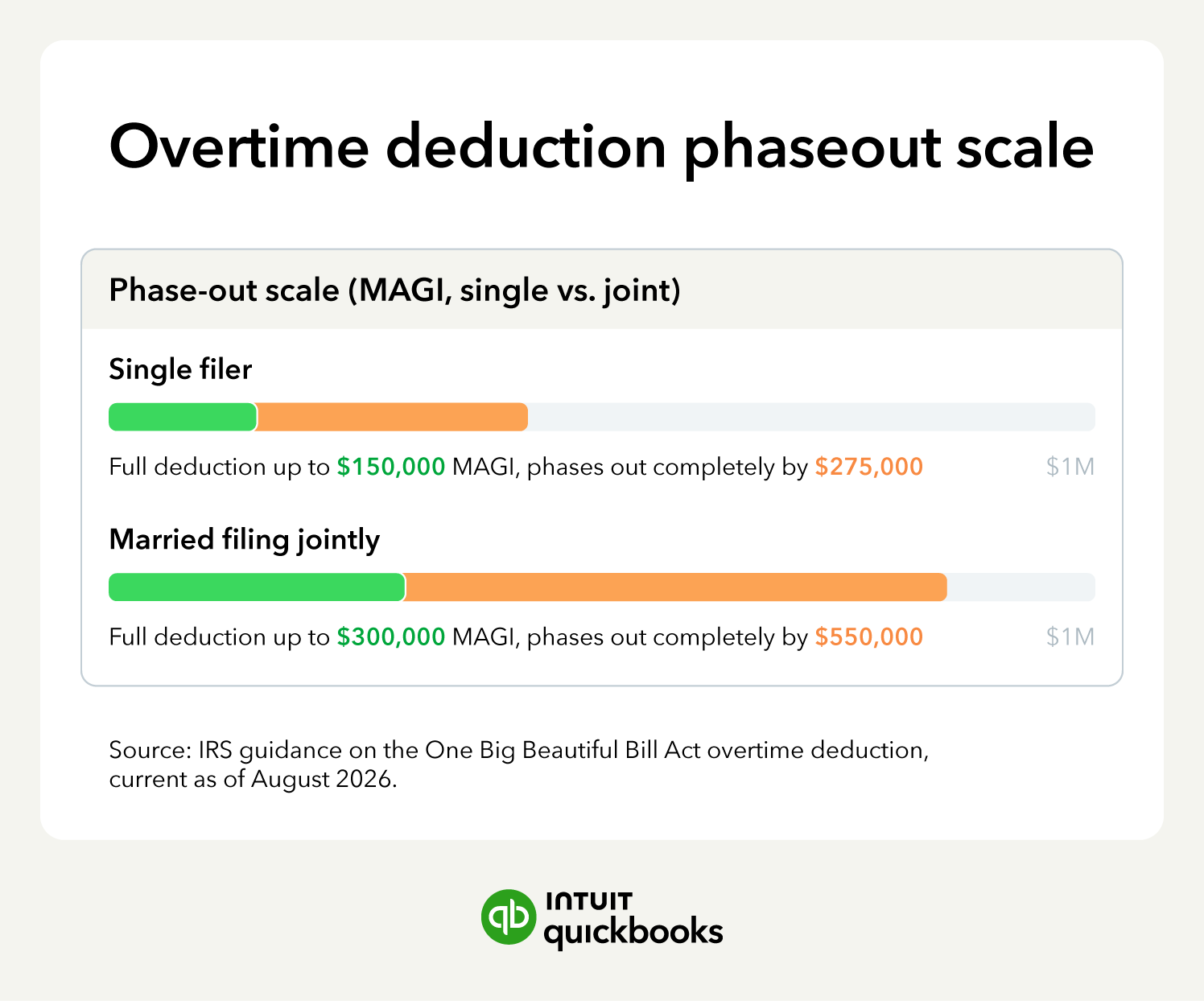
Before factoring this deduction into planning conversations with your team, here are the key limits and rules to keep in mind:

Important: If an employee isn't sure where their income falls relative to the phase-out thresholds, checking their prior year's MAGI on Form 1040, line 11, is a good starting point.
Now let’s go over how the deduction plays out in a few different scenarios. These are simplified for illustration. Actual deductions depend on an employee's full tax situation, so consider these a starting point, not tax advice.
Maria is a single filer who earns $18/hour and has worked 150 overtime hours this year. Her overtime premium is $9/hour ($18 × 0.5), so her qualified overtime totals $1,350 ($9 × 150 hours). Her MAGI is $60,000, well under the $150,000 phase-out threshold, so she can deduct the full $1,350 from her taxable income.
James and Priya are married and file jointly. Their combined MAGI is $320,000, which is $20,000 over the $300,000 phase-out threshold for joint filers. Their deduction is reduced by $100 for every $1,000 over that threshold, a $2,000 reduction. They earned $5,000 in qualified overtime this year, which is under their $25,000 cap, so their deduction is $5,000 minus the $2,000 reduction, for a final deduction of $3,000.
David is a single filer with a MAGI of $280,000. Because that's above the $275,000 threshold where the deduction fully phases out for single filers, he can't claim any portion of the overtime deduction this year, even though he earned qualified overtime.

While this deduction is claimed by employees on their personal tax returns, it does create a few new responsibilities for employers, especially in accurately tracking and reporting overtime.
Here's what to keep in mind as you prepare for the current and future filing seasons.
In a nutshell: The overtime deduction is a tax change, not a labor law change. Keep calculating and paying overtime exactly as you did before.
The overtime deduction doesn't change federal or state overtime laws. Employers should continue to calculate overtime pay in accordance with the FLSA and any applicable state requirements, exactly as they did before this deduction existed.
This is a tax deduction, not a change to overtime eligibility or how pay is calculated. Who qualifies for overtime and how much they're owed is still governed entirely by existing labor law.
If you operate in a state or locality with overtime rules that are more generous than the FLSA (for example, daily overtime after 8 hours), keep that tracking separate. That overtime still needs to be paid, but it won't qualify employees for the federal deduction.
In a nutshell: Keep withholding federal income tax, Social Security, Medicare, and state taxes from overtime pay exactly as you do now.
The overtime deduction doesn't change your withholding obligations. Continue withholding federal income tax, Social Security, Medicare, and applicable state taxes from overtime pay exactly as you do now, unless the IRS issues guidance stating otherwise.
Because the deduction is claimed by employees when they file their tax return, not through payroll, it generally doesn't eliminate normal withholding during the year. QuickBooks Workforce Payroll automatically applies current IRS withholding requirements, so your payroll system stays accurate for both regular and overtime wages without manual tracking.
In a nutshell: Track regular wages and overtime premium separately so employees have what they need to claim the deduction.
Accurate payroll records matter more than ever with this new deduction in place. Make sure your system clearly tracks regular wages separately from overtime compensation, including the premium portion specifically, since that's the figure employees need to claim the deduction. These records also support your year-end tax reporting and give employees documentation to reference if questions come up during filing.
Continue maintaining payroll records in accordance with existing federal and state recordkeeping requirements. Those rules haven't changed, and good documentation now will make compliance easier as reporting requirements continue to evolve.
In a nutshell: Reporting rules have already changed once. Watch for updates and check in with a tax professional as guidance develops.
Implementation guidance for this deduction is still developing. Reporting requirements have already shifted once. A dedicated W-2 field for qualified overtime wasn't required in 2025, but starting with tax year 2026, employers must report it separately in Box 12 using Code TT.
Keep an eye on updates from the IRS, Department of Labor, and any relevant state agencies. If new reporting requirements are introduced, review your payroll processes and consider consulting a tax professional to ensure your systems remain compliant.
QuickBooks can pull the qualified amount into the tracking item automatically if your overtime is straightforward FLSA overtime, time-and-a-half after 40 hours in a workweek.
More complex setups, like daily overtime rules or blended pay rates, need a closer look. You'll want to review or adjust the tracked amount manually so only the FLSA-required premium gets captured.
Either way, the tracking item accumulates throughout the year and feeds directly into your 2026 W-2 reporting. The pay off is that you're not reconstructing the number by hand at year-end.
Keeping up with a new tax provision like this one isn't always simple, especially when you're also managing employees and handling everything else on your plate as a small business owner.
QuickBooks Workforce Payroll, part of the QuickBooks Workforce HR solution, gives you a dedicated way to track qualified overtime as you run payroll, so it flows straight to your W-2 reporting come year-end. Explore how it can help simplify overtime tracking and tax filing.









Call Sales: 1-800-285-4854