QuickBooks Blog
An image of a business professional reviewing W9s.
taxes

What is a W-9? A guide for businesses and contractors


Key tax updates for tax year 2025:

  • The threshold for needing to fill out a W-9 and be issued a 1099 is increasing from $600 to $2,000 in 2026.
  • The IRS is strongly encouraging employers to use the TIN Matching Program to reduce errors and penalties.
  • With the recent increased enforcement of withholding compliance, backup withholding will be more heavily scrutinized in the coming years.


Each year, businesses issue 1099-NECs to the independent contractors, freelancers, and vendors they use. The contractors then use the 1099s to file their taxes. But none of this would be possible without the W-9. 

The W-9 form enables businesses to gather the necessary information needed to issue 1099s. Without a complete and accurate W-9, both companies and contractors could face penalties come tax time. And since around 64 million Americans engage in some form of freelance work, this tax form is crucial for a large segment of the economy.

In this article, we will explore what a W-9 is, what information you need as a contractor to fill one out, and what steps businesses can take when requesting and managing contractor W-9s.

What is a W-9 form used for?

The information you'll need to gather on a W-9

W-9 vs. 1099: What's the difference?

Best practices for handling W-9 forms

Find peace of mind come tax time

What is a W-9 form used for?

A W-9 is a form used to gather personal information for tax filing purposes. In most cases, small businesses use this form when they hire independent contractors or freelancers. The information collected includes the business name, a Social Security number (SSN) or Employer Identification Number (EIN), and the address. 

Once completed, a business can use this information to prepare and issue 1099 forms at the end of the year. A W-9 form is only used to collect information. This form is not sent to the IRS. 

Quick facts about Form W-9:

  • Filled out by independent contractors and other non-employees
  • Used to collect tax info
  • Required for generating accurate 1099s
  • Requested and held by businesses paying contractors

Who fills out a W-9?

Generally, self-employed individuals who provide services to a business may be asked to fill out a W-9. This includes: 

  • Independent contractors 
  • Freelancers
  • Sole proprietors
  • Single-member LLCs
  • Anyone receiving at least $600 in non-employee compensation from a business in a tax year

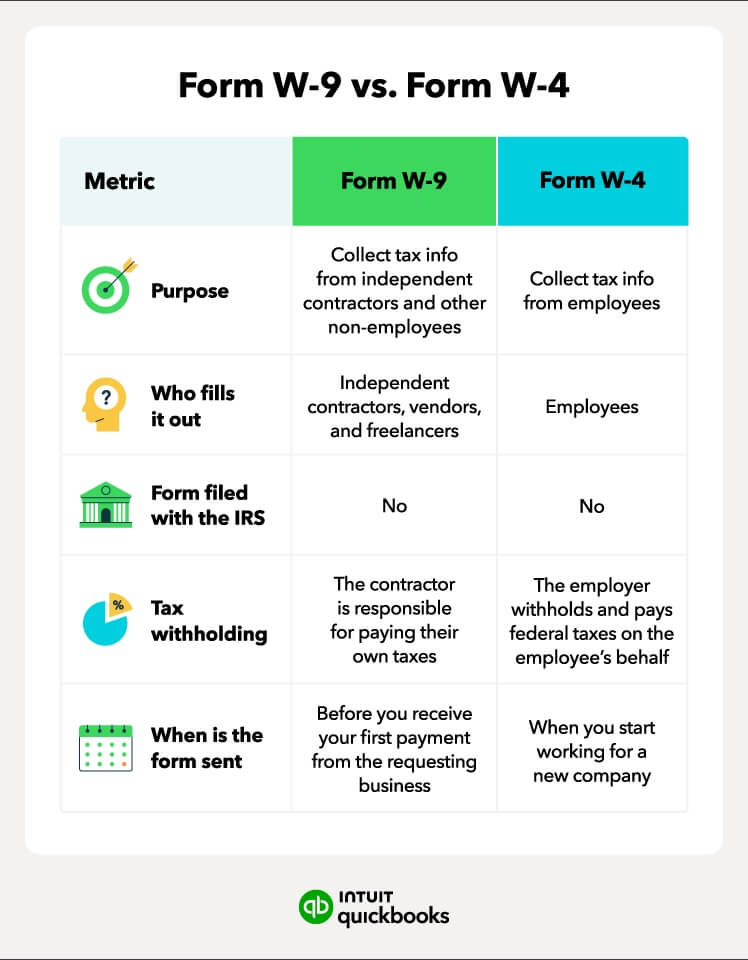
However, individuals who are employed by a business and paid via a W-2 will be asked to complete a W-4 form instead.

A chart showcasing the key differences between W-9 and W-4 forms.

Does a business or individual request a W-9?

Any business or individual (requester) that pays a non-employee for services may require a completed W-9 form. For example: 

  • A startup hiring a freelance graphic designer for a logo design
  • A small business paying a professional to build its website
  • A company paying an attorney for legal services
  • An author hiring a freelance editor to proofread their book

W-9s can also be requested by institutions like banks, mortgage companies, and even sweepstakes companies. 


note icon A similar-sounding form, Form I-9 , is used for determining employment eligibility for immigrants. However, this form is only used for employees. Independent contractors and other self-employed individuals do not need to complete an I-9.


Key information you'll need to gather for an IRS W-9 form

The purpose of the W-9 form is to gather the necessary information about an individual or business to file the required tax forms accurately. To do this, the IRS W-9 form is divided into three main sections: 

  • Basic info
  • Taxpayer identification number (TIN)
  • Certification  

Lines 1, 2, 5, & 6: Name and address

The top portion of the W-9 collects basic information, such as your business name and address. The information you need to fill out will depend on your type of business. 

For the name fields, you’ll need to enter your name plus the business name if there is one. For instance, if you run a small IT business, you’ll need to provide your name (owner’s name) as well as your separate business name. 

The address can be either your business or personal address, whichever you prefer for your tax forms. 

Line 3: Business classification

Selecting the correct business structure/classification on your W-9 ensures that payments you receive are reported accurately. There are several checkboxes for different types of businesses, including: 

  • Individual/sole proprietor 
  • C corporation
  • S corporation
  • Partnership
  • Trust/estate
  • LLC
  • Other

When it comes to LLCs, there is one exception: disregarded entities. So, what is a disregarded entity on a W-9, and how do you select it? Put simply, it is usually a single-member LLC, but more broadly, it is any business that is considered separate from its owner for liability purposes but not for federal tax purposes. 

Because disregarded entities file taxes in their owner's name, you should select the classification that applies to the owner, not the business. 

Line 4: Exemptions

Certain entities may be exempt from backup withholding or Foreign Account Tax Compliance Act (FATCA) reporting. This means that the 24% tax withholding rate will not apply to any payments received. Generally, exemptions are available only in limited situations, such as for real estate investment trusts and government agencies. 

Most sole proprietors and small businesses can skip line 4, Exemptions on the W-9 form.


note icon Backup withholding usually only applies when you fail to provide the requester with an accurate Taxpayer Identification Number. The backup withholding rate is 24% regardless of income or filing status. At the end of the year, any money withheld will be credited against your tax liability.


Part I: Taxpayer Identification Number (TIN)

Your TIN is what identifies you as a taxable entity. It is crucial for avoiding backup withholding and for ensuring you can claim all the tax breaks your business is entitled to. 

There are three types of TINs: 

  • Social Security number (SSN) - often used by independent contractors and freelancers
  • Employer Identification Number (EIN) - any person, business, or entity that has applied for a separate identification number for business purposes
  • Individual Taxpayer Identification Number (ITIN) - resident aliens not eligible for a SSN

If you have an EIN, you must enter this number in Part I, not your SSN or ITIN. 

Part II: Certification

The last part of the W-9 form is the signature portion. By signing the form, you certify that all information is correct and that you are not subject to backup withholding.

Your accounting, your taxes. All in one place.

Save time by seamlessly moving from books to taxes in QuickBooks, then file your return with unlimited expert help and your maximum refund.*

W-9 vs. 1099: What's the difference?

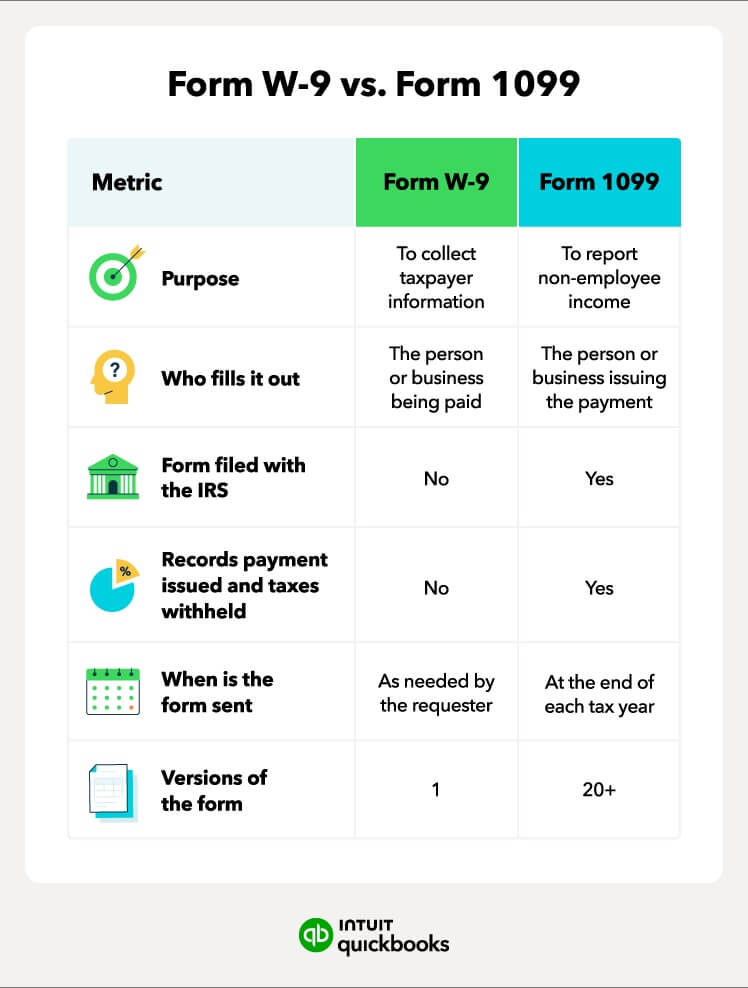
There can be confusion between 1099s and W-9s. While both are necessary for recording non-employee income, they serve two different purposes.

A chart showing the key differences and purposes of the W-9 and 1099 forms.

The W-9 form

Completing a W-9 is the first step required to ensure an accurate 1099. The purpose of the form is to collect the information needed to issue a 1099. 

In the same way an employee fills out a W-4 and receives a W-2 at the end of the tax year, after completing a W-9, an independent contractor or business will receive the appropriate 1099.

The 1099 form

The 1099 form is used to record non-employee income. If you are a business paying a contractor, it is your responsibility to complete this form, file it with the IRS, and send it to your contractor.

Information from the W-9 is used to prepare the appropriate 1099. There are more than 20 different types of 1099, including: 

  • 1099-DIV: investment dividends and distributions
  • 1099-INT: interest earnings
  • 1099-C: cancellation of debt
  • 1099-NEC: non-employee compensation
  • 1099-R: retirement account distributions
  • 1099-MISC: all other income

1099s must be completed and mailed (or sent electronically) no later than January 31.

What happens if a contractor refuses to fill out a W-9?

If a contractor refuses to complete a Form W-9, you must start backup withholding on their payments immediately. This means you are legally required to hold back 24% of every payment you make to them and send that money directly to the IRS. This protects your business from penalties for failing to properly report contractor income.

You will report these withheld taxes to the IRS annually using Form 945. Even without the W-9, you must still issue the contractor a Form 1099-NEC at the end of the year, showing the total payments and the amount you withheld. 

Best practices for handling W-9 forms

As a business owner, W-9s should be handled with care. From when to request W-9s to securely disposing of old W-9s, here are some tips for managing these sensitive forms. 

Request early

As a business utilizing the services of a non-employee, the sooner you request a completed W-9, the better. To ensure that payments and taxes are recorded correctly, the W-9 request and completion should occur before the first payment is issued to your contractor. 

Additionally, updated W-9s should be requested from all existing contractors your business uses at the start of every year. 

With a hard due date of January 31st for sending out 1099-NECs, you don’t want to leave W-9 information collection till the last minute. 

Securely store the forms

W-9s contain sensitive information. To protect a contractor’s TIN, address, and other info, completed forms should be stored securely. 

If you are using paper (physical) forms, they should be stored in a secure location, preferably locked. When you are ready to dispose of the forms, use a cross-cut shredder to ensure the information remains protected.

For W-9s stored in digital format, there are some basic electronic storage security rules you can follow:

  • Use an electronic signature platform when collecting contractor signatures
  • Send W-9s via email using encryption
  • Implement password protection and multi-factor authentication (MFA) on W-9 forms
  • Limit access to completed W-9s
  • Do not send or access W-9s using an unsecure internet connection

When you're ready to dispose of old W-9 forms, ensure they're destroyed completely. For digital copies, this means you need to permanently delete the files, not just send them to the recycle bin. 

Verify the information

The most critical part of a W-9 is the TIN. This needs to be accurate to prevent tax filing issues. Luckily, the IRS offers a TIN matching service that can help you verify the information your contractor provided. 

To get started, you’ll need to register for online e-services and apply to the TIN Matching Program. Once signed up, you’ll be able to match TINs on an individual or bulk basis. 

Getting TINs matched before filing 1099s with the IRS is especially crucial for businesses that pay income that could be subject to backup withholding.


note icon TIN Matching is just one of the many free e-services the IRS provides. You can also e-file your taxes, verify income, set up a secure mailbox for IRS communications, and more.


Find peace of mind come tax time

Whether you’re employing an independent contractor or you are one, understanding what a W-9 is and how to complete one accurately is crucial. One small mistake could cause you a severe headache come tax time

The good news is that bookkeeping software can help you avoid costly errors. With payroll and accounting tools, businesses can quickly track contractor payments to ensure 1099s are correct. 

Learn more about how accounting software like QuickBooks can help you.


Recommended for you

Mail icon
Get the latest to your inbox
No Thanks

Get the latest to your inbox

Relevant resources to help start, run, and grow your business.

By clicking “Submit,” you agree to permit Intuit to contact you regarding QuickBooks and have read and acknowledge our Privacy Statement.

Thanks for subscribing.

Fresh business resources are headed your way!

Looking for something else?

QuickBooks

From big jobs to small tasks, we've got your business covered.

Firm of the Future

Topical articles and news from top pros and Intuit product experts.

QuickBooks Support

Get help with QuickBooks. Find articles, video tutorials, and more.