







QuickBooks Blog
An illustration of a business owner learning how to start a business from scratch.
Starting a business

How to start a business from scratch with automation + AI


Key things you need to know when starting a business:

  • Key things you need to know when starting a business: First, define your vision, select the most tax-efficient business structure, and create a pitch to win over lenders and investors.
  • Then register your business, obtain the necessary permits, open a company bank account, and set up your accounting system.
  • Launch lean and bring in part-time outside expertise to avoid costly mistakes while you focus on growth.


According to a QuickBooks survey, only 16% of new small business owners have a business degree or similar qualifications. The rest of us learn as we go, which makes good advice all the more valuable.

Whether you’re starting as a solopreneur or you’ve secured backing and are ready to start building your team, this guide will help you grow your business with confidence.

Below, check out our comprehensive, user-friendly checklist of 17 essential steps you need to know to start up a successful business.

Jump to:

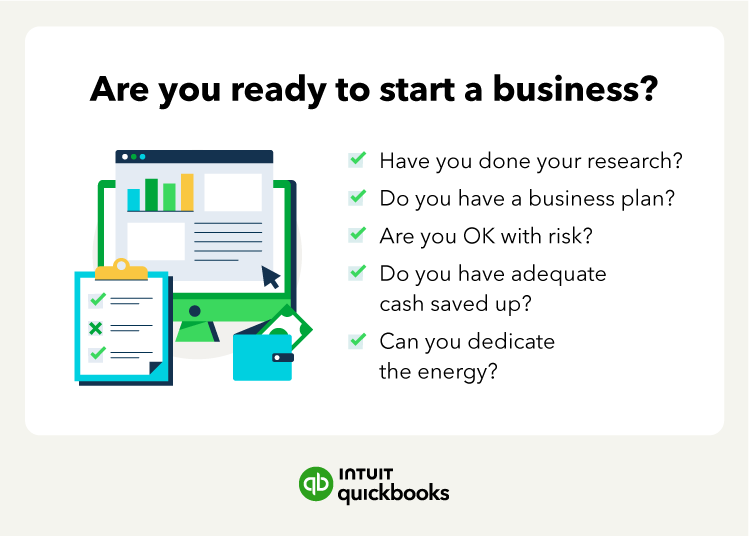
A checklist showing the preparation steps for starting a business.

1. Define your vision + AI ethics statement

Vision statements, sometimes called mission statements, set out what your business does, who it serves, and why it matters. They describe the principles you use when making decisions, like hiring, sourcing, customer service, and sales and marketing.

Use your statement to let prospective clients know what you stand for and why they can trust you. In 2026, how you use AI and protect customers’ personal details should be a core part of your vision statement. So, it’s helpful to include:

  • A clear AI disclosure: According to the Edelman Trust Barometer, only 32% of Americans currently trust AI. Show customers how you use AI (for example, scheduling and customer service) and when you involve real people (advice, complaint handling, and quality control).
  • A data privacy position: Explain what customer data you collect, how you store it, and what you use it for. Think of this as both a legal consideration and a way of building trust.

Maintaining a human touch is a priority for many modern founders as AI becomes more prevalent; research shows that 30% of women business owners would keep a human involved in every task even if AI were perfectly accurate, ensuring that values and relationships remain the heart of the brand.

Balancing your values around AI use with your commercial goals will help make your vision something you can build a profitable business on. Refer back to it when making decisions, so you stay true to your stated values.

2. Research your market opportunity

There’s a lot to consider when starting a new business, from developing your product to accounting and legal practices. That’s why you want to ensure you have a strong market opportunity before going too far.

Research your market opportunity by:

  • Selecting a product or service: Decide your value proposition and unique selling proposition, which is what you’ll sell and how you plan to stand out from the competition.
  • Validating your product idea: Research the market and see what’s trending around your product, pitch to your target market and see the response, and test if your product generates leads.
  • Defining your target market: Identify your target market with demographics, like age, gender, income, and location. Then create personas and a customer journey map.
  • Knowing your market size or opportunity: Figure out the total addressable market (TAM) of your potential customer base. Estimating the current and future value of your business idea and setting reasonable goals can help you win a piece of the pie.

At this stage, you should also conduct a competitive analysis, which is a key ingredient for business success. It lets you see your competition and where they’re lacking. This involves identifying gaps, exploiting them, and reaping the benefits of your improvements in the market.

3. Write a business plan

Writing a business plan is the next important step for starting a small business. Keep in mind that your first business plan isn’t final. Parts of it will likely change as you learn more about your market and grow your company.

You can start with a business model canvas, a one-page document covering the critical information you need to get started. This option can save you time and get you up and running faster.

Once you’ve been in business for a while or are ready to seek funding, you can build a more detailed plan. Your plan should cover:

  • Your operating resources.
  • Your overall marketing plan.
  • Your cost and sales structure.
  • Your financial management and business growth.

Your business plan will help you focus on concrete objectives and attract talent and investors.


note icon

Not sure where to get started? Get ideas and a structure with the QuickBooks business plan template guide.


4. Create and register your business name

Your business name must be unique for legal registration, web domain, and social handles. If the name you want is available as a registered mark but the .com or social handles are taken, consider using a different one to prevent problems later.

Before deciding on a final name, run these checks:

  • Legal registration: Search both your state's business name database and the USPTO trademark database to check availability. Make sure it’s distinguishable from existing entities in your state if you’re forming an LLC or corporation.
  • Web domains: Look for a .com that matches or closely reflects your business name. AI-powered naming tools like Namelix or Shopify's business name generator can suggest ideas. Perform one last check before buying to make sure there are no unintended meanings or negative associations online.
  • Social media handles: Secure your name on at least three major platforms, even if you won’t be posting on them for a while.

Consistency of naming makes your business much easier to find online and harder to impersonate.

5. Perfect your multi-channel pitch

If you want to persuade investors, lenders, or potential partners that your idea is worth backing, you need a well-written business plan with strong financials to support negotiations. But that comes later.

First, to find your backers, start with a pitch stack—a set of ready-to-go materials that need minimal editing to adapt to each setting.

In 2026, backers increasingly expect to see your concept in action before they'll take a meeting, so lead with a 60-second high-energy video for social platforms and cold outreach. Make what you’re asking for clear and give potential backers a clear way to contact you.

For face-to-face or video call meetings, create a concise, interactive pitch deck (10-15 slides with one point per slide) to guide the conversation and keep the meeting on track.

Both the video and pitch deck should contain:

  • What your business does
  • Why it’s unique
  • The benefit to the investor or lender
  • What you need from them (like funding, a partnership, or supply arrangement)
  • How you’ll leverage tech like AI tools and accounting software to reduce overheads, protect margins, and run lean in the early days

Practice your pitch on camera first. Think through the potential questions investors and lenders might have, and prepare credible answers. So when a backer contacts you for a meeting, you’re ready to sell your vision with confidence.

Personalized insights built for your business

Intuit Intelligence delivers relevant, up-to-date insights that are tailored to your business size and industry.

6. Determine your business structure

Next, choose the legal structure of your business entity. Are you better off as a sole proprietor? Do you have a partner? Do you plan to incorporate your business?

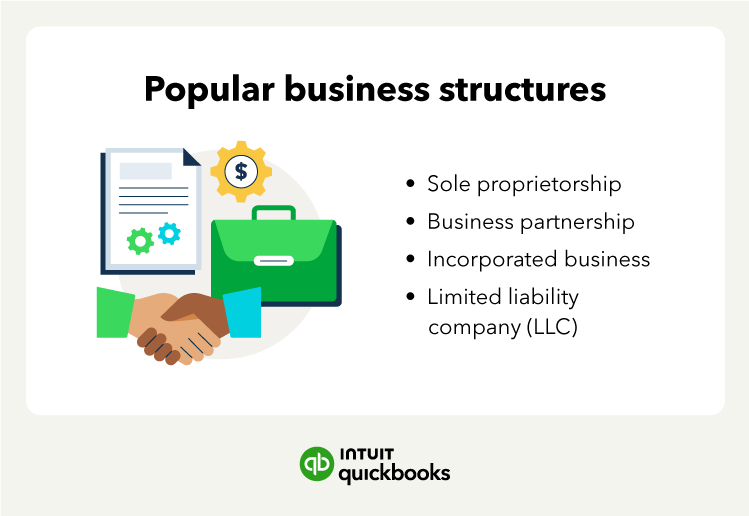
An image listing the popular business structures for a new business.

Each business structure option has its advantages, tax reporting responsibilities, and regulatory requirements.

Here are some popular business structures:

  • Sole proprietor or sole owner: This is a popular option for anyone who doesn’t have a lot of liabilities (e.g., no employees or significant investments) when they start, and an excellent option for those with a small side hustle or day job.
  • Business partnership: If you’re going into business with a partner, you will need to register as a business partnership or limited partnership. Expect to work with a lawyer and a tax professional to lay out your partnership type, terms, and tax implications.
  • Incorporated business: Some notable benefits of incorporating your business are tax breaks and liability protection. Due to upfront costs, many sole proprietors wait until they have earned enough funds and are at the right stage to incorporate.
  • Limited Liability Company (LLC): A form of private limited company that safeguards business owners, managers, and the LLC itself against certain types of personal liability. Personal liability is an important consideration if you plan to operate from a brick-and-mortar location. Should someone get injured on your property, you may not be personally liable for the damages.

As you can see, there are a wide range of options.

Going solo is a strategic choice for many: 42% of women business owners run their companies alone, which is more than twice the rate of men. This lean approach allows for maximum autonomy, though it often means the founder handles more of the administrative load early on.

If your business is an LLC, corporation, or partnership, you’ll likely need to register your business with any state where you conduct business activities. You may also want to opt for a federal tax ID number or an Employer Identification Number (EIN) instead of using your Social Security number. The IRS uses this number to associate you with your business.

There are several other business structures to choose from, depending on which country you live in. Speak with an accountant or bookkeeper to determine which option best suits your needs.

7. Investigate your legal requirements

Before starting a new business, consult a lawyer to ensure you’ve considered all the legal requirements. A reliable lawyer can help you solve legal and contract disputes and give advice before you sign a new contract.

Here are some essential questions to ask your lawyer:

  • Should I trademark my company name or logo?
  • Do I need a patent, copyright, or intellectual property protection?
  • Can you create standard contracts for negotiating with other businesses and vendors?
  • How do I form a sole proprietorship, partnership, or corporation?
  • What’s the process for sharing equity when seeking private investors?

Different laws apply to every type of business, product, or service. Every country, including the United States and regions within, will have its own set of rules. Your local and federal government websites are an excellent place to begin your research about legal requirements.

Beneficial Ownership Information (BOI) reporting is required for businesses to disclose their owners to FinCEN under the Corporate Transparency Act.

At the time of writing, an interim ruling means the regulation requires only foreign-formed entities registered to do business in the US to file. US-formed companies are currently exempt. It’s worth keeping your ownership records in order, just in case the position changes. Speak with your lawyer to stay up to date.

You should also consult national consumer and privacy laws for collecting personal customer information.

8. Apply for permits and business licenses

Next, visit your government services or the Small Business Administration (SBA) to determine whether your business requires any national or local licenses or permits.

While you’re at it, check to see if you qualify for any tax deductions and credits. Many local governments design special credits to help small businesses grow faster.

You will need an EIN if you plan to hire employees or open a business bank account. This will also serve as the tax ID you'll use to pay federal, state, and local taxes.

Find an accountant or bookkeeper who can advise you on any other tax-related applications you may need to complete. Again, this process depends on where you live and the type of business you’re operating.

9. Understand your startup cost

Whether you’re self-funded or you work with angel investors, you still need to understand the costs of a small business startup.

Start by mapping out all of your anticipated costs for the next year. Then determine how much money you need to earn every month to stay in business—for example, your operating income and salary—and be mindful of costs like business taxes.

It can take time to build up your revenue, so recognizing costs and cash flow management trends early on is critical.

The cost of starting a new business varies by business type, industry, and location. Estimate your startup costs on the SBA website before starting your business to determine how much you’ll need and whether you should apply for funding.

There are a few costs every business can expect to incur upon startup, such as licenses, permits, registration fees, insurance, and marketing. It’s also a good idea for every new business owner to invest in an accountant or legal professional.

Plan finances with revenue-based financing (RBF)

Once your business has been generating consistent cash for several months, revenue-based financing (RBF) or small business loans can help fund expansion without taking on high-interest bank loans or sacrificing equity.

Instead of fixed repayments, you pay back a percentage of your monthly revenue. When sales are down, your repayments drop, and rise again when sales pick up. You stop repaying when you reach an agreed cap, which can range from 1.2 to 3 times the original amount.

Because you retain full ownership of the business, RBF can be suitable for founders who need capital to purchase inventory or high-impact marketing but aren't ready to bring on investors.

RBF platforms tend to specialize in specific business models, like e-commerce and SaaS subscription services. Check which lenders fit your business type and revenue pattern.

10. Open a small business bank account

A business bank account can help you track business expenses and take advantage of tax deductions and credits available to small business owners. You might consider opening a business bank account when you start making business transactions. If you’re an LLC or corporation, you must have a separate bank account for company finances.

There are other benefits to opening a business bank account, including:

  • Opens the possibility of lines of credit.
  • Credit card availability.
  • Access to in-house loans.
  • Mobile payments can go straight to your account.

Arrange a meeting with a business banking specialist to determine which type of account is right for your business. Cross-reference the bank’s advice with your accountant to determine which savings bundles or special accounts will benefit you.

11. Set up OBBBA-compliant accounting systems

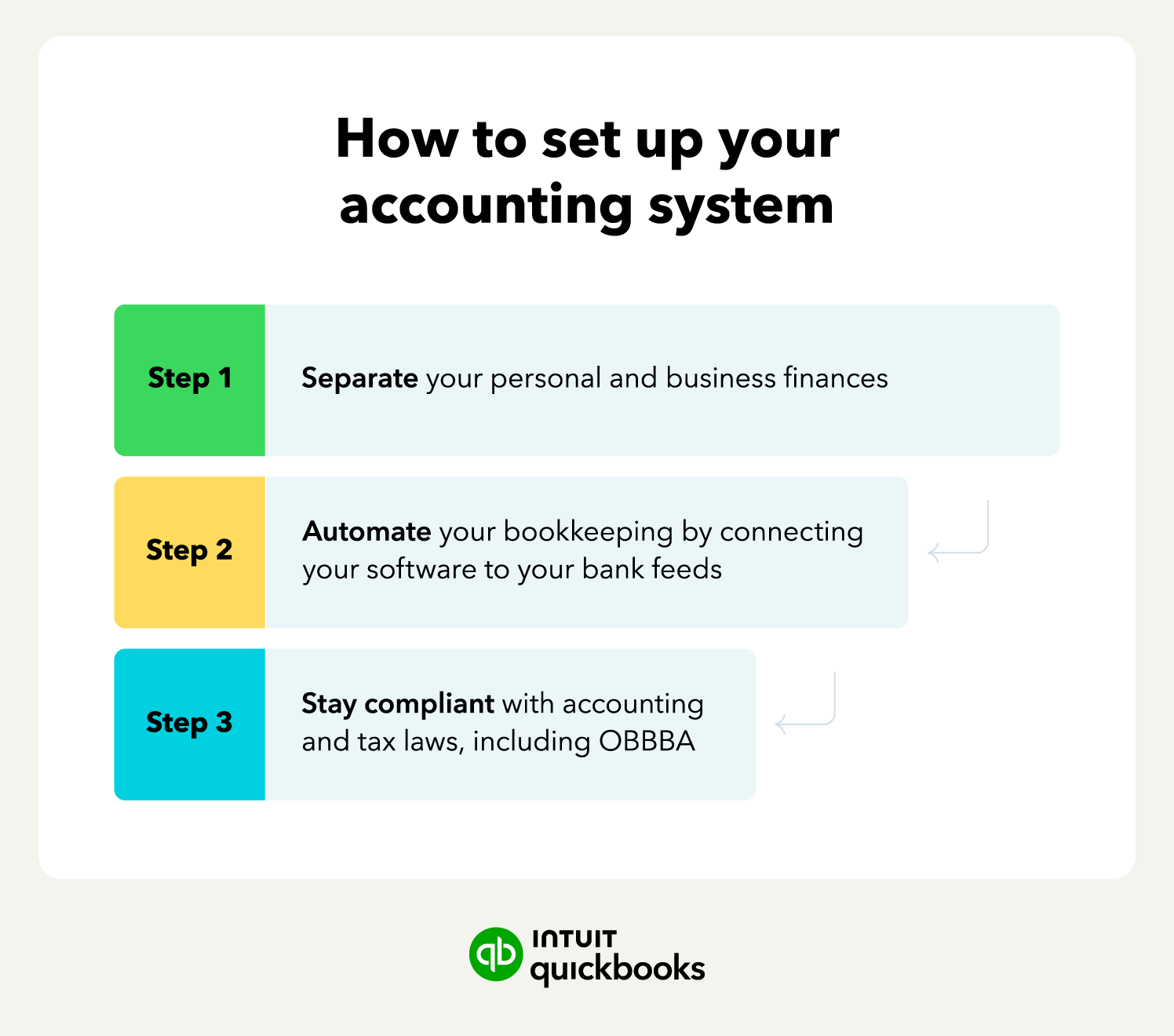
An image showing the process of setting up your accounting system.

The One Big Beautiful Bill Act (OBBBA) was signed into law in July 2025. One of its provisions lets employees claim new federal income tax deductions for qualified overtime and qualified tips on their personal returns for tax years 2025 to 2028.

As an employer, you need to set up your payroll system to track the overtime premium (the "half" of time-and-a-half required under the FLSA) and qualifying types.

Employees can deduct up to $25,000 in qualified tips or $12,500 in qualified overtime ($25,000 for joint filers). They start to phase out on modified adjusted gross income over $150,000 ($300,000 for joint filers). These amounts are still subject to Social Security and Medicare taxes.

From 2026, you need to report these amounts using new W-2 Box 12 codes (TP for tips, TT for overtime). Updates for QuickBooks Payroll have already begun rollout.


note icon

Not sure whether to start an LLC or an S-corp? LLCs often suit solo founders and small teams who want flexibility, while S-corps are better for higher-earning businesses looking to reduce self-employment tax costs.


12. Activate your accounting AI agent

Agentic AI in accounting has moved well beyond basic data entry. For example, QuickBooks’ Accounting Agent now:

  • Chooses the correct transaction categorization the majority of the time
  • Matches and records transactions
  • Detect anomalies
  • Gathers missing information from clients

The Agent’s accuracy improves over time as it learns from your corrections and transaction history, turning hours of monthly bookkeeping into a quick review.

That well-organized data makes it easier for many AI systems to find tax-saving opportunities. For example, the OBBBA permanently restored 100% bonus depreciation on qualifying equipment. It also brought back immediate R&D expensing for domestic research costs.

You can also build a "Human-in-the-loop" review process so you get the chance to approve or override a recommendation before posting it to your books. This means the final authority on every financial decision stays with you.

Take time back with AI agents in your corner

Let QuickBooks AI agents handle the busywork so you and your team can focus on what really matters.

13. Outsource essential functions

When starting a business, you might be tempted to do everything yourself to save money. But spending time on tasks that aren’t in your skill set can cost you even more time and money.

Delegate or outsource tasks that aren’t your area of expertise, like accounting, administrative work, or public relations. If you have the funds and legalities worked out, you can hire a few employees to share the workload.

It might be tough at first to trust other people with your business. But if you hire great employees, you’ll question why you didn’t hire them sooner. If money is tight, but you still need help, you can enlist contractors or freelancers.

Add enterprise-level expertise by contracting a “fractional” (part-time) CFO, CMO, or COO. For a monthly retainer, you can bring a senior strategic leader to your team who has a track record of growing businesses. They work with you to overcome your current challenges and spot issues you may not yet be aware of, such as pricing set too low to survive a dip in sales.

You can also replace many traditional administrative roles with automation platforms like Zapier AI or Make. They let you connect your business apps and build no-code workflows.

For example, someone inquires on your website, sending a welcome email to the potential client, and adding a new lead to the CRM. Start with two or three repetitive tasks that eat the most time, then expand from there.

14. Learn how to pay employees

If you decide to hire someone instead of outsourcing to a contractor, you’ll need to familiarize yourself with business taxes and payroll.

For example, you must withhold taxes from employee paychecks. Speak with your accountant to ensure you meet all your tax responsibilities. Ask common payroll questions to understand payroll basics.

Make paying employees easy by using digital payroll services that offer both self-service and full-service options. Using payroll software can help you:

  • Set up and track employee health insurance, retirement plans, deductions, and garnishments.
  • Monitor employee payroll data and annual changes, like bonuses and salary bumps.
  • Establish a digital process to deposit your taxes automatically.
  • Add new employees to your payroll system automatically.
  • Enable automatic online direct deposits, which transfer funds into your employees’ accounts worldwide.

Overall, payroll software can help you manage payroll effectively and better understand how to process payroll.

15. Find a business location

If you’re preparing to open a brick-and-mortar food or retail business, picking the right location is extremely important.

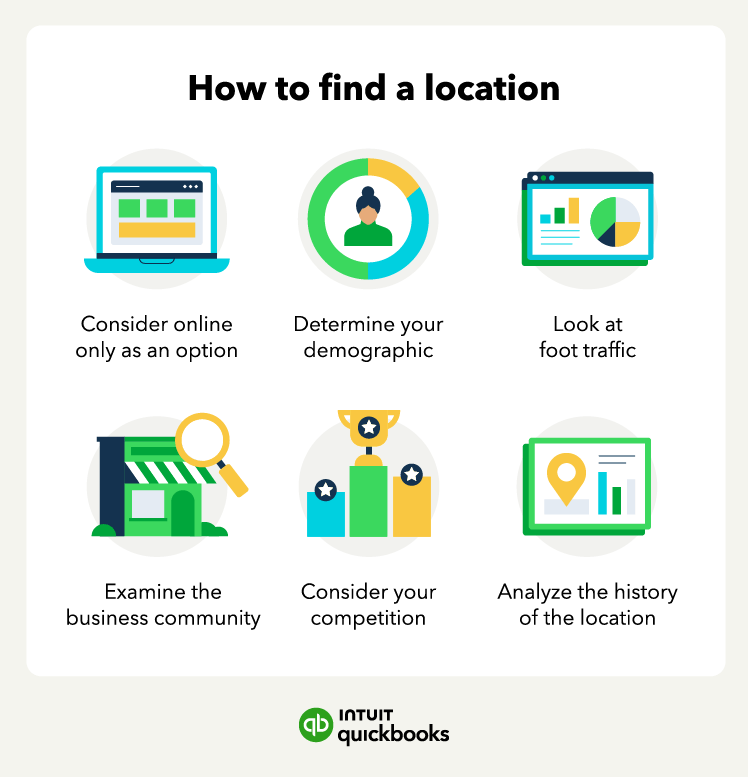
Tips on how to find a business location, including determining you demographic, considering online, looking at foot traffic, community, competition, and history of location.

As you scout locations, there are a few things you need to keep in mind:

  • Online only: If your business is online, you need to consider where you will host your site, as well as the design and speed to handle web traffic.
  • Demographics: Consider who your customers are and how they’ll interact with your location. Does your target demographic frequent this potential location? Make sure your location reflects the image you’re trying to project.
  • Foot traffic: Before you sign a lease, monitor the foot traffic outside a potential location throughout the day. Is it tucked away, or does it see plenty of passersby? Does the location have suitable parking for your future customers? Is it accessible?
  • Competition: Having competitors nearby isn’t always a bad thing. Either way, you’ll want to be aware of them before you decide on a location.
  • Business community: Are there other businesses nearby? You may benefit from their foot traffic. Are there restaurants nearby? Your customers might enjoy a bite to eat after shopping at your store. Look for a location where you can benefit from other businesses—and they can benefit from you.
  • History: Research the history of the location. If other businesses have tried and failed in a space, you might want to know why.

No matter what type of business you plan to start, ensure your location can meet your present and future needs. Look for adequate electrical wiring and utilities, space for your employees or any special equipment, and even zoning ordinances.

Finally, keep the cost in mind. Rent is a major monthly expense for many small businesses, and there may be other location-related expenses like insurance, cleaning services, and parking fees.

16. Launch a community-first website and ecosystem

Your website should be more than a static brochure—it should be a destination for the community. By building a space where customers interact with you and each other, you transition from a service provider to a community leader.

This community-centric approach is part of a larger trend: nearly half of women business owners believe their business has a responsibility to support the local community, and 7 in 10 already contribute in concrete ways. Integrating these values into your digital presence can help you build long-term trust with customers.

Some ways you can build a digital community include:

  • Using platforms like Discord, Circle, or private groups where customers can discuss your products and share feedback. Offer members something here that they can't get anywhere else, such as early access to products, exclusive Q&As, or behind-the-scenes updates.
  • Add an AI-powered "Self-Service Agent" to handle 24/7 customer support and generate leads for your pipeline. Chatbot tools like Intercom and Tidio can answer website visitors’ questions and route more complex issues to you when you're available.
  • Optimize your site for social media search, so your target audience can discover your content on platforms like TikTok, Instagram, and YouTube. Use keyword-rich descriptions and captions to make your business easier to find.

A website, social presence, and online community can all help free up your time and act as channels to attract and convert new customers.

17. Market via authentic human voice video

Short-form video content is the fastest way for a new business to earn trust, a key component of early success. Potential customers want to know the person behind the brand. No amount of AI-generated marketing copy can replicate that authenticity and human connection.

Start a YouTube challenge chronicling your founder journey. Share your behind-the-scenes struggles and victories as you grow your firm. Explain why you chose this small business idea over others.

Upload content that shows how you solve problems, what you learned from past mistakes, and why you built your product the way you did. Promote your channel with short videos on TikTok and Instagram reels.

Consistency counts, so aim for two or three videos a month. All you need is a smartphone and natural lighting to get started.

An authentic video gives potential customers a reason to choose you over a competitor they've never seen or heard from.

Stay on top of 1099s with Bill Pay

See your vendors and everyone who needs a 1099 all in one place. Plus, get unlimited 1099 e-filing, with printing and email, for no additional fee.

Start your business with confidence
Starting your own business is fun, but it presents many challenges. Give yourself the best opportunity to succeed by thoroughly planning and setting up the right financial and operational systems from day one. The QuickBooks blog has hundreds of helpful, insightful articles that offer practical guidance at every stage of your journey.

And with free QuickBooks accounting software, you can create the solid financial foundation you need to grow your company confidently.


Recommended for you

Mail icon
Get the latest to your inbox
No Thanks

Get the latest to your inbox

Relevant resources to help start, run, and grow your business.

By clicking “Submit,” you agree to permit Intuit to contact you regarding QuickBooks and have read and acknowledge our Privacy Statement.

Thanks for subscribing.

Fresh business resources are headed your way!

Looking for something else?

QuickBooks

From big jobs to small tasks, we've got your business covered.

Firm of the Future

Topical articles and news from top pros and Intuit product experts.

QuickBooks Support

Get help with QuickBooks. Find articles, video tutorials, and more.